Aqaba Thomas: The Cat in the Pack

The last time I tried to Cat, both Sam, Sam, the Happy Hound, and Bertrand the Muttibeasti were living with me. Wakita, the cat in question, tried to jump from one counter to another in the kitchen and Sam came within an inch of catching the cat in midair. Sam was waiting, watching, and meant to kill the cat, even though we had discussed this sort of thing.

            Furious, I grabbed Sam by the collar, but Bert body blocked me off him. I put the cat out. I gathered the dogs and we had a long and intense discussion about cats, hierarchy, the source of food in the house, and even if there was no violence, I did mention it a few times.

That was back in 2006 or 2007. Wakita was killed in the woods by an unknown assailant, and I gave up ever having a cat live with me.

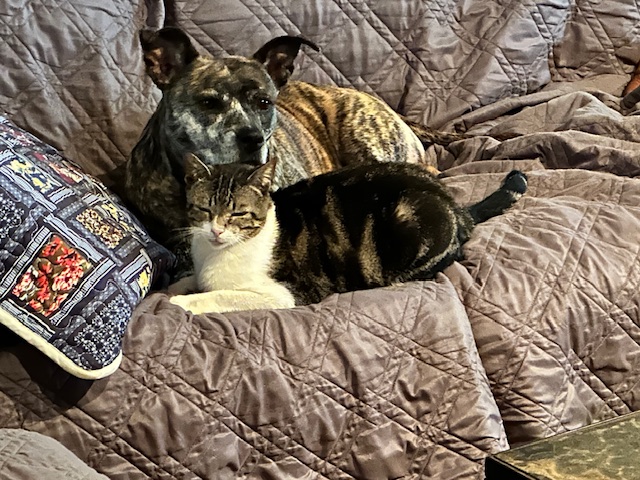
Couple of days ago, Aqaba jumped up on the bed, started head- butting Budlore under his chin. Aqaba doesn’t trust Bud one on one, but with me there, Aqaba thinks this is the time to make friends with the only dog in the house I do not trust with That Cat.

Bud growls. It’s a soft, low, nervous type growl, but I grab his right ear and hold it. Not tight, not squeezing the ear, but just to let you know Bud, I have your ear. The meanings are a duality of sorts, because Bud knows what I am saying, which would be: Threaten the cat, and this ear is going to hurt.

Bud’s body language, which is everything in canine speak, relaxes, just a bit. Bud doesn’t like the cat, but he isn’t willing to start a fight. I’m mildly surprised, but I also know something about this ear. With a thumb and two fingers, I can pet both ears at the same time, behind Bud’s head, and he likes this a lot. Aqaba is still headbutting Bud’s chin, but the ears.

Bud starts going limp, puts his chin on his paws, and Aqaba moves on.

There is peace, perhaps an enforced peace, but it is what it is. Bud is alone in his dislike for That Cat, and he is fully aware of this. He will get no backup from Jech. Wrex won’t help him on the best days. Bud doesn’t like the math of going against all I want all alone. He does like both ears petted.

I do not think I have ever worked this hard, this long, to convince a Hickory Head Pack things have to be a certain way. Of course, Bertrand was the original heart dog, the best dog of all best dogs, and Lucas came along towards the end of Bert’s reign. After they were gone, only Wrex really reached deep inside, and now he’s aging, too.

I do not think I have ever an a dog work as hard to fit into the pack the way Aqaba Thomas Firesmith has. It’s stunning the amount of effort he’s put into making friends with the dogs, and doing the things I’ve tried to get him to do. Like every dog I’ve pulled out of the woods or out of a ditch, or taken out of a bad home, Aqaba has an overwhelming sense of gratitude. Mauled and starving, I was his last best chance of merely staying alive for a few more days. Aqaba has made the most of the time he’s been given. More people should think about this.
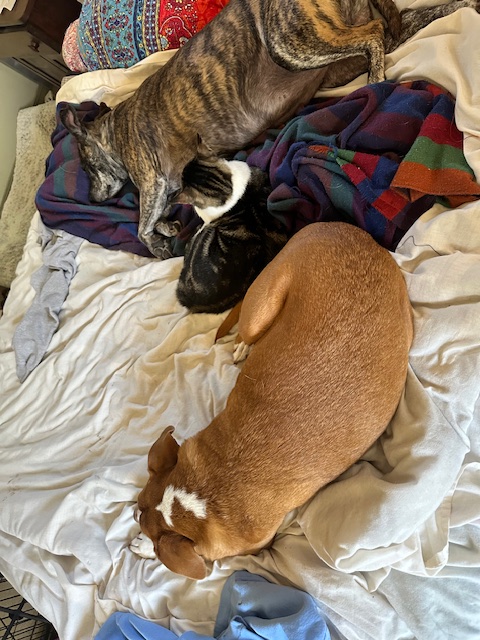
I have a lot of respect for the way this cat has taken to his new home. He seems focused, driven almost, to make this his place in the world. I’ve done everything I can think of to help him. Lilith and Wrex joined in instantly, and even Jessica Elizabeth (Come here!) has joined the new pack.

Oh Dear Dog, the help I have been given by so many Cat People, and Dog knows I’ve needed it, too.

And thus, a new Hickory Head Pack is forged. That Cat in the Pack.

And thus, it continues.

Take Care,

Mike

Yoga Wrecks, First Time Prostitutes, and You Can Write.

You either can or you won’t. That’s the story, isn’t it? When you’re doom scrolling on social media, could you be writing? Writing is waiting while you watch some video of a half-naked twenty-year-old who is doing Yoga poses you won’t see me in unless I get hit by a log truck while I’m in a Volkswagen Beetle.

Hopefully, you will not see that anytime soon.

But you could be writing. A video game entertains you idly, and by idly, I mean it’s not your creativity behind the storyline, scenery, or characters. It’s not the same as getting down to the soul of someone only you can bring forth into existence.

You have a scene in mind. It’s nagging at you to do something with it. Why wait? Why wait to see if it functions? Mary is walking down the dirty sidewalk, stepping over used condoms and plastic whiskey bottles. A puddle of puke spreads out from a man passed out, face down, and she keeps walking.

Mary is going somewhere, doing something, but what? Who is she? What does she look like? What timeline is this? London in 1888?

See how easy that was? In the space of a paragraph, we have an idea of a woman with a destination and scenery.

Mary looks up at the numbers on the building and hesitates. This is a hovel house where men with money rent women who need it. The building looks reputable in front, with a barber shop, shave and a haircut for a few pennies, and a shoeblack works out front. But the main draw for the men are the women who work inside the building, who enter by the back entrance. Mary has been given the address by a woman who sets up these meetings. Mary must keep the appointment if she wants another, but this is the first. She’s never sold her body before.

            And here we go. Now we know it’s London, back in the late 1800s, and we know Mary is young. We have to go back and change the way the story began to wooden walkways and get rid of the plastic bottle, but the feel of the scenery will be the same, won’t it?

            2.0 let’s go! Mary is walking down the dirty wooden walk, stepping over apple cores and chicken bones tossed from the upper floors of a tavern. Puke spreads out from a man passed out, face down in the muddy street, and she keeps walking.

            Unless Mary is heading into unknown territory here, we know she’s a denizen of the poorer sections of town. Then we add the next part, but what does Mary look like at this point? How do we find out in a time when Mary doesn’t take a selfie?

            Walking into the back door of the Hovel House, the woman who hired her waits, “It’s you then? I gots to make sure the new ones show. He likes fair hair and fair skin from what he tells, and your eyes are pretty enough blue. If’n he messes you up some it’s paid extra unless you need a nurse. Ain’t you eati’n regular, missy? You need some meat on your bone other than what the men put on ya. Up the stairs, second floor, stay off the lift, go to room seven on the right, get undressed and in bed and wait for him’n to show. Don’t say nothing less you asked and act like you like it, right?” the woman hands Mary a key and walks away.

Dialogue is an interesting tool, no? In the space of a short paragraph, the unnamed, unformed, and temporary character describes much about what is going on. Twainesque, the dialogue also demotes Mary to uneducated, poverty-ridden, second-class citizens not allowed to use the elevator. A little dialect goes a long way unless you write superbly, and I’m not there yet.

As a side note, in the wildly popular television series, “The Walking Dead,” characters would be introduced speaking in dialect, yet after the first two sentences, switch over to more standard speech. The story’s writers dialect slows the story down.

Now Mary is walking down a long hallway, the key clenched in her fist. She’s never sold herself and wonders if it will hurt or if the man will be cruel. Will he demand she do things she does not know how to do? Fear slowly builds into terror, her thoughts cycling through faster and faster.

She gets undressed, gets into the bed, admires the clean sheets, soft pillow, and warm room. She hopes the man doesn’t keep the appointment, and she can nap here. But he arrives on time, says hello absently, and takes his clothes off. Mary lies still, terrified, yet unable to resist as he climbs on top of her. Seconds later, it seems, he gets up, dresses, and leaves without a word. Mary is lying in the bed, wondering if that’s it, and gets up, cleans herself off, picks up the coins he’s left on the table near the door and leaves.

 And here we go. The scene of the man leaving, without speaking, without so much as looking at Mary, leaving a few coins on the table, can be pivotal. Mary has gone from a frightened young woman to one who has survived her first encounter with the oldest profession in the world. How does she feel? How has Mary changed from undressing to when she puts her clothes back on? The money is more than she would make in three days in the sweatshops, and here it is, a few moments later. Yet Mary has sold herself to a stranger. How does she feel now?

You sit idly and say you cannot write, but look at this. We’ve wandered through how writing comes together from thought, introduced three characters, maybe four if you count the puking man, and set up a lot of future conflicts.

You can, but you won’t. Is that what you are still saying?

I say you can.

Take Care,

Mike

Summer of 2023: Dance with the Dragon Queen

            Summer isn’t a season in the Deep South, but rather it is a condition, a state of being, or a prison sentence. Unlike any other time of year, Summer becomes omnipresent at all times of the day. She has minions, this one does, this Dragon Queen of Heat. It’s not just the mercury being forced higher into the thermometer, oh no, were it only that simple. Summer is an assault on many fronts of the human senses and psyche.

            Any rain that accidentally falls, does so in sheets, in volumes, and it does so quickly, as if the clouds have only a specific time allotted to them by the Queen. Quickly, the heat turns rain back into clouds of humidity that are dense and suffocating.

            One of my pet theories regarding Summer and the South is the citizenry scores so low in nearly every educational category is for four months of the year, they are in a state of half drowning in humidity. If this causes any permanent brain damage has never been tested, but it would explain a few things.

            But humidity is a condition, not an entity. The Dragon Queen brings the scorching heat and billions of gnats, mosquitoes, biting flies, and all manner of creeping, crawling, and flying insects. No step is taken outside without an entourage of misery. Human eyes, ears, and noses are fair game for these peddlers of pain. Gnats, whose function is unknown to science, fly directly into the eye, and it’s painful to remove them. Mosquitoes alight on exposed skin, demand a blood donation and leave welts as payment. The biting flies are kamikazes, diving down to rend flesh and leave swelling wounds. Only poisons, like diethyltoluamide, create a barrier between the minions of the Dragon Queen and anemia. But this, too, is part of her world. Insect repellent is the cologne we wear to appease the Queen.

            Yet the Dragon cannot concern herself with individuals. She must bring excess to her domain. Ponds explode with algae and water plants even as they dry up. Land vegetation grows overnight to require mowing or pruning. Gardens quickly produce, but fruit rots if not promptly harvested. Summer demands the world slows down but quickens the growth of all things green. Trees soak up sunlight like solar addicts. The woods thicken to the point of blocking the sun, creating a dark green globe of vegetation and shadows, each plant at war with all others for every photon.

            Humans hide from the Dragon Queen of Summer. Safely secured in cars or their homes, air conditioning prevents any experience with the real world. Binge-watching, video games, and social media become electronic refugee camps for those who can or will not face the Queen.

            I am part reptile, part lunatic, and fully cognizant of whose realm I trespass. Walking in the day’s heat brings her wrath upon me, and working in the compost pile irritates the Queen with my presence, but who are you? Would you cower behind your ceiling fans, their blades protecting you, as the world turns outside your drawn shades, blocking the sun’s assault? I breathe the Dragon’s Breath and feel her power, absorb the heat, and I become one with it. The path around the fenceline is cleared with a bush hook and with sweat and done in full view of the sun. Wide brim hat, long sleeves, work boots, and the desire to experience Summer, in all her glory, compel me to tempt the Dragon to kill me.

            The Queen loves no human. She will leave me dead in the woods without a thought towards life. If I choose to dance with her, then it is up to me to survive the music played. Yet for decades, I have done this, walked into the heat, flexed muscle, bled sweat and swam in the river Styx. It is only hell if you choose to be unhappy. Misery is a state of mind. If you want to, if you set the conditions of your life to do so, you can walk inside the breath of the Dragon Queen, embrace the world she has created, and live to write about it.

            Take Care,

Mike

Lilith Anne’s Mosquito Patrol

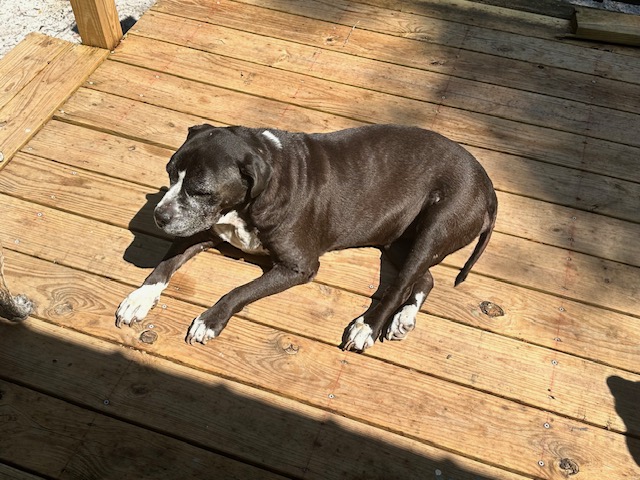
Lilith Anne makes the slow journey out, plodding along like a death row inmate heading for certain execution, but the trip is essential. It’s ten in the morning when Lilith has her daily bowel movement. I prefer she has it outside.

            It’s optimum she does this away from the house, and if I do not walk along with Lilith, she will deposit her goods close to the deck. We walk down to the old dog kennel, where a bucket of fresh water awaits. I  return to the house, and Lilith drinks deeply and then off to the weeds to leave her pile.

            Lilith likes to lay in the sun on the deck, and I noticed a few days ago, when she returned from the weeds, a swarm of mosquitoes followed. Regardless of what might be said, mosquitoes aren’t excellent fliers and fly poorly in direct sunlight. It’s their hope to withdraw some blood and return to the humidity and shade from whence they came. Lilith is old and slow, therefore, an easy and lumbering target.

            The leaf blower sat nearby, and an idea formed.

            Using the power button judiciously, the air coming out was strong enough to blow the mosquitoes back but not intrusive to Lilith’s slumber. Of course, they would return undeterred, but I kept them at bay. Then one or two flew too high, and I was able to blast them, and a strategy formed. I used the nozzle to form a barrier around Lilith, and if any of her tormentors managed to go too high up or too far out, I blasted them with a burst of accelerated air. Lilith dozed unconcerned.

            After a few minutes of this aerial combat, the mosquitoes were thinning out. I watched as none returned to the arena, and Lilith slept comfortably under the sun.

Take Care,

Mike

The Woman in the Blue Hat.

The dream dogged my every step today, slunk around like a second shadow, always there, invisible unless I looked directly at it, and even when I did, the question remained: What is this? But writing is not a process without its little quirks. I have no idea what it is, but what else might there be because of this thing?

The thing is a device, old, metal rusting away, tiny window, and it looks like an odometer. Standing at the edge of one of Valdosta’s side streets of a side street, Jenette Street used to be open to the public, but the University absorbed it. I dreamed a device stood at the edge of the street, had a button to push, and the numbers would spin for a few seconds, and like a slot machine, they would slow down and finally read, “1.4.” No such device exists. I looked. But why have something that tells you how far away the edge of the road is from that point? (Don’t ask me how I know what it does and why I know what it does, but I don’t understand why it does it, I just know, okay?)

You got a point to this, Cowboy, or are you just burning off some excess caffeine here?

And here we go. Buckle up, Kittens. Dreams can get away with this sort of thing. The device is either meaningless, or the meaning is lost somewhere in the imagery. Or I didn’t retain something I should have. This bothers me because that sort of thing in fiction is a distraction.

But suppose I write a story where the meaningless distraction is part of the plot.

First Swing: A cop is tracking down a serial killer. The man or woman who has been killing delivery drivers has killed four people, all in the same area of New York, and all were delivering food. The detective walks out of a restaurant, following a driver, when a woman in a blue hat approaches. She tells the detective a man in a white truck asked her if she was a driver and if she would deliver to his apartment. She gives the detective a description and hurries away.

The detective finds the man in the truck, but he speeds away at the flash of the badge.

It takes a while, but the detective catches the man, arrests him, and finds enough evidence for a conviction.

The detective seeks the woman in the blue hat. She saw the killer, spoke with him, and he asked about delivery. He doesn’t need her, but he wants to find her. But no camera captured her. No one else saw the woman, and it seemed she had vanished. Even after his conviction, where he confesses to other murders, the killer does not seem to remember this woman.

Is the woman in the blue hat an intriguing part of the story or a distraction?

Take Care,

Mike

Shopping with the Dead Man on Sunday Morning

Shopping zero early on Sunday morning means fewer people to deal with, so the dead man was a surprise, a shock, and for him to be standing in the meat section seemed oddly appropriate. He was among his own in this, all the dead in one place. I fled to the produce section, trying to sort out what was seen. 

Of course, he is not the dead man. The dead man was named Mike, that’s the only part of his name I remember, but he was a deeply religious man at work, and like most of the deeply religious men at work, he had a problem keeping his dick in his pants. He got caught having an affair with his married secretary, he was married, but the deeply religious supervisor he had also had the same problem, so the issue was swept under the rug. 

We had one conversation, about my lack of belief, the only conversation we would have, and he said I ought to change my ways and become a better person and I said, “You first.” And we never spoke again. 

I had a supervisor that was cut out of the same holy cloth, that look-at-me-I-love-Jesus-but-damn-what-a-set-of-tits-on-that-bitch type of white guy with a little power over people. When he wasn’t hitting on the women under his supervision, he was trying to get people to come to his church. 

The dead man died of cancer. Slow and hard, he died over a period of months, and he told people that his god was punishing him for his infidelity to both his wife and faith. I’m pretty sure any deity who would kill a person like this isn’t holy at all, but I was amazed my supervisor bought into it, or claimed to, and worried that his god would come after him one day. 

I went to check out, and at zero early hours, there’s one cashier, usually bored to death, but there was the dead man, being checked out before me, and I hesitated, waited a bit, it felt weird to be that close to someone who looked just like the dead man. 

“The computer just died,” the cashier said, and she had to reboot it. 

The dead man was bagged up, paid, and away he went. I checked out, and left a few minutes later. He was parked beside me, loading his groceries into the trunk of his car. 

“Do I know you?” he asked. 

“I don’t think so,” I replied. 

“You looked like someone I knew,” the dead man said, staring.

“Yeah?” 

“He died back in, uh,…”

“2010.” I finished for him. 

“That’s right,” the dead man says. 

“I got to go,” I tell him, loading my stuff quickly and getting into the truck. 

I pull away and watch in the rearview for just a few seconds. 

Take Care,

Mike

Not Nearly Late Enough

original

If there is one single benefit of night work it would have to be I can go to one of the few places that are open all night and shop without a crowd of human beings convincing me that a species specific virus with a .0001% survival rate would be the best idea ever. I have never had to fight a crowd an hour before the sun came up and morning people are usually in a hurry, and I am, too. I want to get in and get the hell out, and go home and pet my dogs, and sleep.


I got off early tonight, not even midnight, and I need a few things. I pull into the parking lot and realize the circus has come to town. There are many cars which means even more people. I pull down a row and there’s two guys pushing a cart, in the middle of the row. The fact there is a vehicle behind them doesn’t mean anything. They get their stuff out of the cart and leave it in the middle of the row as they’re loading their car. They move the cart only because they don’t want to back over it. The guy pushes the cart in a random direction and that’s an allegory of his entire existence.


Inside, it’s too crowded for me to be there. But now that I am here, I may as well try to make the best of it. That’s hard to do, really. I’m looking for vitamins, and I stand far enough back to let people pass in front of me. A woman comes and stands right in front of me, and starts talking on her cell phone. I pull out my phone and say very loudly, “You have a great ass” and the woman turns around sharply, but I’m staring off into space and acting like I’m on the phone. She edges away from me, and looks at me as if she thinks there might be more to this than meets the eye. There isn’t. I know women with great asses and she isn’t one of them. Mediocre at best and no body hung on someone that rude looks good. I’m sorry, but you can’t paint roadkill and call it a Picasso.


There has to be someone who is good at math that can explain to me the probability of there being a screaming child in the same building with me, at any given hour, considering the population size of the people inside of the building, and the type of wares being sold inside. I need a cellphone app that I can pull up and check before I go anywhere, and see, mathematically, the odds of a screaming child inside. There is a screaming child. The sound is found in the darkest parts of Hell, and shipped upwards, and then installed in kids who parents who should have never bred in the first place. First, the Zombies.


Zombies are those people in a store who wander aimlessly. They have no direction. They have no shopping list, no mission, no real reason to be there. They go from display to display, fascinated by colors or design, and they’re going to move slowly, and they’re going to push their carts into the high traffic areas. They are the blood clots of human existence. The first video games that were made back in the 1980’s had Non player characters in them the players could speak with for information, but the NPC would sometimes stop in odd places and trap the players or prevent them from moving forward. It was a design flaw, a glitch the game builders didn’t see coming, and if you believe in such things, you have to believe people like this in real life are God’s worst mistakes other Florida Gator fans.


Worse, infinitely worse, are those people who cannot shop alone. They’re as weird as those people who cannot have a bowel movement without an audience. I simply do not understand it., They’ve gathered half their blood relatives, two in laws, three people who live in trailers nearby, a homeless man, and they kidnapped one person simply because he would get lost in the mob, and then they decided to go shopping. It’s like locusts or swarms of gnats. Or the stuff that comes out of overflowing toilets that keeps you out of a public restroom, if the smell didn’t get you first.


And then, the Screamer.


There’s a square. It has an entrance. It has an exit. Inside lies the heart of the problem here; that’s where all the machine that scan items and take money resides. There are two human employees whose job it is to herd shoppers into the square, and to the next available scanner.


How? Hard? Can? This? Possibly? Fucking? Be?


The woman with the screamer stops at the first scanner, and uses her cart to block the entrance. She ignores her wailing child. So perversely has she parked her cart she has to take three steps back to the cart, get an item, take three steps to the scanner, and she’s got one of everything in that damn cart. Finally, one of the cartherds reaches in a pushes the cart closer. The child screams. The woman moves slowly. The child screams.

The woman in front of me is buy camping equipment, including a sleeping bag, for reasons that escape me, she has unrolled in her cart. She’s on the phone and there’s a gap between her and the square’s entrance. Just as I am about to pass her, because clearly she’s uninterested in getting out of the store before dawn, her boyfriend shows up and they move up, and discuss the sleeping bag. It’s South Georgia. It’s eleventy-billion degrees with eighteen hundred thousand million percent humidity, inside an air conditioned building. Buy your camping gear in the native land of where you are going to sleep out, not here. She moves into the square and I hope if they share that sleeping bag in a tent in South Georgia, the offspring of their union of that night has superpowers. They’ve earned it.


The screaming child screams. It screams as its mother pushes the cart out of the building. I can hear the child scream in the parking lot. I can hear the child scream as the car leaves the parking lot. I can hear the child screaming as they get on the Interstate, I can hear the child screaming even now, as they are in Indiana.


There is one scanner different from all the others, it has a piece of paper taped over the scanner. There is a sign that reads “Cash Only” on the piece of paper. There is a sign on the machine that reads, “No Cards. Cash Only” and a woman with a full cart pushes over to it. One of the cartherds comes over, and loudly enough for me to hear her says, “This machine is cash only.” But the woman ignores her. I get a scanner as I move up.


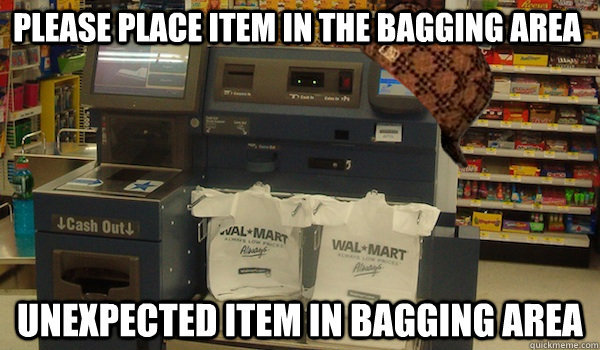
These are new machines. None of them will tell you to please wait because there is an unexpected item in the bagging area. If I ever win the lottery I will buy one of the old machines and when it locks up because of the unexpected item I’m going to open up with a Browning Automatic Rifle and put holes into it until I run out of ammo, and I am going to have a lot of ammo.

“What the hell is wrong with this damn thing?” Yes, the woman at the cash only machine is yelling. Yelling. She has no cash. She has taken the piece of paper off the card reader and is trying to put a credit card in it. The woman begins to throw a fit. “I ain’t got time for this shit” she yells repeatedly as she exits the store, all her stuff still at the scanner. The cartherds don’t so much as bat an eye at this. By far, the type of behavior they’ve just witnessed, is mild. Think about that. Think of where you have to be before this sort of thing is totally normal.


I have shopped not late enough. I have entered the realm of the people who are directionless, without intent, and they are purposeless. This is a foreign country to me. This is not my land. These are not my people. I wonder where the screaming child is, and I wonder how many of the people I’ve interacted with today were raised just like the screaming child; left to make noise regardless of how it affects others, with uncaring parents who might have been raised the same way.


Take Care,

Mike

Character Sheets

images

I’ve created a world inhabited by fewer than one hundred people. As it’s progressed, I’ve created character sheets for over half of them. Someone of them will die early in the story, but they’re still connected to the people who survive. These are people who all lived in a County with a small population with a town inside of it that had an even smaller population. From afar, and untouched, mostly, they watched the larger cities fall, watched as sickness and destruction, and monsters, devoured the heavily populated areas on Earth, and finally, like a river that floods finally reaching far flung areas, the small town was all but overwhelmed.


For course, I cannot have one hundred main characters, and three of the first one hundred are kill in the first day, but the story weaves a different feel for what’s happening depending on who is in the scene. Thomas Coker and his wife, Brenda, have never lived anywhere else except this small town, and they’ve never known any other people but the people here. They are alone in their direct families, having lost all siblings, children, and most of their close cousins. Yet there are people they’ve know, quite literally, all their lives. When maps are being drawn as to where there might still be un-looted stores of good and places that contain vital pieces of equipment, Thomas knows where to look and he knows three ways to get there and four ways to get back again.


Then you have Annie, the young, heavily tattooed, and very liberal pink haired woman from Colorado who became stranded in South Georgia and never made it out. She knows no one, has no idea what happened to her own people and realizes she never will, despises the heat and humidity of the South, and hates the men of the South who view her as some sort of oddity with her face piercings and strange accent. While everyone else in the camp see this place as perhaps a new Eden, Annie see it as nothing less than a prison, and wants nothing more than to leave. But to be on the road alone is certain death, she knows that, too.


You have men who are secretly gay, you have women who have cheated on their husbands with men who are in the camp, you have people who have swindled others in the county and they must live and work side by side with these people. You have Robert Peters who worked as a meter reader for thirty years and retired two years before the end came. More than anyone else, Robert is vocal about having been cheated out of something promised, and he represents attachment to the old world that no longer exists in any form. There are those inside the camp who have accumulated great wealth, and there are those inside the camp who have always been dirt poor. There are those who will take to farming and the hard work required to survive and there are those who will simply find a way to die quietly.


The cloud hanging over everyone’s head is the lack of children. Of the ninety-seven people in the camp when the story begins, only three are younger than ten years old. Two of those are under five. There is one “real” kid, Jamie Marks, whose parents took turns guarding him until they were killed. He spent five years inside his house never going outside for one moment. At nine years old, Jamie is a lost soul. He has no family, and even though he is adopted by kind people, there is no childhood for him to have now. The camp as seen through the eyes of a little boy who might be the last child alive on earth will be interesting writing.


The story begins in September, of 2020. By hard work and some good luck, by Spring the camp has been secured, and the ground must be readied for planting. There is a hot house with vegetables being grown, but there is corn, soybeans, and other large yield crops to grow. The food inside the camp might, if stretched, last for another year, but that would require the people inside to further reduce their calories, and the two meals a day regime is beginning to wear on everyone’s nerves and bodies. They want this harvest to work, they need it to work, and their focus is in making it work, harvesting their crops, and storing food, and making life better for everyone.


So suddenly, in a time of plenty, a security camera catches the image of someone trying to sabotage one of the walk-in freezers, that is powered by solar panels. It’s Jamie. Very few people knew there were security cameras, and the question now is, how many are there and where are they? And the question of what to do with a nine year old that came close to ruining many months worth of food? Who decides his fate? What punishment fits the crime?


In a camp where food was very scarce, the mood was different and punishment was always a question of how much food to take away from those who committed what offenses they had the energy to commit. Yet now, in a time of plenty, or reasonably so, what is the guiding light of justice if everyone now believes they have beaten starvation?


And, the more pragmatic members of the group say, what it this year and next year is not? How many bad years would kill us? How much sabotage would it take to be an extinction level event? Nearly all mothers have lost children, nearly all fathers have lost children, yet here is the last child committing an offense that might be considered worthy of the death penalty if he were an adult. What to do? Who is to do it?


Ninety-six people gather in an auditorium to consider the possibilities. What do you think they should include and what would you not consider?


Take Care,

Mike

2006

IMG_2357.jpg

There was a time that if the power went out and you didn’t have a telephone, that was it; you had no idea what had happened or why, or if something was going to be done about it. I lived years without a phone, and of course, there were no cell phones when I was in the military. Pay phones were all there were for people like me, and I had gotten used to it. I resolved never to get a cell phone when they started becoming popular and affordable. I finally went down in 2006, the same year I started needing glasses to read. I can’t do without glasses now, or a cell phone.


I woke up tonight in total darkness and watched the lightning playing across the sky outside. It’s clearing up, finally, and the moon is no longer full, but the dreary weather that’s hung around all day is finally leaving, at least for a few hours. This is Summer in South Georgia, and it will rain in the afternoon and still be ungodly hot at night.


Air conditioning is something else I lived without for decades but I’m not sure I could now. I remember it being hot, damn hot, in Valdosta when I lived there, and about the time it was cool enough to get some sleep it was time to wake up. I miss having the sort of immunity from the heat I once had, but old age and air conditioning will take its toll. I cannot imagine the generation of human beings right now if the AC stopped working. They would all die, I think. But once upon a time people who had wells had to look at those people with electric wells the same way. I was a generation away from hauling water in a bucket from a hole in the ground. I think about that on occasion and wonder how anyone survived it, but everyone, or nearly everyone, did.


It’s hard to imagine that it’s been twelve years since 2006, but it has been. In that twelve years I’ve become older and slower and my cell phones are now intricate enough to launch rockets into space and bring them back again, but mostly I use it to send text messages to people I’ll see in less than an hour, and to check the weather at work. It’s also a damn good camera. I take a lot of photos of sunsets and of dogs. If I had to say what use of cell phone really is, photos of sunsets and sunrises would have to be the thing I use it most for, and in the end, that really is a pretty good use for the machine.


I went and had my eyes checked and I got reading glasses in 2006 because I was running out of excuses at work for taking so much time trying to read things. It wasn’t bad, but it was getting to the point people were asking me if I wanted to borrow their glasses. I remember talking to a man who said he couldn’t read the dates on coins anymore and I found that incredibly strange. Even with my glasses it’s hard to read some of the dates on some coins, and I can remember when it was easy. The man who spoke with me in 2006 about his eyes being gone and mine going died several years ago. He had quit smoking but the damage was done. I quit in 2005, January of 2005, a full year before 2006 rolled around, so I think I’m safe now, or at least I would like to think I am. I get my lungs scanned once a year, on my annual check up, and so far so good.


The moon comes out and the dog are restive. They have no idea why I’m up at this hour, when it is very clear I should be sleeping on the bed, so they can too. I have turned the AC off and opened the windows to hear frogs and night noises, and I wonder if there are people who have never heard these things at night, late, when human noises all but ceases? What noises did someone hear when they went to the well late at night, what sounds did they hear that are now forever lost to us? What was it like to stand in front of the well and look down into it, and see starts, perhaps, in the reflection of the sky in the water?


I can pull up an app on my cell phone and it will tell me the names of all the stars in the sky, tell me which stars are what planets, and what constellations are wheeling around overheard, even in broad daylight. Yet the person at the well had only memory of words spoken about stars, and might have looked up at a sky unpolluted by security lights and car lights and town lights, this person might have smiled at the sight of the Big Dipper.


My cell phone doesn’t have a dipper. I doubt anyone I know still does. Long before plastic bottles became our trash of choice, people used and reused dippers at wells, and no one ever died from it. Or mostly, everyone survived it anyway.


There’s no way for most people to go back to digging wells and sleeping with the windows open, and even I shy away from the idea of having to drink water from a hole in the ground. It’s 2018, so many years have passed since they filled in the well at my grandmother’s house, and the outhouse fell into disuse. Now I can drink water from my glass bottle while writing on a computer, and remember 2006, which was interesting for reasons I cannot bring myself to write about quite yet and don’t think I ever will. But in the end, that year has passed, this one will too, and one day, perhaps someone will wonder how we primitive people got by on so little.


Take Care,

Mike