If there is anything more aggravating, and at the same time more meditative, it’s resetting Word for the way writing should be done when I do it. New Times Roman, font size 12, double spaced between lines, margins at 1.5, and this is the way all new documents ought to look for me. This is how I write. I do not want to discuss it.
There’s a certain amount of time that should be set in preparation, in getting things ready to go, foreplay for creativity, if you will. After all, without realizing it or planning it out, you usually take a lover knowing there will be kissing, touching, the shoes have to come off, the clothes are removed, there’s a method of getting things going, but after that, it’s creativity at its finest. Afterwards, both parties lie panting, sweating, hearts beating hard, and a sense of wonder takes over, as to how those moments in time came to be. It simply is. Chorography can set the dancers in motion but the style in motion is uniquely personal, just like the motions in physical intimacy. Your body knows, mostly, what it wants, but it’s more than just putting the right pieces in the right places, oh my yes, it’s getting the exact timing down, the perfect moment for the perfect place and space.
When I was a teenager trying to get my girlfriend’s bra off her body in the front seat of a car, and back then front seats were bigger, and we were much more limber, it was a direct approach towards nudity, with the ends justifying the means for both of us. Time was scarce when you have thirty minutes before it’s time to take her home, and everything has to be done, and if it happens to be done right, that’s okay, but usually it wasn’t. Neither is writing, when one first begins to write. Both are a process.
Dancing, like sex, without a video or a camera, will be like unrecorded music. There will be the memory held inside the minds of those involved, and oh my yes, those memories will last an entire lifetime, but no more than that. Words written may or may not survive, even with publishing there is no promise of eternity. All is temporary, except in the mind, and the mind will soon begin to fail, far too soon, and all it holds will be lost.
But for now, the cup is not full, the mind still yearns, I yearn, I yearn, and there is more work to be done. The page is set, it is clean and empty, and the twenty-six letters of the alphabet will swirl and be arranged, and rearranged, until something in my mind feels a sense of completeness, and satisfaction.
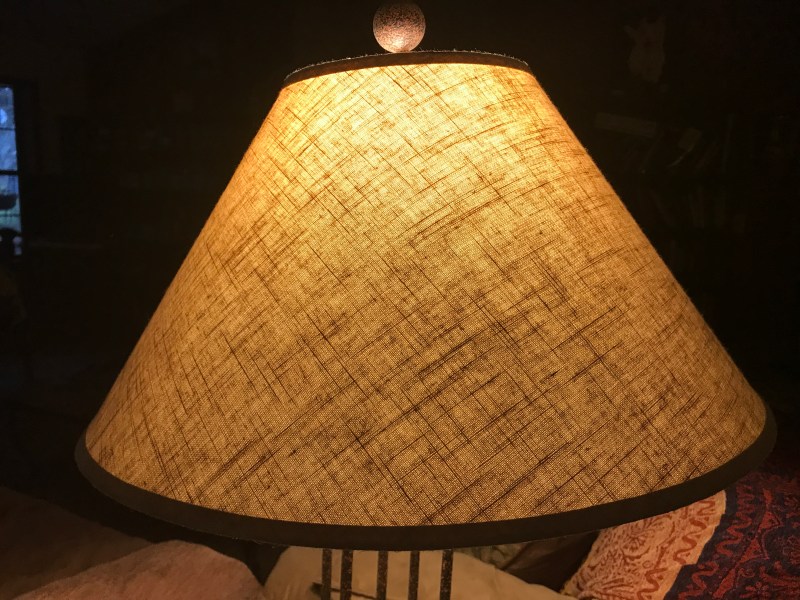
While trying to change perhaps the last incandescent bulb out of a lamp, I put my thumb through the lampshade. I bought this lamp back in 1996, when I bought my first house. New furniture, that was a must, people told me, and admittedly, the new furniture looked nice back then, and it has aged well, but now it’s all old and stained, and fragile. I didn’t foresee ever needing a lampshade, but the lamp itself is still good.
The thrift is run by a religious cult. They get people to donate stuff, sell it, and claim to save souls, and some of the people who work there seem programed. But it’s early in the morning and as far as I can tell, I’m alone in the giant warehouse. It is huge, and relatively sorted. The lamps are right there in front, a suitable replacement is found easily, and my journey ought to continue. I have shit to do. Odd phrase that, actually, but really. Instead, I wander.
An Italian looking cast iron statue draws my attention. It’s a woman wearing a low cut dress and she’s holding what appears to be grapes in either hand. Where did this come from and who made it? I shall not engage these people in conversation, no. A piano with a sign that reads, “Sold only to a Christian home” and I knew a man named Chester Christian years ago, and I wonder if he needs a piano.
Dozens of headboards, footboards, bedside tables, but no used mattresses, thankfully, that would be a little weird. There’s cheap new ones, still wrapped in plastic, “guaranteed new.” I wonder how they cover that warranty? If someone gets bedbugs do they give them their money back?
I wonder how many of these beds were points of conception for someone. Years ago I bought an old mattress to keep on the back porch for the dogs when I was at work, and when I told the woman at the yard sale what I was going to do with it, she balked. She had conceived her children on that mattress, and her husband had to talk her into selling it. The dogs destroyed it in a day or two.
Racks and racks of clothes, like snake skins shed on hangers, the clothes of mothers, fathers, grandparents, taken out to the retirement home for old clothing, left to go to bed with the dishes and spoons, the cups and glasses.
Can you imagine what it must be like, late at night, when the beds, and clothes, and the silverware start to talk? The beds have the sex stories, the flatware are the foodies, but I think the knickknacks, the dust collectors, and those items that were whimsical are those with the best tales to tell. Oh, and how sad now, for some mantlepiece vase, passed down by five generations, finds herself rubbing elbows with a plastic plant from Wal-Mart, cast aside for free.
The ceiling fan, installed in the bedroom knew about the affair, knew the marriage was doomed, but never knew the wife would get rid of everything, even the fan, to start over again. There’s the rug who was bought rolled up, never used, and is still brand new, but so ugly no one wants it, and there’s the mismatched glasses, who have been together since the 1940’s who know that one day they will part forever. An animated movie about the items in a second hand store who share their stories, and at the end, a fire breaks out and burns the place to the ground, with only the iron statue remaining. The sole survivor now holds all the stories within her.
“How much for the lamp shade,” I ask.
“How much will you give me for it?” The man asks.
“Three cents,” I reply.
“Really?”
“I’m hoping you’ll name a reasonable price and we’ll meet in the middle,” I tell him.
“Three hundred dollars.”
“I have four bucks in my pocket.”
“Okay, four bucks it is then,” the man smiles.
“Got change for a ten?” I say and he stops smiling. We agree on five bucks for the lamp shade.
Two shells in the shotgun, and five rounds for the rifle. How many men would come down the trail, no one knew, and maybe they wouldn’t come this way at all. But we expected the main force to hit us head on, at the camp, and a smaller group to try to sneak around the back. My mission was to guard this path that led to the farm, and I thought they put me here because I was older, less useful in the attack up front, and the only man in the camp not a veteran of at least one firefight. At a minimum, I would make enough noise to let everyone know there was company coming. Yet it was hoped there would be bloodshed, and not all of it mine.
Deer, maybe a racoon. That noise, the sound of leaves being crushed underfoot. Loud in the early morning stillness, the sun now above the horizon, the silence of the day just being violated. A tree branch fell to my left, and distinctly someone whispered, “What the fuck was that?”
I saw a spider crawling up the stem of the bush in front of me. It was a small, tiny, and slow moving thing, and the smell of crushed greenery wafted in. They had come in slow, without a sound; my heart pounded. In front of me, close, and they too, were waiting. I knew they would rush forward as soon as the shooting started. I eased the shotgun barrel forward and became part of the woods. I felt sweat flowing like tears. I felt small, and helpless, and scared.
Twenty feet of light underbrush would mean nothing to the stainless steel ball bearings loaded into the shells. Finger off the trigger, finger off the trigger, wait, wait, wait.
The sound of the rifle fire crackled, two hundred yards behind me, and this was the moment we would live or we would die. The men rushed forward, suddenly, and one of them saw me, too late, he stopped, halting the men behind him, and both barrels of the shotgun erupted in fire and smoke. Screaming, screaming, screaming, falling bodies, wild shots, and smoke.
“Aim low,” Billy told me, “knock’em down, make’em bleed bad, and they’ll be useless in a fight, and somebody’ll have to carry’em, after that, you got five rounds, no more, make it count, Mike, close the backdoor.”
I was the only man between the camp and the raiders coming in from the back. If they got past me, there was nothing.
Two bullets made a frying sound by my left ear, close enough for me to feel the warm breath of the Gods of War. I pulled the rifle up, another bullet whizzed by, but men were down, screaming, screaming, I sighted and there was only one shooting back, wildly now, panic taking over. He saw the rifle and his eyes opened wide.
The man jerked hard as the first round caught up just below his throat, and he threw his hands up, as if he might undo the damaged flesh. A man got up, limping hard, trying to run, and the second round caught him in the back at the waistline. He screamed, screamed, and kept screaming. Other men were yelling, “How many of them? Where are they? Jesus Christ, we’re surrounded!” and for some reason, they thought the sounds of gunfire from the camp, echoing through the woods, were coming from all directions. Another broke and ran, dragging a body behind him. My next shot caught in him in the right eye as he turned to fire, and the top of his head exploded like a fountain. That was enough. Two men threw their weapons down leaving me with the injured and dying. I stood and fired. Pop! Pop! Both men went down hard.
“Don’t get your ass up for nothin’,” Billy told me. “We lose the front, stay down, make a run for it. You go south, move at night, take care of yourself best you can. We hold, if’n we do, and we’ll come get you. There’s be a party after we bury the dead.”
I waited. The screaming stopped. The shooting stopped, but who won? Who would come down the trail to get me. Five feet away a rifle lay on the ground so I inched forward, grabbed it, and checked. Ten rounds in the magazine, one in the chamber. The former owner started at me with the half open eyes of a dead man, the first I had ever killed. He looked past me into the void.
“Mike!” It was Salman, the foreign guy who had moved to America a few years ago. He was good with guns, and I looked over my shoulder at him and grinned.
“Sal, we win?” I asked.
“Yes we win. What you think?” Sal crouched down. “How many get away, Mike? You make a mess in the woods. I tell Billy you messy.”
“None got away, none got past me. We lose anybody?” I asked as Sal handed me a cigarette.
“We lose men, Billy’s brother Hank. And new guy, odd name. Bubbles. Wounded gonna die.”
“Bubba,” and I actually laughed. I looked up and saw a woodpecker fly over, glorious and huge.
“Let’s get the guns, go back and see what happens now, okay?” Sal said and he helped me stand up. “Billy tell me, ‘We put Mike on the back, nobody live, nobody get past.”
“Thanks, Sal.”
Wrex pawed at my face, waking me up. I sat up and smelled blood and gunpowder.
But I held the line before I came out.
The night was locked in clouds, a light mist, no moonlight, no stars, and I could walked to the place on the trail from here, in the darkness and it felt real, as if the bodies would still be there.
Breakfast felt odd, too much light showing, they would see me. The dogs whined, went in and out, as if they sensed the veil had been strained, the dreamworld and this one had gotten too close to being in the same time. I was a vet in that world, and I would miss the party. Billy, Sal, and the guys who I had drank with a few days before the fight. Bubba was dead. His wife, two kids. Billy brother, I can’t remember his name now. Quiet man, reliable, it ran in the family.
It fought me. I went to Yoga class and was dizzy, I stumbled a couple of time, this reality isn’t holding, the other cannot.
This is the explanation of a dream, if that was what it was. What about the other side? Are they used to people just disappearing? Did I? Am I still there, drinking to our fallen, secure in a place I helped defend, or is it gone, all gone, forever?
Talking about writing comes in many forms. You can talk nuts and bolts, sentence structure, where the comma goes or does not, or how to write dialogue which are all needful things. Most of the new writers I meet have this vision their creativity will be enough to captivate the reader so spelling and grammar and structure be damned. This is never the case. The vehicle in which your writing flies will determine how high and how fast and how smoothly the flight.
And, regrettably in some cases, how long the flight lasts.
But there is the discussion on the philosophy of writing, on how writing should be done, and what it takes to tell a story. The person telling the story decides how, and if they are smart, they will already know how before they begin. If they try to wing it, they might be good enough to carry the tale to the end, but mostly, in writing, they must know right from the start.
A friend of mine went through a lot of text on a detective story. He began with first person, switched to third person, then back again to first person, and finally went with third person for the tale. Why? It felt right. It felt better to him as he wrote it. The process of writing, not the rules and regulation of writing, is what this is all about, mind you.
In one scene in the story, he walks into a bar, and the bartender tells him all about the history of the building. It’s a real building and the history is accurate. It isn’t a bar, but an office, but he transported it into another location and reworked it into a drinking establishment where horse racing and horse breeding people come to drink. This is where a murder takes place. The scene is important. How a writer gets that scene into the mind of a reader cannot be taught but it can be borrowed.
Think about Bilbo Baggins and his Hobbit Hole. That was his family home, Bag End, where Bilbo’s history was stored, his belongings, and his comfort. Torn away from this place was part of the opening of the story, and it defined the main character with style.
A bar, elegant and classy, where moneyed people go to talk horses, with photos of horses adorning the plain red brick walls, an antique piano on a small stage, and the massive mahogany bar, so brown it is nearly black, the perfectly clean mirror behind with shelves of bottles, each higher shelf holding a rarer version than the one below, and no prices asked or given.
The work it takes to define a location will stay with a reader. It will give them a place to relax and think about as the story evolves. You have an image of this place, and the people who go there, do you not? And I have not done it any justice.
What I have done, is given you an idea of what you must do to define, or refine, your story. Where? Where is this place? How does your characters feel about being there? That photo, in the corner, near the old corn cracking hand cranked farm tool, why was the victim standing there, staring at the photo? You have no idea, and no one has told you what or who was in the photo, and by the time the detective arrives, the photo is missing.
Is the photo a clue or a red herring?
We talked about the photo, over good beers and a chess board. Horses, of course, but a woman was in the photo, but who was she, and was she connected to the murder?
Don’t connect the dots, lead your reader to a room and allow the human mind to look around, to study the place and feel what it felt there. Your location should give you information about the characters there, and who they really are.
Your character is a woman, self assured and a good judge of character, we know this from her surroundings. We know this because of what she does for a living, where she lives and works, and we know because the other characters treat her with respect. So, does she get into the canoe with the stranger to go to the island in the lake? How big and island, how big a lake, and who is this person? All of this is important information that only you have, and to make your point, you must share it beautifully.
None of this can be found in a rule book. You can read books written by writers and find out what they’ve done, or better yet, you can read good books, lots and lots of good books, and find out how it’s done right. Or not done well at all. But reading is the best tool for learning how to write.
Mark, the man who was writing about the detective, had a problem with present a pause between two people speaking.
“Why would he have that problem?” Mike asked, as he looked around the room, searching for the waitstaff who seemed enthralled by the woman with the baby. It bothered him the child might start wailing and drown out the piano player.
“Because he had never thought about it,” Mark replied.
There you have a pause between Mike’s question and the answer to it. Mark worked it out.
This is the kind of conversations people ought to have more often about writing, instead of worrying about sentence structure, which you can learn from a book. I’ve got Fowler’s and Holt’s handbook, Strunk and White’s, of course, but none of that teaches you how to use words effectively to create a mood, or inflection. You do have to build the airplane with these tools, these rules, but the fuel can only be from your creativity.
Shopping zero early on Sunday morning means fewer people to deal with, so the dead man was a surprise, a shock, and for him to be standing in the meat section seemed oddly appropriate. He was among his own in this, all the dead in one place. I fled to the produce section, trying to sort out what was seen.
Of course, he is not the dead man. The dead man was named Mike, that’s the only part of his name I remember, but he was a deeply religious man at work, and like most of the deeply religious men at work, he had a problem keeping his dick in his pants. He got caught having an affair with his married secretary, he was married, but the deeply religious supervisor he had also had the same problem, so the issue was swept under the rug.
We had one conversation, about my lack of belief, the only conversation we would have, and he said I ought to change my ways and become a better person and I said, “You first.” And we never spoke again.
I had a supervisor that was cut out of the same holy cloth, that look-at-me-I-love-Jesus-but-damn-what-a-set-of-tits-on-that-bitch type of white guy with a little power over people. When he wasn’t hitting on the women under his supervision, he was trying to get people to come to his church.
The dead man died of cancer. Slow and hard, he died over a period of months, and he told people that his god was punishing him for his infidelity to both his wife and faith. I’m pretty sure any deity who would kill a person like this isn’t holy at all, but I was amazed my supervisor bought into it, or claimed to, and worried that his god would come after him one day.
I went to check out, and at zero early hours, there’s one cashier, usually bored to death, but there was the dead man, being checked out before me, and I hesitated, waited a bit, it felt weird to be that close to someone who looked just like the dead man.
“The computer just died,” the cashier said, and she had to reboot it.
The dead man was bagged up, paid, and away he went. I checked out, and left a few minutes later. He was parked beside me, loading his groceries into the trunk of his car.
“Do I know you?” he asked.
“I don’t think so,” I replied.
“You looked like someone I knew,” the dead man said, staring.
“Yeah?”
“He died back in, uh,…”
“2010.” I finished for him.
“That’s right,” the dead man says.
“I got to go,” I tell him, loading my stuff quickly and getting into the truck.
I pull away and watch in the rearview for just a few seconds.
I wondered where it came from, and I still do. It’s a massive structure, revisited, my second time here, and it’s breathtaking. The edifice reaches the clouds, maybe two kilometers in the sky, maybe even higher, there’s no way to measure, and birds must fly around it, great flocks trying to gauge if it would be better to skirt around the man-made mountain or go over. It’s when the birds are close is when the scale becomes apparent. Tiny flying insects they become, against the soaring walls. Higher and higher the flock flies, up and up, until I cannot see them anymore.
Why red brick? There’s a reason it’s built out of red brick, and I feel I should know why but no. I stand closer now and have that feeling a person gets when they first visit New York City, and walk among the skyscrapers. But a good portion of New York could fit inside this building, and as far as I can tell, there’s no reason for it to exist, except it does.
Engineering would deny this thing in reality. From space, it would look like an old fashioned water well, simple and round, the walls only thick enough for a small truck to drive upon the open rim, a three meters wide, at most. I’ve been up there once before. I think I fell.
There’s a tiny café to the left of the entrance and people time their visits to avoid the guy mowing the grass here. He pushes a loud, smokey, clunky mower, just like you would find in suburbia in the mid 1900’s and honestly, I have no idea if one person could actually mow the inside area and not have a permanent job. But the men and women working to repair the wall also have a full time job. There are hundreds of them, scaffolding clings to the bricks in various places, and stray bricks fall at random times. But overall, there are vast, immense areas where unbroken fields of bricks stretch into the skies.
But why red brick? The question comes to me, even as I walk in the freshly mowed grass, I can smell it, and I know it’s a dream, but the red brick stage setting intrigues me. Something tiny to give The Well a larger sense of proportion? I have no idea. Then I see her, the woman I was looking for last time, sitting alone, waiting for me. The dream is repeating, the dreamscape and characters are back, and even though I know it is a dream, the smile is involuntary. I’ll ask her why the bricks, why everything, over a drink, and a cigarette, but I wake up instead.
The dream stayed in my mind, like the residue of honey in a refilled cup of coffee. It’s not there, not even the memory of the dream is there, nothing but something akin to a psychic aftertaste, something floating around in the mind like a speck of red dust in the air, reflected by sunlight for a moment in time, picked up by imperceptible currents in the room, before drifting back into the shadow near your closet.
It’s still there, it still exists, you know for a fact it does, but you also know you couldn’t find it, and by looking for it, by trying to define it, you would pollute and distort it, change it so completely as to destroy the vision entirely.
How can it be both there, not there, remembered, not remembered, forgotten, not forgotten, Schrodinger’s Cat, with your conscious being the radioactive isotope, that triggers the poison. Your subconscious doesn’t know if there was a dream, or if you dreamed there was a dream, but the if you look for it, you kill the dream.
Perhaps the same part of your mind that forgets people one millisecond after you’ve been introduced is responsible for remembering your dreams. It’s a faulty device, battered by television shows, bumper sticker politics, and Prosperity Religion. If you spent more time reading, you’re remember what you had dreamt in more details, and Barbra Anderson’s name after you met her.
You can feel it, can’t you? You know it’s there. You meet someone and you’re looking at her, she’s speaking to you, and her name was said out loud, you shook hands with her, and now you’re scrolling through names in your head without a road sign or a map to help.
Feels just like when you’re trying to remember a dream, doesn’t it?
When was the last time you did remember a dream? The dreamscape, the setting of the dream, was it familiar only while you were there, or it is a real place? The people, were they characters in your life, or did they only exist in your slumber? Perhaps there was fear, some creature that meant you harm, were you lost, were you missing someone, was there abject terror of death, fire, falling, bullets, bears, or Johnny with an ax?
Maybe that’s why we don’t remember dreams, it’s a self-defense mechanism keeping us from screaming during the day while we remember what happened in our sleep. And perhaps, for mechanisms we cannot quite comprehend, it’s the same reason we forget the names of strangers.
When I got involved in Snake Identification in Facebook groups, I had no idea there was a culture, and subculture, that revolved around snake myths, and snake identification. I should have known, for if you get ten people together in a room for a week, by the end of that seven days, you’ll find narratives that have no basis in fact at all. Three people will believe the narrative, three will accuse the first three of lying, three will be indifferent, and one will have never heard of it.
Even before we are able to fully understand our mother language, as infants, we are fed the myth of Santa Claus. Every year, as we grow up, we see photos, videos, movies, hear songs, listen to adults and other children talk about Santa Claus, so we believe, because why wouldn’t we? Why would all of this be based on a lie?
But it is a lie. It’s not a misunderstanding, or some tightly held religious belief with no evidence, no, it is an outright lie.
Whether you want to admit it or not, whether or not you think it matters or not, parents teaching their children about Santa Claus is teaching those same kids, once they discover the truth, that lying is acceptable, and even more desirable, than the truth. To use a lie to modify someone’s behavior, like parents do when they tell their kids if they misbehave Santa won’t come, is perfect.
Here’s the fallout: Children will so reverently believe this lie they’ll repeat it to other children, and among the kids, will be stories of how one or the other, or some group, stayed up late, or got up early, and actually saw Santa. Others will see something in the sky and know, really know, deep down inside, they truly and honestly saw a red nose, brightly leading the sleigh through the sky. Moreover, as the kids get older and the lie gets harder to defend, and the truth becomes glaringly clear, both parents and children will pretend to believe, as to keep the lie alive, for just a little while longer.
Gee, Mike, that’s certainly a buzz kill, but what’s any of this got to do with Cottonmouths?
Here in The South, as I was growing up, I was told the tale of Hoops Snakes who would grab their tails in their mouths and roll like a hoop to chase you. Then there was the story of how Coachwhip snakes would chase you and whip you with their tails. And rattlesnakes had a poison dust in their rattles that would kill the unwary. Snakes hypnotized birds to catch them. And if you killed a rattlesnake, its mate would hunt you down by the next day. And there was the story of the water skier who fell into a nest of moccasins, and as rescuers tried to drag the lifeless body from the lake, the snakes were still hanging on!
Also, Cottonmouths would chase you.
None of this is true, of course, and most of these myths have slowly evaporated as videos become more and more ubiquitous, and the evidence for such snake activity becomes more and more impossible to prove.
Yet the one myth that seems to be the hardest to dispel is the one of Cottonmouths chasing people. In ID groups, long and irritating threads will stretch on and on, with the person claiming to be chased never relenting, never giving an inch, but yet never producing a photo or a video that their claim is true. They grew up hearing about people being chased, and they feel they are not part of their own culture if they do not produce a story about nearly being killed as they barely escaped the deadly fangs of the moccasin.
Yet there are issues here, and those issues are based in reality. The truth of the matter is while these snakes do strike swiftly, on land they are remarkably slow. The Cottonmouth got its moniker by its eponymous mouth agape position, showing its fangs. But it is impossible to chase anyone from this position as it is a purely defensive posture! Moreover, there have only been four recorded deaths from Cottonmouth bite in the United States. If these animals are so dangerous, and they do chase people, why is it so few people have been killed? Why is it so few people are bitten? Why is it we have no videos, why not hundreds of them, if the myth is not a myth?
The truth is we have “The Santa Claus Effect” here. People have been fed a lie, by people who were fed the lie, and each generation passes it own without thought. It’s true not because it happened but because it’s part of the culture. People lie about it, and find a ready audience for their lies, because they have already told the lie themselves. To argue this point is to find a group of people emotionally invested in what they are telling, and what they have been told.
If you really want to piss people off, tell the truth. Tell a four year old child the truth, Santa doesn’t exist and watch their parents explode in anger. It’s magic, the parents will tell you, it’s wonderful, that is, until the bill comes due after Christmas and all the fake snow and tinsel has really brought is credit card payments and a child who believes no amount of toys is quite enough to keep the magic alive.
The Cottonmouth tale is much like this. People want excitement, and safe fear. They want to feel brave and heroic as they blast away at a creature that will run away if given a chance, and who has harmed no one. They want to feel like they have, once again, conquered the wild by beating to death a snake they have always heard was dangerous, and they have always told people was dangerous, without giving a single thought to the truth.
Back in the day, I had a co-worker who hated the sight of people eating with chopsticks, at a Chinese restaurant, in south Georgia. Chopsticks, he claimed, was not only un-American it was anti-American. Of course, forks were brought over from England, so not strictly American, but I occasionally used chopsticks in the office while eating lunch just to watch him melt down. It was interesting in that he personally invested in chopsticks being the antithesis of American values but cell phones, clothing, and thousands of plastic items from China polluting the waterways were perfectly fine.
It should be noted that injustice is practiced, and nearly perfected, when it comes to conjuring excuses to colonize violently those places deemed desirable. Once the early settlers became strong enough to declare war on those who helped them survive, one of the tried-and-true methods was religion. In due course, the settlers accused the natives of Satanism, for they knew nothing of Christianity. In Central America, the Spaniards would hand a local leader a bible, and if he failed to be able to read it, they would kill him and loot his kingdom. Greed, the psychological desire to possess more than enough, drove the Spanish to destroy ancient and advanced civilizations, and erase cultures from the maps of history. Christianity was their excuse of choice.
Of course, destroying a civilization isn’t the only horror to be laid at the feet of the Genocidal Marriage of Greed and Christianity within the boundaries of this nation. Slavery was used to kidnap, murder, rape, and to steal the lives of people whose only crime, or only sin, was to be born of a darker skin color than the men who held money and land. For four hundred years, enslaved people could be, and would be, kept in bondage and made to work, getting nothing for their labors but the barest of necessities. Women were used as breeding stock, men were worked to death, and nothing, no bright point of existence could be experienced without the permission of those who were pocketing the money the slaves worked for.
Greed, in all of its various forms, has always been accompanied by spiritual heroin. The rich can convince the poor their lives are only meaningful by their submission to the way things are, by the rich getting richer, the poor getting poorer, and obeying those in power is the only real virtue. After all, how could the rich have all the money and all the power if they weren’t those selected by the gods to have them? Who are the poor to questions this?
It’s no mystery why churches in America are tax exempt. It’s the tithe they receive from those in power for keeping the poor looking past their own lives for something better. Here, in this lifetime, they must be productive, meek, and work themselves to death, very much as the slaves did. The misery they endure will be assuaged by some mythical creature, but only, never before, they die.
Time to sit down with a cup of coffee and write. Good coffee makes for good writing, I believe, and better coffee makes for better writing. But writing is different now and I have lived to see a couple of changes in the way writing is done, and how reading is done, too. Rolling with these changes can be a bit tricky, and it is not enough now to know your audience, but you also must know the medium as well, for now, the medium in which you express yourself will define the audience that you reach, and most importantly, how that audience will react.
Twitter is the fifty word novel of social media writing. A writer is constrained from deep explanation or meaning and instead goes for the sound bite and the punchline type writing. Twitter is superficial to the point of being nearly meaningless, and before you rise to defend this site remember most commercials on television are make for an audience they know they can reach in thirty seconds, with ten seconds of that being staccato fast disclaimers being spoken in a near whisper. The level of dishonesty and deception that can be delivered very quickly is amazing and is it simple. Writing deeper requires your audience to think about what has been offered, and often it requires time to consider the level of veracity. Also, there are these thoughts:
“He who knows only his own side of the case knows little of that. His reasons may be good, and no one may have been able to refute them. But if he is equally unable to refute the reasons on the opposite side, if he does not so much as know what they are, he has no ground for preferring either opinion… Nor is it enough that he should hear the opinions of adversaries from his own teachers, presented as they state them, and accompanied by what they offer as refutations. He must be able to hear them from persons who actually believe them…he must know them in their most plausible and persuasive form.”
― John Stuart Mill, On Liberty
There is a lot to unpack in this quote. Rarely, very rarely, on social media are there those who will consider deeply those opinions they do not themselves hold and hold dearly. Entrenched positions are defended from any thought or idea, or words, that might not perfectly match those being held as the one word of truth.
Humans, particularly those who were raised by television while their parents were preoccupied, were trained to think of good versus evil, all issues black and white, and this is to the detriment of gray areas where both sides meet and build compromise for the greater good. One team scored more points, or killed more of the other side, or had more weapons, or goods, or food, and that side was the one who won the argument, irrespective of the truth. Our American culture reflects this quite strongly in our past, first with the Natives who suffered genocide, then the other colonists who were on the same continent, and finally, the enslaved people who were freed suffered the fate of those who lost. Only great political and cultural upheaval has forced change upon those in power who from profited from this system.
Now, on social media, anger is the weapon of choice. It is not preferable to debate an issue, to look upon all sides of it, no. Now, only anger will do, and once again, those who express the most power, who get the most reactions in their favor, have “won”. No issue is decided by anything short of brute force in the form of the cyber version of pitchforks and torches.
It’s important to remember the users of social media have decided to join a culture where anger is the weapon of choice in interaction between members who disagree. It is entirely within their power to commit to change.
The ability to chance will be drive by the desire to change. The emotional feedback loop, of a group of people continuously agreeing with one another, and reacting in anger to all others, will grow stronger and more resistant to change. Moreover, it will become refined, stronger, with those in the group who are less fervent being attacked by those who are more radical, and the process will continue until what was once seen as fringe beliefs become mainstream.
Compromise and loyal opposition are eliminated quickly in this process, until nothing is left to talk about.
In closing, this is a cultural phenomenon. It can be changed, not without some conflict, and it will require an effort. But as the use of anger as the primary means of communication spreads, we will all become human beings, caught in traffic, impatient to get to where we are going, readily blaming someone for getting in our way, blowing our horns, raising our middle fingers, and still going nowhere.









 The Hickory Head Hermit