All Preachers Are Grifters

Watching the cursor blink, waiting, waiting, the first sentence was going to read, “I don’t like preachers” which would have been accurate, but imperfectly so. Let us try this, shall we:

I dislike preachers.

Yes, that’s more to the point, stronger, and says what I want the sentence to say.

This morning, zero early hours, I’m in the waiting room at the doctor’s office to give blood for my yearly checkup. I hope I don’t have rabies. After almost dying a couple of years ago or so, I’m more than a little paranoid about getting looked at once a year.

            The waiting room fills up, like a wading pool of sickness and injury, and the room may or may not be a launching pad into the Great Unknown.

            A man is talking to a woman, and he’s loud. Loudly loud. He has a spiel. I’m under the impression these two have never met, but he keeps telling her how “blessed” she is and how “blessed” he is, and how “blessed” it is to be here, bless his heart.

            He laughs every time he finishes a sentence, as if he’s a comedian. And the laugh is the same laugh every time. It has four syllables, like Ha ha ha HA! With the last syllable accentuated. I stop reading to watch. He’s talking loud enough for everyone in the room to hear him, and when any preacher does this, he’s sharpening his knives.

            He asks the woman questions, “Where do you go to church Ha ha ha HA?”

            “Oh, I go over there on the west side of town, it’s Unified Christian Hypocrites, and. . .”

            “Do you like it there Ha ha ha HA?”

            “Oh yes, it’s a good church, we…”

            “Who is your pastor? Ha Ha Ha HA”

He’s not only pumping her for information, getting her to talk faster and faster to keep up with him, he’s also making her feel more and more like she should. Used car salesmen use this technique to work people into buying a car. It’s fast, effective, and slimy as the feel of a preacher’s hand on your shoulder.

But this is minor deception, a sort of exercise, warming him up for bigger game, and I can feel it. The only difference between a preacher and a homeless person lying to get a few bucks is the homeless person has to be somewhat honest; preachers tell the biggest and the most lies than anyone you will ever meet, and their livelihoods depend on their ability to be great liars. This man is good.

“Mr. Marshall?” the receptionist calls, and the preacher stands up, makes a fuss about saying good by to the woman and have a blessed day.

“I’m Reverend Marshall,” he says with just a trace of that judgmental tone of voice that she should have known that was his title but she was too sinful to be aware. I’m sitting close enough to hear him. So were you, if you were in the same zip code.

“Reverend Marshall, you’re a new patient, we’re going to need cash, or a credit card, or a cashier’s check for your first visit,” the receptionist tells him. There’s a sign on the wall that has this information on it, at eye level, in a 48 font, bold. I’m also sitting close enough for the fumes coming off Marshall to choke me. He’s wearing some sort of perfume, cloying, sweet, and powdery, like cotton candy scented drywall dust.

“The Lord takes care of me,” Marshall says loudly.

The receptionist is a woman who has heard it all before, even if she hasn’t heard this before, it doesn’t matter.

“Yes sir, I’m certain he does. You’re a new patient, we’re going to need cash, or a credit card, or a cashier’s check for your first visit,” she repeats, and doesn’t bat an eye.

“The Lord takes care of me,” Marshall says loudly. “Ha ha ha HA!”

The receptionist sits there, counts to ten, silently, and then repeats what she’s already said.

Marshall laughs and waits.

The receptionist cocks her head to one side, and waits.

Marshall pulls out his wallet and says, loudly, “Money is the root of all evil, ha ha ha HA!”

“Thank you, sir,”

I give three vials of blood to the phlebotomist, while Marshall is talking to a guy who looks older than me by half again. Marshall is doing his rapid fire question routine but the other guy is hard of hearing, and hilarity ensues.

I pick up my paperwork and leave the medical professionals to the circus that’s come to town.

Take Care,

Mike

Dreamscapes and Damascus

One of the reoccurring Dreamscapes is a building built on a slight rise, so the sidewalk in front of it would be great for skateboarding if concrete wasn’t broken up and cracked so badly. An awning once stood over the length of the sidewalk, but it’s missing in places. The flagpole stands naked. Why the building was abandoned, I have no idea, but the grounds have been kept somewhat, yet it’s deserted, mournful and empty.

More than once in my life, and often in my dreams, I’ve looked at a house or a structure and wondered what the designer had in mind, or if they were just making it up as they went along. Of course, all the Dreamscapes come from my mind, and I wonder what it says about me that this building exists in the form it’s taken.

Early in my career in transportation construction, there was a program that would give each congressional district X number of feet of roads to be resurfaced. These were not highway projects, but meant to be doled out to poor counties and small towns, and usually it amounted to resurfacing a street four of five hundred feet long, in a town with a few hundred citizens. Over the years, I paved roads in dozens of little towns and out in the middle of nowhere county roads, and I swear that building exists somewhere out there.

Damascus, Lawrence.

Life is stranger than fiction. Damascus Georgia, a small town, even for small towns, is the place I began writing, even though I was only there for a few hours. The building in the Dreamscape is possibly larger than the town of Damascus, yet somehow, the two locations, one in south Georgia and the other existing, possibly, only in my mind. I keep thinking I will go back to Damascus, to see if what I remember is still there, but it’s been over thirty years now, and it is possible reality doesn’t exist the way I remember it, for it rarely does.

Kestler.

That would make sense. The original name of Damascus was Kestler. I’m Rabbit Holing now, predawn, coffee setting in, mind bouncing around like a kid out in the rain, following each scrap of information like a Holy Grail. I’ve looked at Google Map shots, tried to find the street, think I might have, but it has been thirty years.

Having no basis in reality, how accurate is a Dreamscape each time it’s visited? Created wholly by the mind, is the mind readily accepting each new version as an exact replica of the last, and the first? Unless a dreamer was to draw a map of the building, each detailed defined, is each dream a newer representation of the same feeling of the building? Is the flagpole a new detail, yet my mind convinced it was there the last time?

There’s no way to tell when the mind is telling you’re the truth, because you are the mind.

Nothing we sense as the truth is totally real, or totally not real. We’re seventy percent water by volume, and if we could get that proportion of reality out of our daily lives, or our dreams, we would be, I think, never aware of it.

Take Care,

Mike

When Your Dog Died, Remember?

Remember when you were a little kid, maybe five years old, and you were watching something on the television? For whatever reason you liked it, you really liked it, but you didn’t have the same concept of time you do right now. A half hour in front of a television when you were a kid seemed to last longer, because you hadn’t developed a sense of time the way you would later in life.

At five, you’re not thinking about everything you have to do, a job, school, death, bills, alcohol, or any number of things that will invade your thoughts later in life.

Later in life, your thoughts will be crowded by much different issues, depending on what’s going on.

Even at the age of ten, you are still a kid, but now there are team sports, you’re beginning to notice other people as a gender, as a function as attraction, your ability to read has evolved, you’ve done things, illicit acts, your parents would worry if they found out, you realize life is more complicated than it seemed five years ago, and five years ago seems to be a long, long, time.

But then at twenty, ten years seems to be a long time, and at forty, if you’ve been married for five years at that point, it may, or it may not, seem to have lasted forever.

But then at fifty, see how I jumped there, because the older you get the shorter ten years can be, but now a half hour show is short, and how television is used, movies, binging, DVDs, series, makes the experience so much different.

Your memories, what actually happened, never really did. Yes, of course your dog died when you were five, and it hurt. But each year that memory is changed by who you’ve become, and who you once were is gone, and so is a vital ingredient of that memory. The person you are has no idea who you were because you have no mechanism to feel that change. All you have is memory, and because you cannot remember a password you reset an hour ago, you know memory is flawed.

            And this all gets much worse.

            You were sad your dog died and you still are sad when you remember the event. That tells you all you need to know. It’s the emotion of the event, not the event itself. You might not even recognize the dog if he walked up to you, but surely you would, because of photos and videos, but would you really know? It’s how you feel that creates memories, not the physical world. Do you remember the day of the week, what you were wearing, the hour of the day, the color of the shirt of the vet, a million details lost forever, added, deleted, forgotten, changed, but pain lingers, doesn’t it?

            Were you five? Your sister remembers you being six. Your mother remembers it happened much earlier. If you have photos or a video, you have a touchstone, something that defines the moment in a certain way, but that doesn’t mean you remember it. It simply means you have a way to identify the time.

            You can’t remember an overwhelming percentage of your life, you fight hard to remember names, you have to write down passwords, and someone from your past, you know you know that person, you went to school with them, but who in the hell are they?

            You don’t remember. You rarely do, actually. Yet you let what memories you do have to have you, to control how you feel, and to judge you.

            Let go of the past. You really do not remember it.

Take Care,

Mike

Of The Sun

Somewhere, in a past so distant that the human brain cannot comprehend the matter, some tiny and insignificant organism was exposed by the tide, yet survived, for being a tidal creature, it could more handle a drier environment. It needed moisture, and when the tide returned again, it was saved from desiccation. Over millions of years, the descendants of the tiny would-be land creature grew more and more tolerant of being away from the sea, and plants were born.

The sun knew nothing of this, knowing nothing of something so tiny as the earth, so far away that its gravitational pull would capture it, but not be affected in any great way. The sun spun on  away to wherever it would be guided, the earth spun around the sun, millions and millions and millions of trips around and around. Billions of creatures lived and died, dinosaurs rose and fell, species evolved or went extinct, and finally, in a space of time so incredibly tiny, so minute as to not be noticed by anything capable of notice, I arrived, and you did, too.

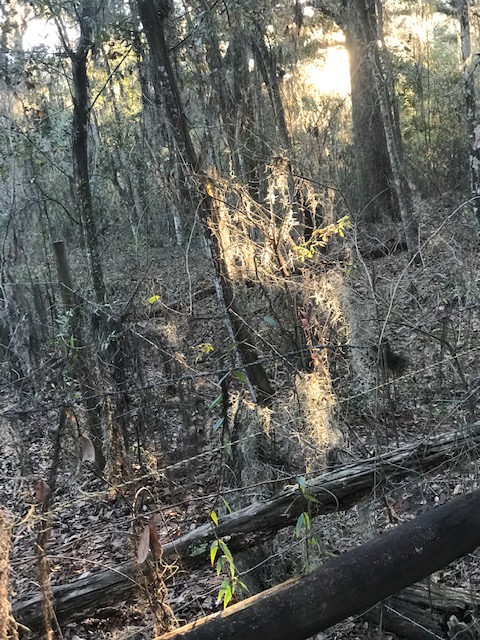
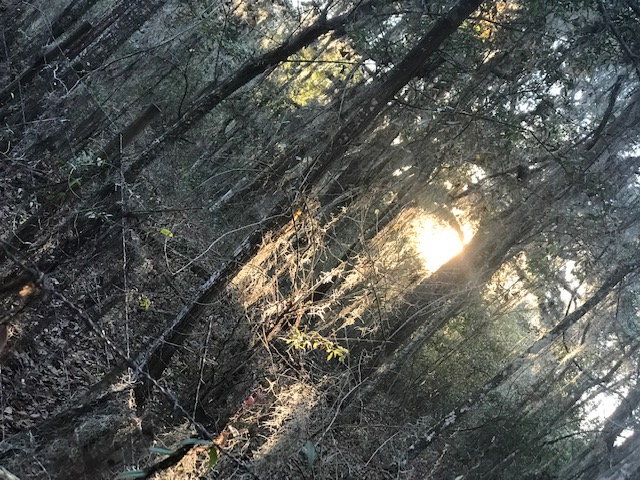
Here are some photos of the nearest star, captured in a moment, the descendants of the first land plant growing around us. To me, and perhaps to you too, the Live Oaks are giants, and perhaps, to them, we are but flashes of life, brief, dangerous, yet temporary.

The morning starts cold, the sun trekking Her way towards the north now, longer days, yet not warmer, not yet. The light slashes through the darkness, feeding the trees, giving heat to the earth, brightening the sky, and I am there to see this, as I am wont to do, very early to greet the sun.

In some way, every living creature is kin to all others, to the first, to the last, to all who were and all who are, and all who will be. The sun spins, spiraling to a tune that lives inside us, too, as we make our way to wherever it is we go.

I greet the sun early, as I am wont to do. The light of the day begins like a liquid, flowing into the spaces it can, then overflowing to the rest of the earth, and into the sky. I greet you too, fellow beings, kin of the first creatures, survivors of your spins around the star nearest to us all.

Enjoy your day, of light and warmth if you have it, and if you do not, may the next spin of the earth, bring you a moment in the sun.

Take Care,

Mike

The Light of Fog

Jessica Elizabeth heads into mom’s room after breakfast but Budlore Amadeus wants to go out. An odd species of weather sits over Hickory Head, directly above the stars blaze, but water droplets like rain fall from the branches of the trees, and when I turn the flashlight on the beam of light is home for thousands, maybe even millions, of tiny specks of floating water. Bud has disappeared into the wet darkness, and where he had gone, and why is wants to go there, will never be known.

The Big Dipper high in the sky, is clearly visible, but the fog hides the woods, the world quiet except for the sound of water dripping from the trees, and for thousands of years, maybe even millions of years, before humans, this sound was one of the loudest any animal might hear, other than thunderstorms.

This water, these water molecules, hydrogen and oxygen, do these individual molecules last millions of years? Could they have seen the dawning of dinosaurs, the extinction of those dominant beasts, and now watch as humans destroy themselves? Is water eternal? Are the tiny droplets I inhale in the darkness those same particles who have passed through the lungs of a T-Tex? Did a Stegosaurus, whose species died off into extinction long before the T-Rex arrived, breathe this same fog?

Budlore makes no sounds in the woods that can be heard, but he’s been out there for half an hour now, and light begins to seep into the edges of the woods, and the sky is becoming more defined. My clothes feel cooler, heavier, as they absorb the moisture in the air, that which is dry becomes wetter, that which is wet becomes drier, that which is darkness becomes lighter, that which is light becomes darker, somewhere, someone watches the sunset right now.

I hear Budlore now, running at speed, he realizes I’m on the deck, and he leaps onto the wooden boards and heads for the door. Whatever it was is no longer holds his interest, and Bud returns home again. He rubs noses with me, a greeting as older than language, touching faces, exchanging breath and moistures, and then he heads for a morning nap.

My compulsion is just as you see, to write, to put into symbols this dawn, that dogs, the water, the trees, and light of the stars, from which we are all made.

Take Care,

Mike

Zebras in the Grocery Store.

The Christmas crowds are finally gone from the grocery stores, and the roads. A brief yet smaller wave of people who are not usually in the way will appear this weekend, disappear, and then we’ll be fine until Memorial Day, when the summer crowds begin. But for now, things are almost normal on the roads.

The parking lot of the store is free of the frantic frenzy of the holidays, and I scan the area, looking for free roaming humans. I try to get from the truck to the door without having to come in contact with people, and it’s strange no one else I know does this. I can’t control what happens at the door, but getting there, yes. I can avoid people to a large degree. Where I always park is key to this. I can go in three different directions, three paths, depending on where people are.

The panhandlers like to set up just south of the entrance. I make sure none are around because approaching from the south is the shortest way to go. Otherwise, I head north and cut back in, or go in at an angle sort of north by northeast. Once inside, there’s little to do but adjust quickly but not too quickly, or it turns into a game of pinball.

The aisles of the grocery store cause choke points, and shoppers who are blissfully unaware of their surroundings make it worse. I can go all the way around someone causing a jam in the middle of the soup aisle before they can figure out there’s a problem and move. Children are the worst, for they are the product of people who lack situational awareness, so they have no idea it exists, much like the kids who have never seen a blacksmith or a miller.

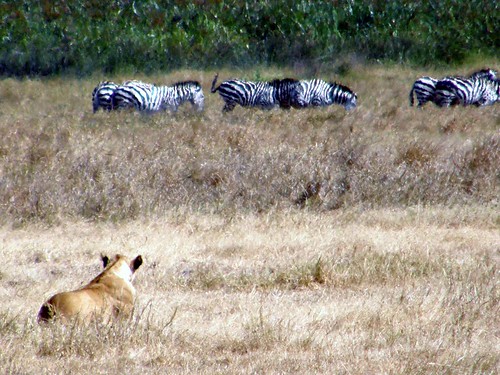
If human beings were magically turned into zebras on the Serengeti, the first lion to charge the herd could simply stop and wait. All of the zebras would run into one another, fight over who was going to be first, deliberately interfere with others, and some would just stand and stare off into space. In the wild, human beings would be extinct in about three days.

Take Care,

Mike

Illumination


High above the cold morning are cirrocumulus or altocumulus clouds, scattered yet together, and the light coming through isn’t direct, nor is it shaded. It’s the same density of light we get in the summer, when the air is so thick with moisture even on a cloudless day the light is diffused and weakened. Not the heat, mind you, from May to September the heat is never weakened, not even by the deadest part of the night.

But today it is cold. The light has been diminished, not enough to really tell, unless you like photography, and you notice the light. Photography, no matter the level or purpose, is a study of light. If one wishes to do well with a lens, there must be an understanding of light, shadows, density, strength, and direction.

I step out of the truck, for the second time today, to take a photo of the sky. Dawn doesn’t demand any sort of greeting, but it’s rude not to stop and say hello, and thanks for the display.

Close to midmorning, there’s more of a mixing of the paint, a stirring of sorts, planning for some mono-colored work, perhaps, something undefined and indefinable, abstract if you will.

When you begin looking for light, looking at the light, in a different light, not for sight, but illumination in a manner of speaking, you can understand why the writers reads. It’s a study of the pattern of letters, for what purpose and method has nothing to do with words, or sentences, but again, of illumination.

Take Care,

Mike

The Blindness of Sight.

The rain began in the deepest part of the morning, somewhere after midnight, and the metal of the roof announced the storm’s arrival. The wind might knock the power out, but it’s cool enough to keep things in the freezer and refrigerator from going bad for many hours, yet warm enough for the heat not to be on. At any rate, the blankets protect me from all things that are not nightmares, and the dogs snore softly.

There’s little lightning, a rumble of thunder in the distance that holds no threat, and I listen to the rain, wind swept rhythm, and hope the compost pile gets a good soaking. It’s another week yet until Solstice, and the heat of the sun will not return until March. Two cold and dark months left before I can start thinking about planting again.

            Drifting between sleep and rain, dreams almost appear, nearly form, but do not. Some of the dream is of drowning, but detached, not terrifying, and in this is the realization not being afraid of drowning creates a bypass for survival instinct, but these thoughts are misty and they, too, drift.

            Wrex Wyatt dreams. His legs jerk, and there are yips from deep within, so I reach out and place a hand on him, say his name, and the sleep returns to us both, unbothered by visions or memories. The rain pounds the roof and sleep comes and goes as if blown by the storm. It’s one or two, maybe three in the morning, no, not yet two, for time doesn’t exist in true darkness.

Primal and wet, the lack of light is the bottom of the ocean, where nothing is ever seen, but felt, and smelled and the sensation of the world around the skin is everything that light is two miles above the trench. What if your skin, the entirety of it as an organ, naked, and floating, was your sight, and could clearly discern a world that existed above, below, and all around you, all the time? Changes in temperature, pressure, heat, cold, the feel of chemicals released by others of your kind, the pheromones of those you were interested in, and who were interested in you, the smell of prey or predators, the feel of electricity in all things, the sensation of the life leaving an old one, their life finished, their body drifting to the very bottom to decay or be eaten, or to be buried by the currents, all of this, every moment, a full body experience.

            Sight is so limited.

            Yet even now, when the realization of this comes, I see a patch of sky that is less dark than before. The rain continues, lighter now, and the wind has stopped. The world is returning to light, slowly, easing into it as if she is loath to begin a day so limited by so little sight.

Take Care,

Mike

The Griner Deal, or Smoke and Mirrors?

At this point, we have to assume the Griner Trade went deeper than just a prisoner swap. A basketball player busted with a tiny amount of cannabis oil for one of the most legendary arms dealers of all time? Doesn’t seem to add up, does it?

Biden could have sat on this deal as long as he wanted, allowing Putin looking worse and worse for the arrest of someone who came to play ball on his court, but instead, things got weird.

The most pressing issue for both sides at this moment has nothing to do with basketball, but Putin needs weapons, and the Unites States would like Russia to leave Ukraine.

Putin has lost the war in Ukraine, and he knows it, or if he doesn’t know it, he will soon enough. An outright retreat under any circumstances and Putin is going to lose his job. However, if he lets Biden head the peace talks, and everyone sits down and agrees Russia got everything they wanted, but no new territory.  The Russians leave with their glorious victory, then suddenly the deal makes much more sense.

Putin gets a win, Ukraine gets rid of Russia, Biden looks like a hero, and the war, for now at least, ends.

If we see a cease fire right around Christmas, we’ll know this is right.

Biden’s critics, and some days I am one of them, are going to say giving in to Putin is a terrible idea. However, the devil you know is much better than the devil you never met. If the war continues to drag on, and the Russian army continues to lose and lose big, and Russia see their military might beginning to drop to a level where a Boy Scout troop with sling shots can invade, Putin might get desperate enough to use nukes. Biden talking Putin down from that ledge with the promise that NATO won’t try to push the borders back might be enough for Russia to leave Ukraine, in and of itself.

In any case that causes a cessation of war, we can call this a win.

Now, Viktor Bout, a world renown arms dealer, spent ten years in an American prison for serious crimes, and you have to wonder if he can get back in the same business with everyone on earth watching him. You also have to wonder who Bout is working for now. A totally amoral character, Bout would sell any weapon to anyone for any amount he could get, and never bat an eye at what happened next. Clearly, the Russian’s stock is tanking, so perhaps Bout will be working to help them? Or not? I can’t really draw a bead on this one yet, but Bout didn’t go free for Brittney, and he isn’t rehabilitated, either.

But the big picture in this is Russia, and Putin, seem to be on the verge of collapse. Griner was a sideshow issue, and Bout could have rotted in prison for all anyone cared. Yet here we are, and I’m interested in how this is going to play out. This is not at all what it seems to be.

Take Care,

Mike

Serial Killers

I’m in the middle of Ann Rule’s book, “Green River, Running Red” the topic of which is the “Green River Killer” who murdered young women in the 1980’s, in and around Seattle Washington. This is the third book I’ve read on the subject, and there is a lot to be learned about human behavior here.

The first is serial killers cannot be understood by average people. It can be explained how they murdered, where they murdered, and who they murdered, but the why of all this is a complicated and terrible issue not easily understood by even the most highly trained law enforcement people alive.

The next is serial killer do know what they are do is, at a minimum, something they can be jailed for if they get caught, which means they understand the rest of us believe what they are doing is wrong.

However, in killing prostitutes, Gary Ridgeway also understood these were people not valued as highly as other human beings were. He could, and he did, kill with near impunity, until multiple bodies surfaced, and the families of the dead women began to generate noise. Even then, even when there were multiple dead young women, bodies in various locations, even then, when money was being spent to find the killer, and no resolution was found, the task force was scaled back. Even at the cost of young women being murdered.

Ann Rule goes into much more detail of the lives of the murdered women. Most came from lower income families, further reducing their worth in American society, and invariably, most of the quotes from parents shade towards “I couldn’t stop her from doing what she wanted to do” type utterances. Jobs that were available for very young women paid very little, and some of the women preferred the life of prostitution over a minimum wage job that required long hours for little pay. In 1982, minimum wage was $3.35. A young woman working as a cashier could hope to make less than thirty dollars in an eight hour shift, but almost that much in a few minutes as a prostitute. On a good night, a week’s worth of pay could be had, and on a bad night, a woman could end up dead.

Another observation is in the books I’ve read, it’s rare to find a man who had been arrested for paying a woman for sex, and universally, all women who have been paid for sex have been arrested. A suspect early in the case was caught in bed with a sixteen year old prostitute, and he was not arrested. Another suspect admitted to having sex with underage prostitutes and was not arrested. Prostitution is a crime committed by women, not by men, in the eyes of the law, and of society.

One victim was thirteen when she began walking the streets. Another ran away from home at age fourteen, was murdered at age seventeen, but her body wasn’t identified for years because her family never reported her missing.

Finally, early in the book, “The Search for the Green River Killer” by Carlton Smith, the author notes one of the detectives, who had worked homicide for years was “shocked at the level of violence directed at women” once he started taking reports of battered prostitutes, girlfriends, wives, and just random women attacked by strangers. The hope of catching the killer by linking him to violence against women was thwarted by the sheer volume of suspects that would have been compiled.

Take Care,

Mike