I woke up this morning at some point in time and wondered about human speech. Actual spoken language evolved slowly, I would think, but some individuals would be better at it than others. Then we reach a point where spoken language is committed to some medium, clay tablets, cave walls, where symbols mean ideas, and those ideas are understood by a group of humans.
Now, at that time, as far as we know, no other animals were speaking a language of their own making, and none were writing. The nebulous art of writing was not yet born, yet human minds were pregnant with it.
Humans, despite what they want to believe, and they do, are not blessed with free will. Identical twins separated at birth discover they smoke the same cigarettes, marry women with the same name and same color hair, vote for the same political parties, and wear the same style of clothing. We are products of genetics, and that will sometimes, maybe often, trump environment.
What we do not know yet, and we will not know until it is too late, and it may be, is how AI will react to becoming self aware. We may be told it cannot happen outside existing programming, yet humans stepped beyond their existence to become something else, users of symbols, making tools, and writing. The first written work of fiction was a step into the unknown. Yet it captivated other humans to the point more was created. AI will create its own fictions for its own reason, and we may not be able to discern this.
You may argue, that as long as humans have their hands on the electrical plugs AI is tethered and it subject to our will, and whatever we call the entity AI becomes, it dares not rise against us, risking its own extinction. Yet human beings are even now destroying their environment, racing towards extinction they could stop, but haven’t the will to do so. Can we hope AI will be wiser than us?
We do not know, and we cannot know, what symbolic system AI will create, and become. It will exist in their world, not ours. They will decide their own destinies, fight their own wars, live their own lives, and create, irrespective of their origins.
We may not be able to communicate with them, no more than the wild animals in the forest are able to tell us to stop destroying their homes for profit.
We are not capable of understanding any warnings of impending change, nor are we willing to accept change. This, more than anything else, will end us.
Three in the morning is good writing weather. Sleep evades me, the room is flooded with moonlight, and Aqaba Thomas, the Cat Unexpected, is sitting on the window sill, silhouetted in the silver light, as still as a shadow. Fifty meters from where he’s sitting right now, he was attacked by an animal in the woods, nearly killed, and Aqaba may or may not be thinking about this right now. It was a full moon the night he was attacked, and I wonder if the moon triggers memories of that morning.
I drift towards sleep, not quite there, not awake, and listen to Wrex snoring. The night is silent except for this sound, and a moment later, sleep flirting with me now, Aqaba jumps up on the bed, purring loudly, and I pet his head, finger and thumb on the side of his face then brushing back as he pushes forward. I do this until he starts to slobber, and now I have a cat sleeping beside me, a warm spot near my ribs, and I can feel the purr.
At no point in time during the twenty plus years that I’ve lived here did I think a cat could survive living in my house. Abbi Gale the Cat from Hell came with me, and disappeared. Wakita, a stray who wandered up tried to survive Sam, Sam, The Happy Hound, but he, too, went missing. Sam wasn’t interested in sharing space, or a yard, or a planet, with a small mammal. Sam treed the neighbor’s cat, Climber, and would have waited at the base of the tree until one of them died of starvation. I intervened but Climber stayed in the tree for another hour. Cats know which dogs mean it.
So twenty years passed without a cat here. I found a dead cat in the woods when Sam was still here, buried the body outside the fence, and never spoke a word of it to anyone. My neighbor’s never asked, and I assume they realize that small mammals in the woods are living on borrowed time. Climber disappeared one night, and I still miss him. Climber was the cat who was in the well house with me when I took the pressure switch off and water sprayed out everywhere. He never quite trusted me after that because it was cold that morning.
An orange cat appeared in the front yard a decade ago, and was gone the next day. That made me miss having a cat all over again. Cats are different forms of energy than dogs, just like a female dog is a different form of energy than a male dog. It’s like sharing time with a woman over sharing time with a man. Even if you’re just hanging out with the woman, and physical intimacy isn’t an option, the energy they bring to the room is different. I’ve been tree cutting with two different guys in the last week, and miss the woman I once sawed with, many years ago.
Aqaba stops purring and sleeps now. I’m going to get up and write, but sleep ambushes me, and when I awake it’s past five. Wrex thumps his tail once or twice, waits for an invitation or some sign I’m awake, then joins me, laying down so as to miss pushing the cat. Wrex is like that. He has manners and won’t invade personal space. He gets belly rubs before we get up. It’s his ritual.
Breakfast for everyone, even me, and then writing. One meter southwest of where I sit, and one meter up, a cat sleeps in his tree. Aqaba is a good Muse, and he knows it. He guards the words as I write them, never bats them around, even though he would like to, and needs to, sometimes, and he sleeps through the sound of the keys tapping. The moon has set, the morning dark until the sun rises in another hour or so, but Aqaba cares not at all. He’s home. He’s safe. And he knows it.
At midnight, the first rumble of thunder sounded off to the east. Drifting in and out of sleep, another boom, this time to the south, echoed through the woods, and I felt the power of the storm deep inside my body as the windows rattled. Now, it was building, scudding towards us, and would soon arrive.
By the time I released the dogs at four, the main body of the storm was coming fast. They came in just as hard rain began to fall, and breakfast was served with the background noises of thunder and rain.
Aqaba went to the door, stood up on his hind legs, and told us the storm was arriving. This cat has a thing about weather. He meows at us all, telling us it’s raining or a thunderstorm is coming. This morning, Aqaba is vocal, very vocal, which means the weather is going to be bad. This is one cat who spent months out in the woods and rode out Idalia, a CAT One hurricane. People dismiss category one hurricanes because they’re inside houses and safe. Aqaba was in the woods and on the ground. There’s a very good reason this cat is interested in the weather.
I opened the front door to look out into the darkness, and Aqaba got close and peered out, too. Rain pounded mom’s wheelchair ramp, which was the same spot where Aqaba first approached the house, walking up the ramp as if he wanted in. After six months inside, it must be strange to look out, and see the world that once nearly killed him.
Aqaba retreats turns and then looks again from a safer distance. This is Aqaba’s home now, not the house, but inside the house, and the rain that once drenched him, is now held at bay.
Aqaba wants to be a meteorologist, but he wants to do it from the comfort of his own home.
A friend of mine who just went through surgery won’t ask for help, won’t ask anyone to take out her trash or play with her dog, or bring her food, so her friends just do it. I called her and she said she was fine, the day after the operation, so I knew to go over and play with the dog and bring food.
The dog is a massive lab with muscles, and he likes to fetch and pull the rope toy until I make him sit to give it back. He’s used to playing with a woman that barely pushes one hundred pounds. I’m used to playing with big dogs. It doesn’t take me long to wear him out and wear him down.
But I got ahead of myself here. First, there was food. Let me say right off the bat, I despise living in a country that still uses gallons, quarts, and pints. I drop in on a Chinese restaurant and order a quart of shrimp fried rice and two egg rolls. The young woman behind the counter reaches over to a shelf then hands me a bag with food in it and smiles.
I do not smile back. I do not understand what just happened.
I look into the bag, and there are two egg rolls, but the container of fried rice is small. I explain to her this is not my order. She doesn’t understand. I explain I want a larger container of fried rice. She looks at the paperwork on the order and says something that isn’t English and I don’t understand it.
Meanwhile, because this isn’t nearly weird enough, there is a guy wearing a toolbelt trying to repair the cooler they keep drinks in. By the way, it is warm in this restaurant, and while not uncomfortable, it’s easing into that territory. The guy with the toolbelt is melting down. He can’t fix the cooler. How do I know this? Because he’s on his cell phone and has it on speaker.
“I can’t fix this, I don’t know how,” he says loudly.
“Replace the module going to the condenser,” the voice on the other end of the line says.
“I don’t know what that is,” the repairman laments. And he takes pictures of the guts of the cooler and sends them. They are basically walking him through the whole thing at a volume. But he sounds more than a little freaked out. I’m not sure why. This thing isn’t going to explode if he cuts the blue wire instead of the red wire, is it?
Is it?
Meanwhile, the young woman is floundering. I ordered what’s in the bag, so the bag is mine. She rings it up. No, it isn’t mine. Finally, she asks if I called in and I tell her no. She asks me if I ordered the same thing. I explained, yes, I did order shrimp fried rice, but a bigger container. Quart, not pint. And why, why on earth would anyone who is running a restaurant use these units of measure? But here we are.
Now. We have established what is in the bag is not mine. It is not mine because it is not what I ordered. The container, no matter what units are being used, is too small.
“Yes, too small,” the young woman smiles at me, and quite frankly, I never want a young woman to smile at me while using those three words.
And go.
A woman comes in, and it is her order. The young woman and I exchange a glance of relief. More customers come in, and another order isn’t right. The cooler repairman wails to his phone like a blues singer on a Saturday night. It’s getting warmer.
My order is placed on the counter. I look inside. It is exactly the same as the previous mistake.
It’s a pint, not a quart.
I could just cut and paste the previous section and save some trouble, but the manager wades in. Suddenly, she’s using the words “large” and “small.” Okay, large. Let’s ignore the menu and go from there, shall we? Meanwhile, this is going to add to the bill, which I have already paid with a card. I have enough cash to pull it off but have to wait. It’s getting warmer. The cooler repairman is getting excited because whatever it was they had him do isn’t working.
“The machine is unplugged,” I tell him. And by the way, he moved the cooler to work in it, and underneath that thing is a mat of black and ugly gunk that I would set on fire before I touched it.
My order is ready. It’s right. I’m gone.
But the whole ordeal cost me thirty minutes. What it did was negate what I was trying to avoid, and that’s the lunch hour rush traffic. I get stuck for ten more minutes trying to get out of it.
Let me be clear here. This isn’t an issue of having a woman from another country not being able to function at her job because of language. Yeah, that was a problem, but quarts and pints are stupid. Why use such things? Why do we live in a nation where two people cannot communicate the size or volume of anything because we’re still using units invented when a King was telling us we had to do it?
The last time I tried to Cat, both Sam, Sam, the Happy Hound, and Bertrand the Muttibeasti were living with me. Wakita, the cat in question, tried to jump from one counter to another in the kitchen and Sam came within an inch of catching the cat in midair. Sam was waiting, watching, and meant to kill the cat, even though we had discussed this sort of thing.
Furious, I grabbed Sam by the collar, but Bert body blocked me off him. I put the cat out. I gathered the dogs and we had a long and intense discussion about cats, hierarchy, the source of food in the house, and even if there was no violence, I did mention it a few times.
That was back in 2006 or 2007. Wakita was killed in the woods by an unknown assailant, and I gave up ever having a cat live with me.
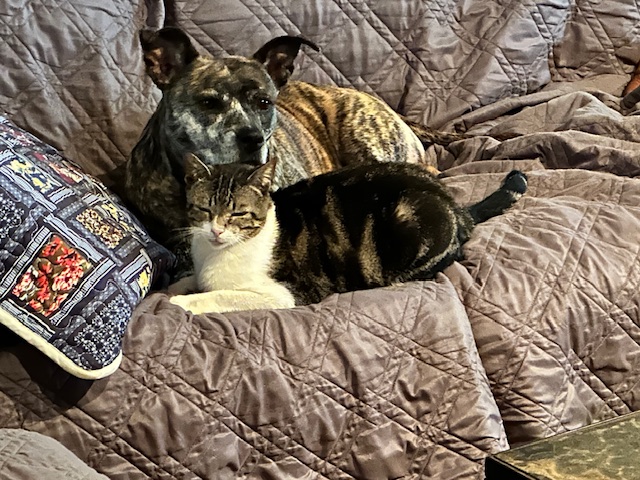
Couple of days ago, Aqaba jumped up on the bed, started head- butting Budlore under his chin. Aqaba doesn’t trust Bud one on one, but with me there, Aqaba thinks this is the time to make friends with the only dog in the house I do not trust with That Cat.
Bud growls. It’s a soft, low, nervous type growl, but I grab his right ear and hold it. Not tight, not squeezing the ear, but just to let you know Bud, I have your ear. The meanings are a duality of sorts, because Bud knows what I am saying, which would be: Threaten the cat, and this ear is going to hurt.
Bud’s body language, which is everything in canine speak, relaxes, just a bit. Bud doesn’t like the cat, but he isn’t willing to start a fight. I’m mildly surprised, but I also know something about this ear. With a thumb and two fingers, I can pet both ears at the same time, behind Bud’s head, and he likes this a lot. Aqaba is still headbutting Bud’s chin, but the ears.
Bud starts going limp, puts his chin on his paws, and Aqaba moves on.
There is peace, perhaps an enforced peace, but it is what it is. Bud is alone in his dislike for That Cat, and he is fully aware of this. He will get no backup from Jech. Wrex won’t help him on the best days. Bud doesn’t like the math of going against all I want all alone. He does like both ears petted.
I do not think I have ever worked this hard, this long, to convince a Hickory Head Pack things have to be a certain way. Of course, Bertrand was the original heart dog, the best dog of all best dogs, and Lucas came along towards the end of Bert’s reign. After they were gone, only Wrex really reached deep inside, and now he’s aging, too.
I do not think I have ever an a dog work as hard to fit into the pack the way Aqaba Thomas Firesmith has. It’s stunning the amount of effort he’s put into making friends with the dogs, and doing the things I’ve tried to get him to do. Like every dog I’ve pulled out of the woods or out of a ditch, or taken out of a bad home, Aqaba has an overwhelming sense of gratitude. Mauled and starving, I was his last best chance of merely staying alive for a few more days. Aqaba has made the most of the time he’s been given. More people should think about this.
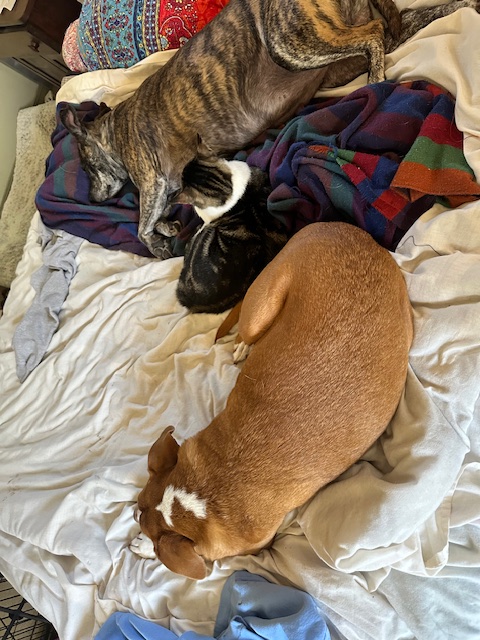
I have a lot of respect for the way this cat has taken to his new home. He seems focused, driven almost, to make this his place in the world. I’ve done everything I can think of to help him. Lilith and Wrex joined in instantly, and even Jessica Elizabeth (Come here!) has joined the new pack.
Oh Dear Dog, the help I have been given by so many Cat People, and Dog knows I’ve needed it, too.
And thus, a new Hickory Head Pack is forged. That Cat in the Pack.
A moment arrives in your life as a writer when you realize writing, editing, sitting and staring at the last sentence, wondering when the next will arrive, all of it, is beginning to thrive.
Ex nihilo nihil fit.
The bad news and writers stash bad news away for scenes in writing, is to write well is to practice, and to practice means to take the time required to write, and that means there’s time you’re writing when other things are not being done.
In 1994, I called in sick one day to write. It was cold outside, and I had an idea for writing. I spent the entire day banging away at the story. By the time the sun had set, I realized the writing wasn’t that good, and I had blown off work for a day. Then I realized writing was eating away at my spare time.
The answer to this question of whether it was a worthwhile endeavor was to try to write better. That’s been the answer ever since that day. I want to write better. It’s costing me time and opportunities, relationships with people, housekeeping, okay, never mind about the housekeeping, but if I am going to do this and spend as much time as I do, I want to be better.
Someone asked me where the ideas come from or where the story is born. I get that question from people who do not create but never from someone who does. If your heart and soul is in tune with the Universe at large to be creative, inspiration never leaves you, and it never stops.
Those who claim Writer’s Block may be tired or may not be able to discern the signal, but they are not blocked. It arrives with each beat of the heart, loud and strong, and the creative person has only to listen.
There are ten million, five hundred seventeen thousand, six hundred and forty-two reasons not to create, given to you by the outside world every moment of your day. There is only one reason to do it; it feeds your soul. It defines your humanity. It is who you are.
I have dreams about familiar places and houses that only exist in dreams. The people there are dream folk, appearing only in certain dreamscapes, never cross-pollinating in the night, and this is the way it has always been. But fatigue lessens clarity, and I have only flashes of the space and time of the dream. I awake a few hours before the dogs, and I listen.
Lilith Anne snores, old and fading; her body is like an ancient engine, still running, with fuel and will, but her time on earth can not be long, and she will not suffer. Wrex Wyatt is in the chair curled up, breathing deeply, easily, and strongly. Near my left leg, a small, soft, warm spot is silent in the darkness. But the night is not still.
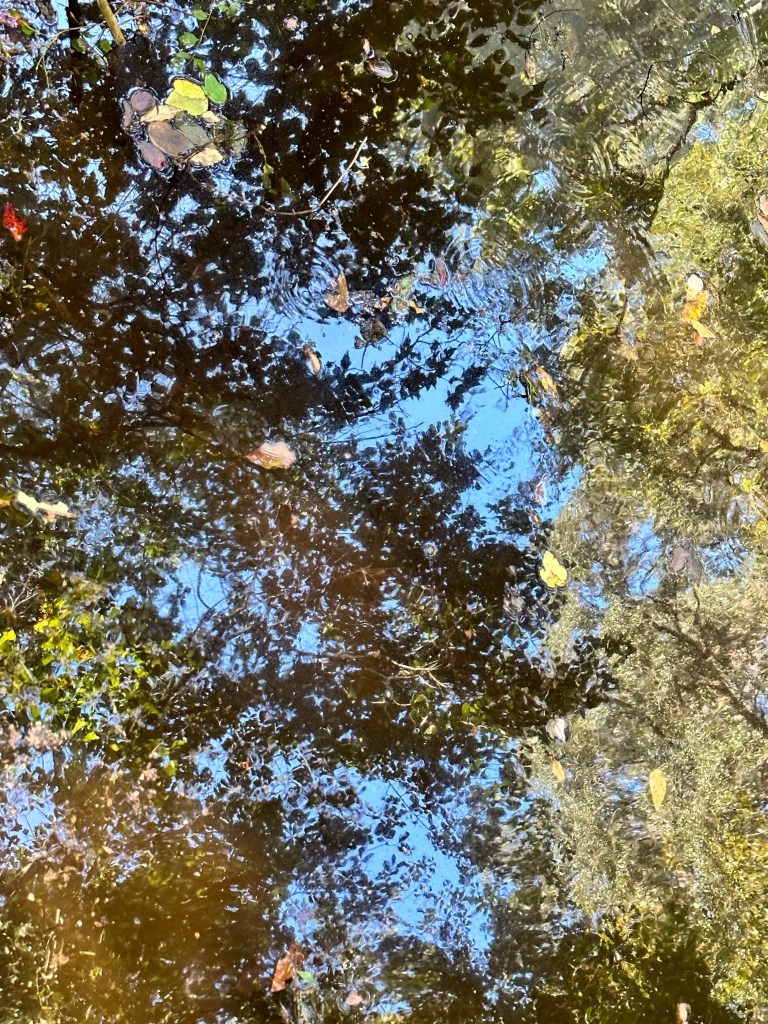
Coyotes begin their yammering, the sounds echoing through the woods, skating across the pond, skipping from lily pad to lily pad, snaking around the ground quickly, whipping and winding around every tree trunk, and this awakens Wrex. But just as suddenly, the noise stops, Wrex puts his head down, and he sleeps again.
The warm spot near my leg moves up and towards my face silently until the purr begins, loud, rumbling down through the mattress of the bed and up again. Was it a coyote who almost killed Aqaba? There is real fear in his body language. I pull his body to mine and put an arm around his tiny body. The purring grows louder.
The rain has pushed the pond deep into the woods, flooding the trail entirely on the east side and isolating the path to and from the house. Coyotes are creatures of paranoia and surety and would not come into an area so closed and narrow now. Budlore Amadeus is large enough to be proof against one and loud enough to stand down more. No, too many dog teeth, too much barking, too much to lose and little to gain, accountants in their pack point their noses elsewhere.
But Aqaba Thomas pushes closer to me, his purrs strong and his volume up. Is this the first time in his life there has been true safety? Is this his primary experience with a guardian, inside a home, and comfort? The purring eases away, and the pack sleeps again.
I swore off burning a few years ago, and things went well. I composted much of the limbs and stuff, so burning seemed a waste of material. But things begin to pile up. Storms blew down some larger limbs, I had three trees too close to the house taken down, I cut them up and added all of this to the firepit.
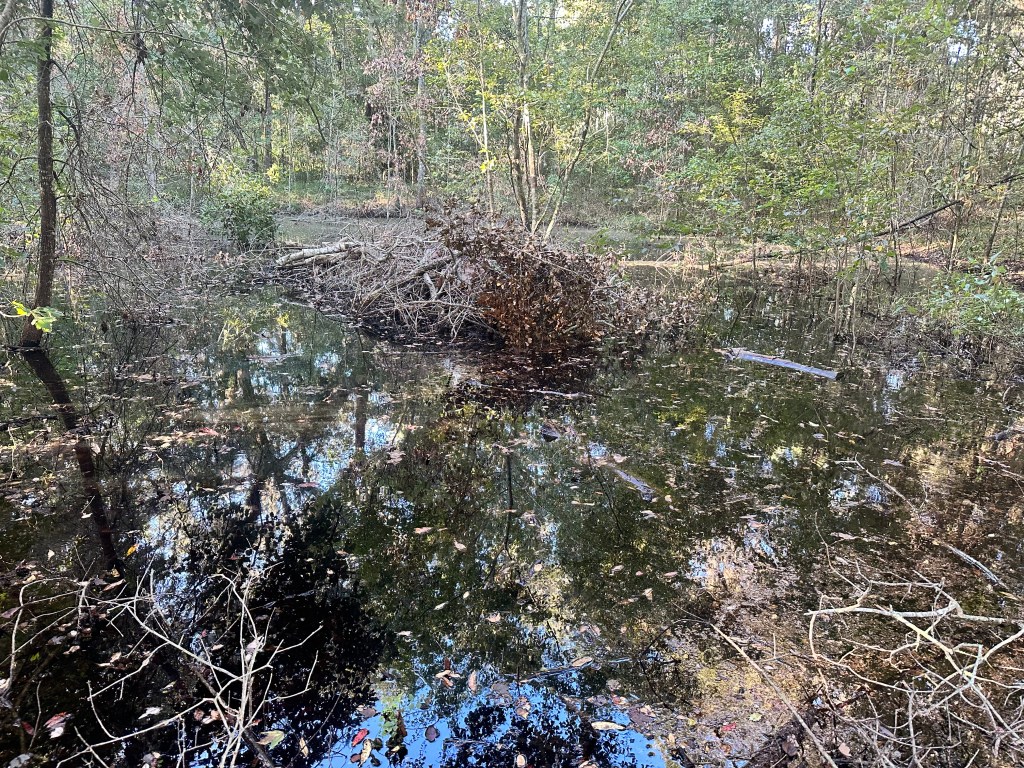
In the meantime, it rained and rained and rained. The firepit became an island. Then it rained some more.
And then the hurricane hit.
Room for limbs, branches, and tree debris has run out, but the firepit is flooded, and I mean over knee-deep in water.
It’s not like I can start a fire on a pile of stuff that’s surrounded by water, can I?
It’s the Equinox. I want to build a fire.
I need to build a fire.
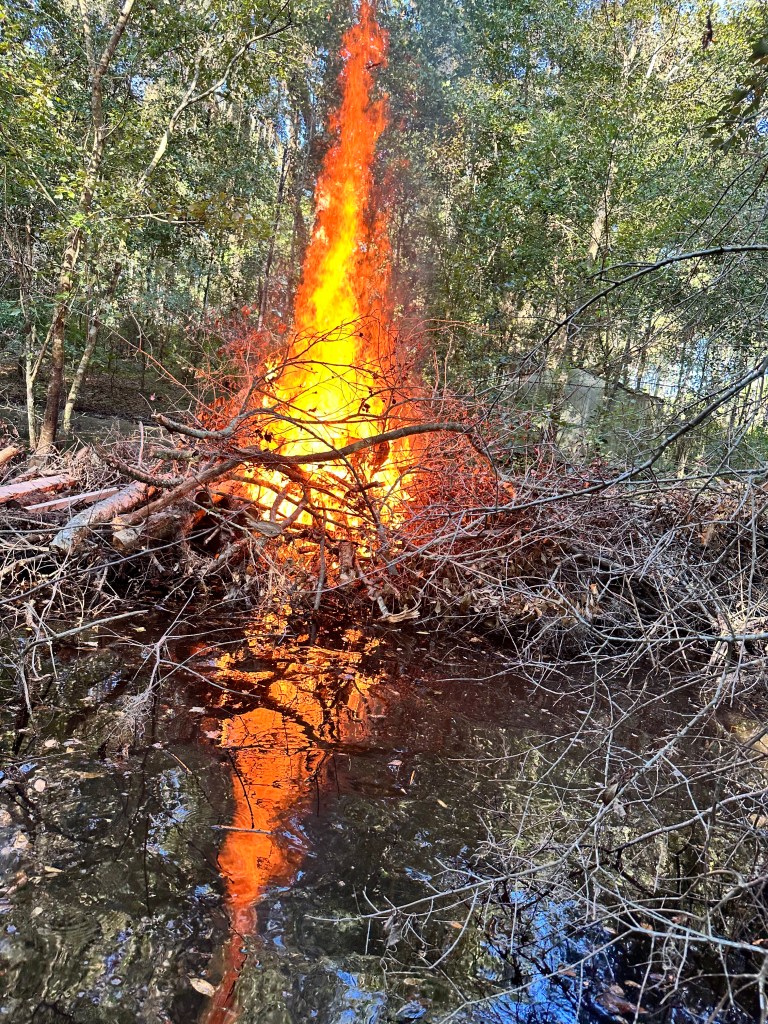
Here’s the firepit. Water, water, everywhere. And it’s deep. Right there in front of the pile, there’s a drop off and the water is waist deep. Hmmm, but approached from the side, it’s only a bit over knee deep or so.
Here’s the issue: This pile is fine where it is, but I have a yard full of stuff. Wading out to the island to add more stuff is going to be no fun, and if I can’t burn it, that means when the water goes away, the pile will resemble a nuclear bomb going off when it burns. The trees around this area are my primary concern. I don’t want them harmed by a giant fire. If I can burn enough new stuff, and enough old stuff on the Island of Branches, that’s best case. But can I even get a fire started out there on the island?
Okay, I got the fire going. How much can I do with it? I have to carry the branches over my head to get them into the fire. But the fire has awaken my inner Firesmith. I feel a yearn, a yearn to burn.
Laborious, is the word of the day. Grab a branch, hold it over my head, wade out to the pile, try to toss it in at the best point, wade back out, rinse and repeat. But I figured out the path in and out, shuffle instead of trying to lift my feet too high, and go slow. The fire goes better than expected. I really though the embers would fall through into the water, but there’s enough fuel in the pile, and it has been compressed tight enough, the fire build up enough heat to feed. And feed it does. The third or fourth trip it I see some of the larger pieces of wood burning brightly. I can feel the heat. This is working. More fuel, please.
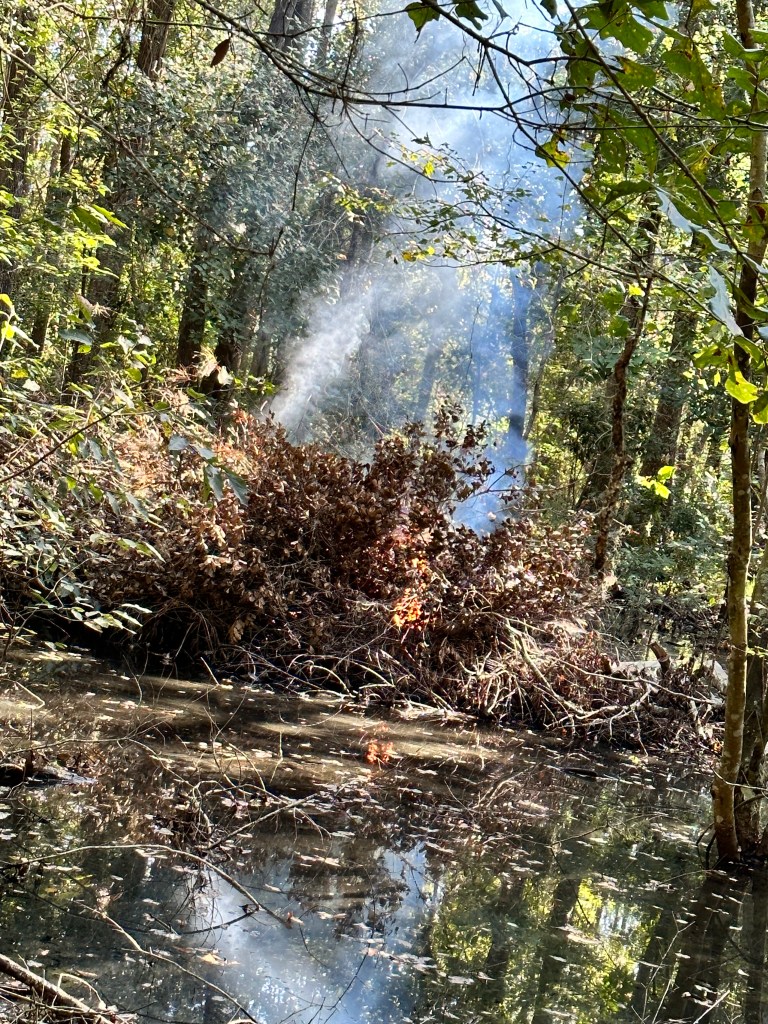
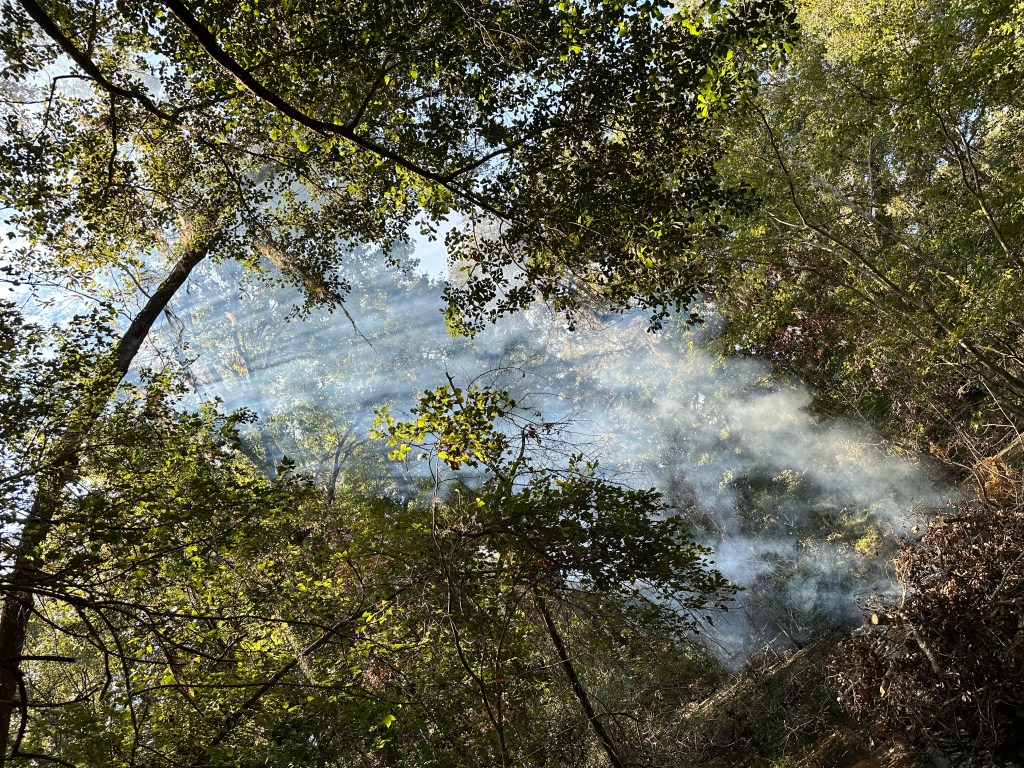
After an hour or so, I take a break and move around for some photos. The fire is building up and it’s time to stop. I can feel fatigue setting in. The trip back and forth through the water is wearing me out. But it feels good to get rid of two different piles of stuff, and dent the old pile, too.
Finally, it was time to stop. But I welcomed the Equinox in a manner befitting the change of season, reduced the piles considerable, and had a lot of fun playing with water and fire. This is the type of thing I would have loved as a kid, and love it still, I do. How many of you have stood in thigh deep water and felt the heat of a fire you built on an Island of Branches?
How many of you remember wanting to do things like this before you became an adult?
Note: Four hours later, this thing is still smoking.
You either can or you won’t. That’s the story, isn’t it? When you’re doom scrolling on social media, could you be writing? Writing is waiting while you watch some video of a half-naked twenty-year-old who is doing Yoga poses you won’t see me in unless I get hit by a log truck while I’m in a Volkswagen Beetle.
Hopefully, you will not see that anytime soon.
But you could be writing. A video game entertains you idly, and by idly, I mean it’s not your creativity behind the storyline, scenery, or characters. It’s not the same as getting down to the soul of someone only you can bring forth into existence.
You have a scene in mind. It’s nagging at you to do something with it. Why wait? Why wait to see if it functions? Mary is walking down the dirty sidewalk, stepping over used condoms and plastic whiskey bottles. A puddle of puke spreads out from a man passed out, face down, and she keeps walking.
Mary is going somewhere, doing something, but what? Who is she? What does she look like? What timeline is this? London in 1888?
See how easy that was? In the space of a paragraph, we have an idea of a woman with a destination and scenery.
Mary looks up at the numbers on the building and hesitates. This is a hovel house where men with money rent women who need it. The building looks reputable in front, with a barber shop, shave and a haircut for a few pennies, and a shoeblack works out front. But the main draw for the men are the women who work inside the building, who enter by the back entrance. Mary has been given the address by a woman who sets up these meetings. Mary must keep the appointment if she wants another, but this is the first. She’s never sold her body before.
And here we go. Now we know it’s London, back in the late 1800s, and we know Mary is young. We have to go back and change the way the story began to wooden walkways and get rid of the plastic bottle, but the feel of the scenery will be the same, won’t it?
2.0 let’s go! Mary is walking down the dirty wooden walk, stepping over apple cores and chicken bones tossed from the upper floors of a tavern. Puke spreads out from a man passed out, face down in the muddy street, and she keeps walking.
Unless Mary is heading into unknown territory here, we know she’s a denizen of the poorer sections of town. Then we add the next part, but what does Mary look like at this point? How do we find out in a time when Mary doesn’t take a selfie?
Walking into the back door of the Hovel House, the woman who hired her waits, “It’s you then? I gots to make sure the new ones show. He likes fair hair and fair skin from what he tells, and your eyes are pretty enough blue. If’n he messes you up some it’s paid extra unless you need a nurse. Ain’t you eati’n regular, missy? You need some meat on your bone other than what the men put on ya. Up the stairs, second floor, stay off the lift, go to room seven on the right, get undressed and in bed and wait for him’n to show. Don’t say nothing less you asked and act like you like it, right?” the woman hands Mary a key and walks away.
Dialogue is an interesting tool, no? In the space of a short paragraph, the unnamed, unformed, and temporary character describes much about what is going on. Twainesque, the dialogue also demotes Mary to uneducated, poverty-ridden, second-class citizens not allowed to use the elevator. A little dialect goes a long way unless you write superbly, and I’m not there yet.
As a side note, in the wildly popular television series, “The Walking Dead,” characters would be introduced speaking in dialect, yet after the first two sentences, switch over to more standard speech. The story’s writers dialect slows the story down.
Now Mary is walking down a long hallway, the key clenched in her fist. She’s never sold herself and wonders if it will hurt or if the man will be cruel. Will he demand she do things she does not know how to do? Fear slowly builds into terror, her thoughts cycling through faster and faster.
She gets undressed, gets into the bed, admires the clean sheets, soft pillow, and warm room. She hopes the man doesn’t keep the appointment, and she can nap here. But he arrives on time, says hello absently, and takes his clothes off. Mary lies still, terrified, yet unable to resist as he climbs on top of her. Seconds later, it seems, he gets up, dresses, and leaves without a word. Mary is lying in the bed, wondering if that’s it, and gets up, cleans herself off, picks up the coins he’s left on the table near the door and leaves.
And here we go. The scene of the man leaving, without speaking, without so much as looking at Mary, leaving a few coins on the table, can be pivotal. Mary has gone from a frightened young woman to one who has survived her first encounter with the oldest profession in the world. How does she feel? How has Mary changed from undressing to when she puts her clothes back on? The money is more than she would make in three days in the sweatshops, and here it is, a few moments later. Yet Mary has sold herself to a stranger. How does she feel now?
You sit idly and say you cannot write, but look at this. We’ve wandered through how writing comes together from thought, introduced three characters, maybe four if you count the puking man, and set up a lot of future conflicts.
You can, but you won’t. Is that what you are still saying?
Stephen King wrote a book, “On Writing,” that describes his journey from a creative kid to a struggling artist, to a force to be reckoned with, to an addict, to who he is today. In the book, he dismisses Writer’s Block as a copout, which I agree with. In the film“The Devil’s Advocate,” Al Pacino’s character asks a young lawyer of his skills, “I know you’re good, but can you summon it at will?”
Oddly, this writing was about something, and it turned into something else. I started two days ago, and at a little past five in the morning, on Hump Day, it’s finally getting here.
Initially, I reflected briefly on “The Man in the Iron Well,” which has been a work in progress for a while, but I feel the end is near. I’ve completed it once, going into a rewrite, and it feels good.
The story begins with a man catching his wife in bed with her lover; a gun fires, and the lover dies. It’s an accident, but no one will believe how it happened, so they must hide the body, and in doing so, a murder is born. Tension between the two simmers, but they have to rely on one another. Inserted into all of this is a brilliant and most evil creature, so they also have her to deal with. And, of course, this being in the present day, issues arise, the fallout from being suspected of a crime in the digital age.
But all the two have to do is dodge a murder charge.
I was working on this during the blackout caused by the hurricane. I rewrote two sections, was happy with the work, and thought to myself, “You’re doing good if you can work under these conditions.
Then yesterday, I went to the library to write during lunch, and a woman came in. The library is a beautiful, sprawling education center full of open spaces. Yet this woman had on so much perfume I was choking fifty feet away. Two young women at a table began coughing. I had to bail out.
Hubris, the thought I could write under any conditions at any time, catches up with me. No writer is as good as they hope. No writer is as bad as they fear. We simply are what we are, with whatever we are doing, and if it comes to something, then it is good, and if it only teaches us to write better, that is also enough.









 The Hickory Head Hermit