Flowers in the Attic. A Book Review

A girl who was a couple of years younger than I was reading “Flowers in the Attic,” by V.C. Andrews when I was in high school, back in 1979. I asked her what it was about and without hesitation she said, “Evil.”

People read more back then. Young people read a lot more. I never picked the book up but always wondered why she would have that reaction. Last week, I finally ordered the book from Amazon and sat down with it. I finished it last night, reading far past my bedtime, and putting it down only after I finished. I miss that.

The story begins with a happy family of four, an older boy, his sister, and twins, a boy and a girl.

The mother takes the kids to her mother and father’s home (no, I will not tell you why) and the children have to hide from their grandfather (I won’t tell you why, stop it) and so begins the story of the children living upstairs and in the attic.

Told from the older girl’s point of view, the reader follows what happens, mentally and physically to the children as they are promised they have to hide for only a day, to only a few more days, and finally, seasons change.

Nearly the entire novel is centered in one room and the attic. Nearly four hundred pages are written about four people in two rooms. Andrews pulls this off deftly.

To call this a horror story isn’t accurate. To describe it as a coming of age book is obscene. To say there is joy to be found in the book isn’t precise, yet with all that happens to the characters, they do survive, in a manner of speaking.

Will the book leave you with a warm fuzzy feeling?

No.

Will the reader put the book down and be happy about having read the book?

Also no.

Is there any redeeming value in the story at all?

I think so. But not in any sense most people aware exists. Survival at any cost is a dangerous path for a writer. How close to the edge are you willing to drag the reader? How far is too far? How much is too much?

You get to decide that as a writer, and a reader.

Take Care,

Mike
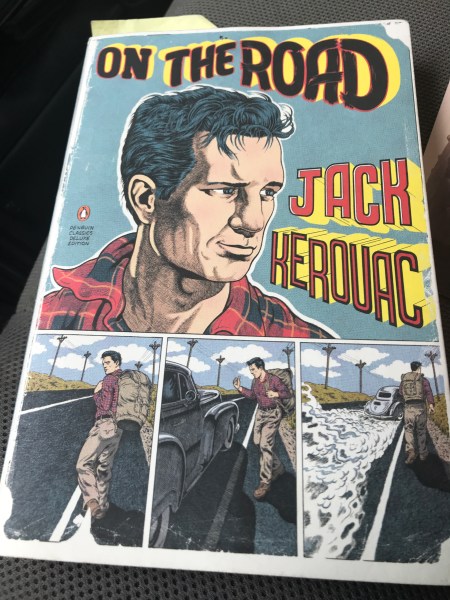
On The Road: A Book Review

Jack Kerouac’s “On The Road” is widely considered one of the seminal pieces of work on the Beat Generation, and I finally got around to reading the book. It’s a fictionalized account of his cris-cross country travels with a friend of his, Dean, who was Neal Cassady, in reality. Several of the characters in the book are based on real people, but Neal Cassady seems to be the main character.

First off, there’s parts of the book which are wildly vivid in the descriptions of people and landscapes, and moods, but there are also vast passages spent on describing personal poverty, theft, grifting, and the idea there is a counter to that day’s culture. Yet at the same time, as much as Kerouac would like to present a world outside the white picket fences and nine to five jobs that normal people have, he and his could not exist without living off these people to a great extent.


Yet there is something here, a warning we did not heed, and Kerouac’s voice ricochets from one coast to another, describing a nation that is changing its identity and losing its soul. This was all occurring after World War II, in 1947 or so, with the people of the country more prosperous, yet somewhat adrift. The war that defined them is now behind them. What to do next?


Sal, the character that is the narrator and Kerouac’s voice, takes off with Neal Cassady and bounces around the country, philosophizing and drinking hard. There’s sex and drugs and jazz, and I wonder what would have been written in a day where Kerouac’s sexuality would have been more widely accepted.


At the end of the day here, I have to reread this book. I have to tap back into the spirit of the writer, because this is a very well written book, and remember this was a piece created before I was born. The language is different, but not alien. The cultural references are obscure, but not unknown to me, dig? The life of wild drinking and untethered sex, long before HIV or any of the other scary sexually transmitted diseases is a long lost dream. The Golden Age of Jazz began right in front of their eyes, and you have to wonder if anything like that will ever happen again, in any form.


In another twist, despite their lives of bouncing around, staggering about from one side of an continent to the other, Kerouac manages to write. He gets published. And he takes enough notes to produce a cohesive work that leaves me mystified. I yearn for a life spent wild and free, but at the end of the book, Sal and Dean part ways, and Sal leaves that life behind.


“On The Road” isn’t a book written for the mainstream or even those near the edge. It’s a book written for those of us who have slept in bus stations and under overpasses, for those of us who have set foot on the road with no means of getting to one place to another, but bent of traveling anyway, and we always made our destinations.


Take Care,

Mike