I take a lot of photos. There’s very rarely a day that goes by a dozen or so shots aren’t taken. Sometimes, there’s many more than that. Why I do this is to better understand the tool with which I work. I learn from shooting, and I try to apply what I have learned to better use the cell phone’s camera.
I do get “lucky” shots, where moments are caught in time, rare photos of nature or the sky, where something unusual happens.
No one, anywhere, at any time in human history, was ever good at anything worth doing because they were lucky, or they had the right equipment.
They’re good because they spend a lot of time doing it and they work at it.
Sometimes, you can spend a lot of time doing something, and work at it, and still not be that good. But if you like what you do it is still worth it.
When the shelling started every man ran for his life, ran for his foxhole, ran for a bunker if he could make it. Some were caught in the open, torn apart, vaporized if one of the eighteen inch guns hit them, merely shredded if a smaller caliber shell landed close. Some lost legs, arms, and screamed as they lay waiting for the next barrage to finish them. Sometimes help would arrive, a buddy would rush out from safety, and sometimes he was killed, too. But the wounded might get dragged into a hole and bleed out.
Our ships arrived. The battle raged from noon until past dark, when the flashes of light from the guns, and the orange colored comets passing in the sky passed back and forth, the shells either landing in water, never to be seen, or hitting their target in an awful sound, and fire. More ships joined in, and then suddenly it seemed the burning vessels, flashes of light, the sound of thunder from the guns, was all there was, or would be. Exhaustion took me, after being awake for three days straight, I slept.
The next morning brought a gray sky, overcast, and dark. Bodies lay where they landed, pieces of men were scattered kindling for the next battle, hatred gripped us all, and the constant fear. The sea spat out survivors in rafts, ours, theirs, burned men who only spoke the language of agony waved blackened limbs at us, and begged for death. Bodies floated in masses, platoons of dead, face down, or staring eyeless at the heavens. Dozens, in pairs, one at a time, but the tide brought them in, and I wondered how many more had gone down inside burning ships, or drifted out into the endless sea.
The radios were silent. Not our signals, not theirs, not a sound except the sea, and the wounded. We ran out of morphine quickly, and then, there was nothing but pain, and screaming. No planes flew overhead, no silhouettes of fear or hope on the horizon. Nothing but the heat and the gray skies, and the sounds of the men whose bodies demanded some relief.
We buried men in the sand with the bulldozer until the fuel ran out, and then we buried men with shovels until we were too tired. Then we burned bodies until the smell was too much. Finally, exhausted and hungry, we sat and waited. For what, and how long, we did not know. Nothing was left to do, no one left to kill, and waiting to die seemed to be better than anything else possible.
We sighted ships a week later. Our ships? Their ships? We could not tell and could not care. As they drew near the earth itself rolled, pitched, and heaved as if trying to vomit the dead from their graves. Bunkers collapsed, trees, what few were left, toppled, and we lay in the sand as if it were a solid sea of waves.
As the ships drew closer and closer, we saw something else, too. A white line on the horizon behind them, at first small, then larger and larger. The ships turned, tried to outrun the wave, but they saw it too late. One by one we watched them flipped, overturned, or plain submerged outright as the water grew higher and higher and higher. Men ran, screamed, prayed, cried, but I sat on the beach and watched. The water retreated, was sucked away from the island for half a mile. Our antiship defenses lay open to the gray sky, the last time they would be.
The wave came rushing, one hundred feet high, and I sat, waited, and made no sound.
“Get them moving, Mike, we can’t wait,” the man tells me. He’s right and I know it, but it’s hard to convince people just to drop what they have in their hands, what they have pushed in a baby carriage or a wheelbarrow, or however they got it here, just to drop it and go.
It’s like looking at the world’s biggest yard sale, with items from their homes, things they remember, things they’ve owned since they were children and now, they have to move fast, and leave it all behind.
“It’s my grammy,” a woman sobs, “she raised me, this photo is all I have left of her, there’s room for a photo, come on, it’s not that big.”
“Nothing,” I tell her, and keep walking as she wails. It hurts doing this, but we have to go, and there’s no time left.
“Look, look,” a man paws at me holding up a golden figurine, “I’ll split the money with you, this is an antique, it’s worth a lot, I’ll give you half.”
“Drop it, and keep moving, drop it and keep moving,” that’s my mantra.
“I can take Gary?” the little boy asks me, and children are the worst, and when their parents aren’t around its heart wrenching. He’s holding up a fuzzy stuffed animal.
“No, you have to keep moving, there’s no room,” I tell him and he drops his head, tears falling.
“You don’t have to be this way about it, they’re confused, lost, they have no idea what’s going to happen,” a woman snarls at me.
“And you do?” I ask, pausing for just a moment.
“I, uh, I made my peace with it,” but she suddenly falters, looks scared.
“The job is yours if you think you can do it,” I tell her, and I keep moving. She’s pretty, and in another time, I would talk to her, but now it’s over, and the end is near for all of them. We’re pushing them forward, tears, questions, anger, resentment, but behind there is nothing left at all.
Then it is over. I sigh. Looking back, to the horizon are suitcases, photos, beloved items that mean nothing and are worth nothing to anyone who still lives.
“More coming in a few seconds, Mike, get them moving.”
The last few nights I’ve had dreams populated by people who do not exist in real life, and dreamscapes which are a hybrid of the dreamworld and reality. The setting for one was Quitman, Georgia, the downtown area, but where there is a convenience store, in the dream was a wooden building, old and sturdily built, which housed a hardware store.
I didn’t go inside, but outside, a window that had been boarded up, and bars installed, had a live snake visible and its pattern changed so it was either a rat snake or a water snake. A young man was standing there talking to me, and I knew he worked for the store. A woman appeared, she was thirty something and scantily dressed, but neither she nor the boy were afraid of the snake. Suddenly, the window was full of snakes, rat snakes now, and the boy picked one up and offered to sell it to me. The woman also began to pitch her wares, and it took me a minute to realize what she was trying to do.
The boy began talking to a woman who was slightly afraid of snakes, and the scantily clad woman leaned over with a leer and whispered, “What makes you think I’m not a whore?”
Today is the birthday of Roy Orbison born in Vernon, Texas, back in 1936. Vernon Texas is close to the Oklahoma state line, and in the late 1970’s, one of the electrical companies in Texas executed “The Midnight Connection”. Federal law states if an electrical company has connections from one state to another, the entire state then falls under the federal regulations. Texas electric companies didn’t want this to happen to they all made a deal not to connect to other states.
All of this was fine until one Texas company who had holdings in Oklahoma and Louisiana decided they would sneak a connection over and bring the state under Federal oversight.
The rest of Texas was displeased. After many legal battles, Texas courts decided to keep Texas electrical systems isolated from the rest of the country.
I heard about this yesterday on NPR, and then today is Roy Orbison’s birthday, the only two events where anyone was likely to hear about Vernon, Texas.
Though older, and sometimes clunky, my body still functions the way I want it to, mostly. The stump in the ground is coming out slowly, like a tooth being pulled, yet the main roots have been cut, and now, excavation begins. This is a siege, not a rapid assault, and days will pass, perhaps many of them, before the stump is headed to the compost pile. Then there are three more.
Heat is settling in, like a watchful demon, whose breath is humidity, and whose purpose is spite. Sweat pours out of a body like blood from an open wound, and the mosquitoes, the imps of the Demon Heat, come to accept unwilling donations.
Yet I have no intention of using brute force, for levers and strategic pries of wedges will do more good than trying to butt heads with the stump. This is a process, as most things that involve humans will be.
The sun comes rushing around again, another week is born from the ashes of a weekend, and the stump awaits. What will I learn from it, today, I wonder?
I added ten square meters to the garden this year. Slowly but surely, the lawn mower is being retooled as a small tractor, and a harvester of compost materials. I once had the better part of an acre to mow out here, and now it’s down to less than a quarter of that size.
The biggest area is that I simply let go back to the wild. It’s full of weeds and small trees now, in its second year of being left alone. In five years or so, trees will begin their ascension to the sky, and their shade will remove any vestige of the sparse grass that rarely grew well there.
The compost pile is beginning to churn now. Days are longer, sunlight is more, heat builds deep inside the mound of vegetation, and the process that takes plants and produces soil continues. Even on the coldest days I can dig down into the mound, turn it so the process has its oxygen, and find warmth, steaming, smelling of rich nutrients and life, still doing what it has always done and will always do.
Inside this compost pile is a metropolis of nature, a bustling city of production and tight living, with predators and prey, yet with each and every creature contributing to the size and function of the place they all call home. Plants arrive, coffee grounds, leaves from the yard, grass clippings, and cow manure are the infrastructure. Water from the drip hoses seeps in and the sun provides heat. Microbes break down the vegetation, their waste is a big part of the soil, and earthworms move in as well. Tiny creatures burrow into the compost, to keep warm, to feed, and to breed. Toads, frogs, centipedes, and a host of predators come to the buffet. Birds and snakes arrive as well. The water from the drip hose draws in the thirsty.
One morning I was turning the pile, keeping the moisture level even throughout, bringing oxygen into the depths, making sure everything was getting all it needed, when I noticed the toads hopping around. At first, I thought the trio might be displaced, and fleeing in panic, but they we running to, not from. As I turned the compost, insects, termites, bugs, all matter of toad food was on the move, and the toads were there for the feast.
All year long, in the cold and dark months, in the bright and busy months, the process of life churns. The compost I didn’t put into the garden is the basis, the fuel, of this year’s compost creation. Moisture, warmth, and oxygen turns plants into compost. This happens when I am awake and tending to the pile, and it happens when I sleep. It’s happening now, in the darkness and chill, as I write about it. The City of Decay never sleeps.
A handful of my compost reveals all. How much moisture, how far has it broken down leaves and grass, what does it smell like, what are the pieces I can see, and tell what is, what does it feel like against flesh, and somehow, I know this is good soil. My plants will grow. There will be vegetables to eat, and their vines and bushes will return to the Earth again, and again, and again.
The dream began in a forest, tall evergreens, the wind in their crowns sounding like a waterfall, white clouds racing overhead, the blue sky visible in patches not covered by dark green or vivid white. The trees parted to a meadow, with the wind rushing over the ground now, pushing the heather to and fro, forcing bees and butterflies away from their tasks.
A large gap in the meadow appeared, it hadn’t been there a second ago, like a dry lake. The bottom was white sand, fallen logs rested here and there, and I wondered what this was, and how it came to be. I stepped into the depression and felt an odd sensation and realized the lake was filled, but the water was invisible. Not clear, or pristine looking, no, it was there but not. The sensation of wetness was not cool, or warm, but simply wet, like light sweat unnoticed on your skin. I stepped forward, not feeling anything, yet with a vague feeling of pressure. I cupped my hand, dipped it into where I thought the surface might be, and felt something, a sensation of nothingness, as if I could feel the air in my hand. There was no taste as I put my lips to the liquid, and in my mouth, it felt as if something was there, like the tiniest weight. I swallowed and felt less than nothing.
I stepped forward, and fell.
The liquid was thinner than water, lighter than air, so I didn’t float. Nothing filled my lungs. It wasn’t like drowning but more like trying to breathe thin air, yet the sensation was of liquid, too. I flailed, didn’t swim, then turned and walked out of the deep nothingness.
I could breathe. Air filled my lungs again, and when I coughed hard, something but nothing came out. The sky was still perfectly blue, the clouds were brilliant white, and the wind felt cool against my skin. I felt the liquid leave the surface of my skin as if it were all a connected, single organism returning to its home.
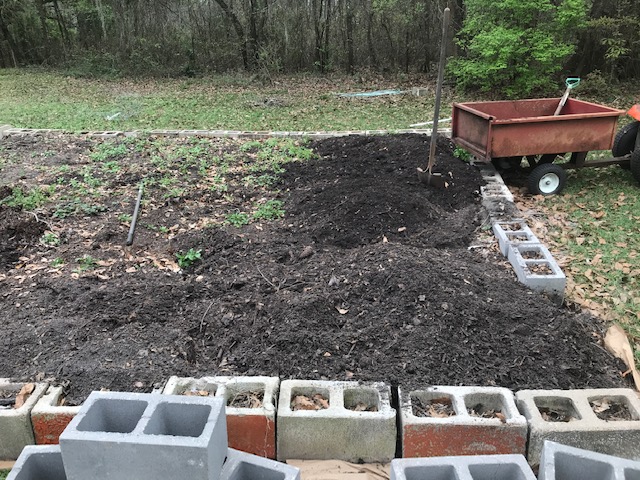
I am happy. The last couple of days working on the garden has produced a harvest of good emotions and achieved goals. Soil from the Compost Complex has been hauled to the garden, and it’s as good as I might have hoped. Deep dark, black, moisture holding, organic dirt, made entirely of eggshells, banana peels, apple cores, vegetable kitchen waste, yard clippings, and leaves. It’s beautiful. And I had enough to fill the expanded spaces in the garden.
The expanded space is just another ten meters square, but now I know I can produce that much compost, and still have enough left over to kick off next year’s expansion. What I am doing, the way I am doing it, is working the way I want it to work.
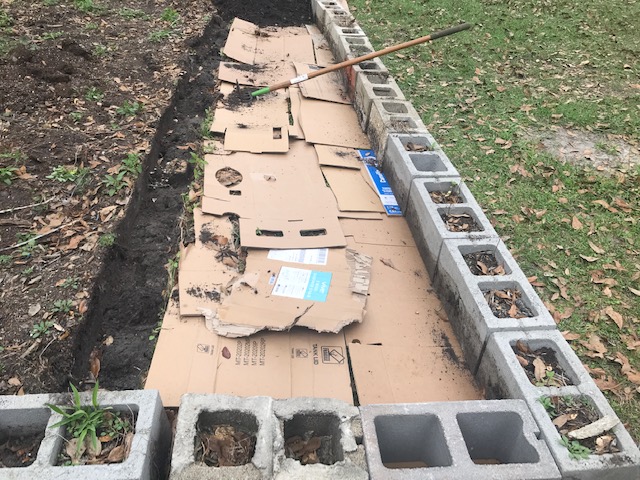
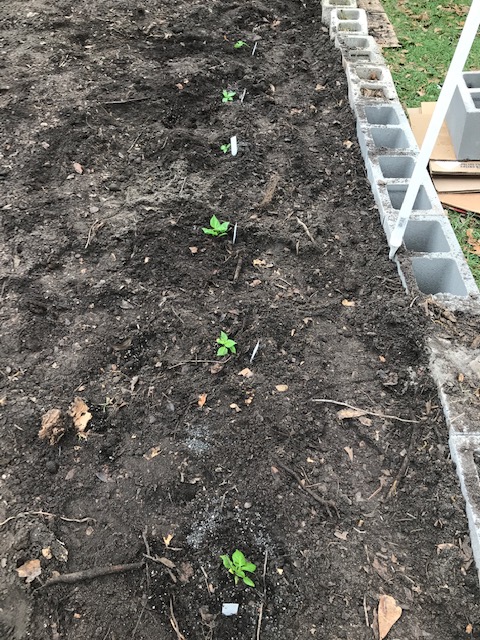
Someone recommended using cardboard under the compost to kill the grass I extended over, and this is my first time trying it. I raided a dollar stores dumpster for enough cardboard, and removed all the plastic tape from the sides. The cinder block border went on top of this cardboard, and then I fill the new spaces with compost, hauling load after load with my garden wagon.
The surface of the garden is still a little lumpy, but raking will even it out, and next year’s crop of compost will add another couple of inches to the whole garden, or at least that is the plan right now. That’s next year, however, and I still have this growing season to provide me with work enough.
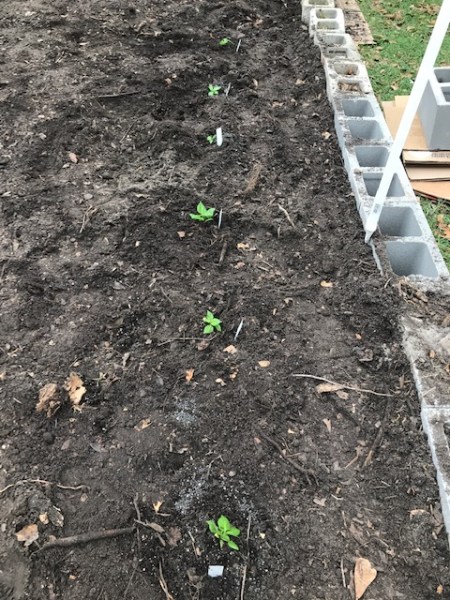
Foolishly, perhaps, I planted six pepper plants. Three Carolina Reapers, and three Georgia Flames. They are my experiment, and maybe my sacrifices, to the Gods of Weather. Have I planted too early? We will see. There is something primal, elemental, and entirely human about digging in the earth with your hands, taking a young plant and carefully placing it into the ground, and creating a new home for it. My soul yearns for these moments of beginning nearly as much as harvest, for in planting we say we believe in the future, we believe we will do well, we believe the Weather Gods, the insects, the random armadillos, squirrels and rabbits, will not defeat us. We are promising the young plants we will water, feed, weed, and love. We are promising ourselves that we will care, from now until harvest, and beyond.
Tomatoes, yes. Always tomatoes. Forever, tomatoes. Large and small, vines and plants, yes. Squash, for mom, perhaps grown vertically this year, for I think it will work. Okra, for soup, yes, and hot peppers. Zinnias for the pollinators, and because I like them. Mom’s mother, my grandma, grew Zinnias, and I will, too. Marigolds to frighten pests away, a fence with a charger, new irrigation, and then one day planting will be done and tending will begin anew.
There is much to be done, even now, preparing the old part of the garden for the new season, raking and leveling and digging out sticks and old stems, but that is work for tomorrow, or the next day. The heavy lifting is done, the new garden ready, baptized in sweat.
Today, friends will come over and share a meal, and food must be prepared. I must clean my nails for there is dirt there, and I must rest a bit, too. But from now until there is frost again, and the plants return to the earth, I will walk in the garden, pull weeds, and watch over the dirt, and all the grows in it.
The dream was one of fear and anxiety. I know the road we were using as an escape route but can’t place it yet. Behind us, things. Monsters? Madmen? Zombies? No, not zombies, but something pursues us.
Go into the woods, some in our small party suggested.
No, distance is the key, move fast and far. Perhaps find help. If we hide they can surround is, cut off escape.
You’re not in charge.
Do what you want.
The party gets smaller as a half dozen or so people flee into the woods.
We push hard, walking fast, the road open and clear, straight as a drawn line in front of us. Behind us nothing, nothing to be seen. But I want a curve to hide us. One of the party is man who starts limping. He’s young, strong, but stepped between two rocks and broke his ankle a month ago. Panting, he looks behind us. Nothing. Ahead of us, nothing. He decides to hit the woods. We lose another.
At a bridge a dying stream staggers though weeds and broken concrete under the bridge, and disappears into the trees. We rest, eat snacks, drink bottled water, and take stock. We have little. By the time the sun disappears and darkness hunts us, we will have nothing.
We hear a scream. We all bolt as one now, people tossing away what little they were carrying. The slowest runner has been given a death sentence, cries for help, but no one stops. I look back. The bridge seems impossibly close for us to have run so fast. The woman who gave out first is looking back, too. She turns and looks at me.
Thanks for coming back, she says, and she crying. We’re dead. Be both know it.
We’ll go into the woods, follow the creek, and hope they go after the group.
Okay.
The bramble slows us too much. It’s too thick. The woman is exhausted.
“Leave me, I can’t keep up.”
“It’s too late.”
We can see the road, see things passing quickly. None of them stop to look for us.
We hear screams. Then nothing. We sit in terror, neither of us speaking. The woman cries softly.
Darkness comes, and it is complete. Sounds of something crashing through the woods. The woman bolts, screams.
I wake up.
Right now, as I write, I miss her, and I hope she made it.
Gee, Mike, write this out, and save her!
It doesn’t work like that. I write what is, not what I want to be.


 The Hickory Head Hermit