All You Need to Know About the COVID-19 Response You Can Learn in Traffic

I worked in traffic for over twenty-seven years for the Georgia Department of Transportation. There were many times in my career where I had a lot of be proud of, with the bridges and roads that I helped build. There were times I was nearly hurt, seriously, because of traffic, and usually it was because someone behind the wheel of a car or truck wasn’t paying attention, or was speeding, or was drunk.

2018 was my last full year with the department, and 2017 was the last year I spent most of my time in harm’s way, and on I-75 at that. Night work on I-75 was enough to convince me that getting out while the getting was good might just save my life.


Traffic is different these days. People are more determined not to yield the right of way, not to surrender what they consider “their” lane, and they’re more distracted. People have gotten more aggressive, and they’ve gotten a lot more rude. They’ve become dangerously infected with the idea things on the road have to be the way they think they should be, at all costs, and that cost is paid by people like me, and the men and women under my management. In good conscious, I could not tell new people it was worth the risk, because I stopped believing it was. The traveling public became too dangerous to work with anymore.


Social media has created the idea that all opinions have real worth, and that worth has to be defended. People have become aggressive about what they believe, and it’s gotten dangerous in many ways. Drivers believe what they read online, and they believe it’s important enough to be engaged online while driving on the Interstate at speeds that can kill in an instant. That’s reality. What someone says that you either agree with or disagree with isn’t worth your life.


It sure as hell isn’t worth mine.


In the last few years, I’ve witnessed more people blocking traffic by positioning themselves to the left, and behind a slower vehicle on four lane roads. They’ll let other people get clogged up in traffic, back up a dozen cars, and they’ll maneuver so no one can get past them. This is new to me. I’ve never seen it until a few years ago, and to pull something like that on the Interstate is insane. But it speaks to the idea that someone wants to be in control of other people, other people must fall in line with that drive thinks is funny, or give that person power or purpose, I have no idea. I do know it is exceedingly dangerous.


Sometimes, on social media, I wonder if some people actually have a point, or an idea, or if they’re just getting in the way of other people because it’s their idea of fun. I asked for a recommendation on FB and got a half a dozen people who tossed out stuff that had nothing to do with what I asked. It wasn’t mean, or malicious, but it was a knee jerk reaction to get in the way because they could.


I think social media asks that we respond. We can be creative, or obstructionist, or we can even be angry. But we are trained to respond, not think, or consider, or even simply read and move on.


Those emoji buttons aren’t there to express thoughts but to give us some way to respond, and feel like we have made some sort of contribution, like screaming at a character in a television show.


When Covid-19 began to creep into the American consciousness, I assumed this would play out like it did in 1919. People would do the right things for the right reasons, and eventually, we would come out on the other side, more united, and stronger. But the dialog was driven by politics, and there were far too many people who say the plague, and the response to it, as political. The deaths and suffering of those who were infected, their families, and those who might succumb to the disease were not relevant. Any action, no matter how small or how large, was met with screaming and hostility, because it wasn’t about life and death, it was about politics, personal or national. It was about opinion and what was repeated in the echo chamber of social media posts. People became even more dangerous to other people than they had been in traffic, and for the very same reasons.


Americans have become a splintered collection of self-centered, selfish, uneducated, ignorant, self-righteous and highly opinionated self contained media centers that puke out whatever each of them feels best about, once they hear that two hundred and whatever many characters that can be tossed out in less than twenty seconds of typing.


The elderly and the children be damned. Social media is the new family now, and it is driven by nothing more complicated than a chicken pecking at a button that delivers a snack.


Over the last three years or so, I’ve watched people I thought I knew, and thought I respected, become seething bodies of hatred and mistrust, believing conspiracy theories that are downright laughable. These people will attack in mass, and viciously, anyone who dares ask them to cite a source, or to produce an honest source for what they preach.


The reaction to the plague, how people drive, and how they treat other people has become a nearly religious event. The right to a lane, the right to an opinion, and the right to treat people poorly is given to them by the Gods of social media, the support of like minded responders, and the never ending belief that if it can be repeated often enough, it must be true.


Can we honestly be surprised the Nazis are back? This is their playbook. People are recruiting themselves for the most assertive groups out there and what they actually stand for is totally and utterly irrelevant because it’s the response mechanism, not the philosophy, that counts these days.


And it’s getting people killed.


Take Care,

Mike


Christianity Is Dead

Screen Shot 2020-07-02 at 5.04.08 PM


Once upon a time, in a land called Amerika . . .


It was a wild gamble, and one with consequences that were easily foreseeable. Back in the 1980’s a sudden shift in the political winds saw the Republican party actively courting Evangelic Christians. It was a ploy, a false woo, but the rewards offered were, seemingly, great for both sides. The politicians would get votes, and the Evangelics would have men in office, very rarely women, who would change the laws of the land to more reflect the values of those who voted in God’s name, Amen.


Abortion was the hot button issue. It didn’t matter, at all, that there were far greater issues facing the country. The Republicans farmed this issue, they mined it like it was gold, and it paid off, even though they never delivered on their promise to end abortion. They truly didn’t want to, because the Republicans believed in the sanctity of life, unless it was their sixteen year old daughter, or their mistress, who needed to get rid of a pregnancy. But to stand up in front of a crowd and call abortion murder was a sure way to get elected. And bring in money.


Republicans took a hit, and a pretty severe hit, when they became the party who opposed gay rights. Their efforts to criminalize sexual orientation backfired, and the Evangelics should have seen the future in this issue, but they did not. They should have realized that mixing politics and religion was an anathema to both the Constitution, and the free will of Christians, but they were blinded by the power their candidates held, and there were seduced by the amount of money that could be raised.


Power corrupts.


Once the Christian Church in America began to act as a Political Action Committee for the Republican Party, they left the path of righteousness. Instead of following the teachings of Christ, they began to following the whims of the men who used them like blind whores, offering change in abortions laws, and opposing gay marriage but emptying the coffers of the churches. Feeding the poor, clothing the needy, taking care of children, healing the sick, and all of the other actions of Jesus Christ were set aside in the name of doing the bidding of the Republican Party.


became the religion of those who sought personal wealth and power. Mega Churches sucked the tithes from the followers, and billionaires began to pop up in the pulpits. They preached against humanitarian actions in favor of political fervor.

Churches changed to media centers, replete with wide screen televisions, surround sound speakers, wifi, ATM’s in the lobby, Starbucks in the parking lot, and at some churches, pledges were taken from church members to donate a certain amount each month, to keep the parking lots paved, the air conditioners running at 65 degrees, and to keep the private jets in the heavens.


But Prosperity Christianity failed many people for many reasons. It failed the poor, it failed people of color, it failed the gay community, it failed anyone who didn’t speak English well, and it fail to address the hunger for a religion that fed the soul, not the bank accounts of the men who ran the churches.


When Trump was elected, it was a sign, a bright orange neon sign, that Christianity could be whored out for nothing more than the promise of oppressing of minorities, banning abortion, and setting the world right again, for theocracy. Trump enriched corporations and gutted environmental laws, trampled on the rights of anyone not white and male, and in the middle of a peaceful protest, he gassed people so he could stand in front of a church, a bible raised, both upside down, and backwards, for a photo op.


But even before Trump, people were leaving the church. People began responding “Spiritual not religious” to polls and surveys. Paganism began a comeback, with the promise of a more ecologically friendly, and earth based belief system. Trump’s high jacking of faith has had a scorched earth effect on the Evangelics. His crassness, his lies, his lack of a moral compass, and his disregard for civility has driven decent people away from the churches who advocated for his election.


I told you this would happen. I told you in the 1980’s that the separation of church and state protected both sided from one another. I said, many years ago, that once religion and politics mixed, it was like stirring manure with cookie dough. No matter how little is in the mix, it still ruins the end product. But now, there is more manure than cookie dough, and there is no way to get it back out again; there are far too many people in the church selling those cookies. And far too many people buying them.


Christianity as most of us once knew it, is dead. In its place is convenience store religion, something that is a little more expensive, but it doesn’t require much time, and there isn’t an expectation in the quality of the product. It’s a cheap plastic Jesus on the dashboard. It’s McDonald’s for the soul. It’s bad for the environment, for families, for the poor, for the downtrodden, and basically, anyone who once believed in the Redeemer.


Take Care,

Mike

The “Problem” With Black People

Screen Shot 2020-06-19 at 2.52.01 PM

The first kidnapped people held as slaves arrived in North America in 1619. Slavery remained legal until 1865.

That’s two hundred forty-six years. We Americans gained our independence from England in 1776, which was two hundred forty-four years ago.


Black people were slaves longer than America has existed.


During the time black people were held in chains, working for no wage at all, there were many American, that’s white people, families who created wealth for their descendants. Some of those families can trace the wealth they hold today back to the times their ancestors used slaves to gain their riches.

During that 246 years, black people, who were not considered citizens, were not allowed to create great works of arts,  or write epic volumes of literature, they were not allowed works of art, could not invent world changing machines, did not have the ways and means to discover new medicines, and they certainly did not have a voice in their government, as to how they should be treated. They were not allowed to do any of these things. And if they had, their kidnappers would have taken the credit for any and all of it.


A vast, terrible, and unfillable void exists in their history, where there is only misery, depravation, and suffering without end.


In 1865, slavery was outlawed after a lot of rich white people talked many more poor whites to wage war to keep slaves. Some slave owners were given compensation for losing their property. Slaves were given nothing. Worse, it had been illegal to educate slaves, so any employment they might possibly get, would not pay much more than being a slave.  Even worse, there was a system called “Peonage” where black people in general, and black men in particular, could be arrested for any imagined offense, and made to work for free for anyone who the sheriff allowed. This went on until the second world war, and ended, more or less, about 1940.


Along with Jim Crow laws, lynching, and a host of other laws enacted by white led governments, black people spent 75 years not only with nearly no representation in their government, but they also had little or no means to gain enough wealth to leave to their children, who would grow up with the deck stacked against them, and have little to leave to their own children.


After World War II, there was still very little access to education, legally enforced segregation, and still nearly no black people as lawmakers, judges, business owners, college students, teachers, and certainly none who had any chance to leave very much at all to the next generation.


During the sixties, the Federal government began loaning money to white people so they could buy houses, and these loans were insured, so if the white person who took out the loan fell upon hard times, at worst, they would receive some sort of equity for their investments. This same program did not ensure the loans of black people. This meant if they missed one payment on their home, they would lose everything they had paid into that house.


Meanwhile, the number of people, and in this case, people means white people, going to college was rising. White families, who had homes that raised their ability to obtain credit, could afford to send their children to schools, and this increased their ability to make money, which was handed down to the next generation.


At no point, from the time the first black person was dragged off a ship and began a lifetime of forced labor, were black people given the same opportunities as white people. At no time were black people free to make their own destinies without interference from the laws white people created to keep black people from being truly free.


This has led to black people living in poverty at rates far exceeding those that white people have seen. This has led to rampant drug use among the poor communities, alcoholism, single parent homes, and an incredible about of mental stress suffered by an entire race of people whose only sin was being born black.


When Richard Nixon was president, he engineered the “War on Drugs” and the sole purpose of that legislation was to punish black people for being black. This began a system of mass incarceration of black men, which is still an epidemic today. White people who commit the same crimes as black people are jailed at a rate of about ten percent as those black people suffer.


Today, a white person posted on Facebook his long and incredibly ignorant opinion on why black communities are poorer, why black students score lower on tests, why so many black people are in jail, and why it seems like black people simply do not live as well as white people do.

What I have written, what you have read, are the facts. This is all readily available for anyone who wants to do the research.


If you want to know why black people are not as successful as white people, generally speaking, you have only to go into your bathroom and look in the mirror. Even if you’ve never done one thing in your whole life to hurt anyone, you’ve still supported and lived within a system with mechanisms in place whose sole purpose is to keep black people from owning homes, from living in certain areas, from becoming educated, and to make sure if there is half a chance, to put them in prison.


That is the entire problem in America today. If you want to know why all of this is happening, now you do know.


Take Care,

Mike

Heat and Light


If you work in a factory making widgets then in eight hours you’ll have some amount of whatever you’re making to put into boxes and ship off to China, or wherever they’re sold. If you mow grass for a living then you can look at a lawn and be satisfied you’ve beheaded enough blades to earn your pay. A highway worker can pave a road and see the results, and be happy the road is smooth.

But writing means nothing more and nothing less than throwing dice where the pips are obscure, and the wager unknown. A day’s worth of writing might mean you merely discovered what part of the plot does not work at all. A finished piece of work may hold no one’s interest. A novel a writer devoted a lifetime into finishing may not sell at all, not one copy, except friends and family, who are just happy it’s over and done with.


Accept this. Live it. Take your work, print it out, and burn it, for the heat and light from the flames might be the only useful thing all your devotion to the Muse ever produces.


Then realize it doesn’t matter if it’s never loved or appreciated, or printed, or sold, or even seen by another living soul.


And get back to writing.


Heat and Light.

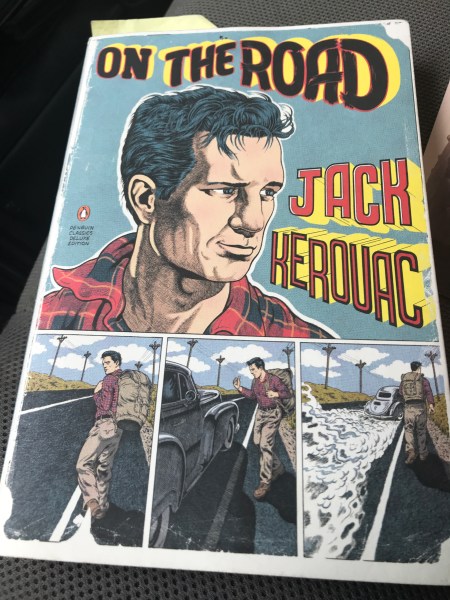
On The Road: A Book Review

Jack Kerouac’s “On The Road” is widely considered one of the seminal pieces of work on the Beat Generation, and I finally got around to reading the book. It’s a fictionalized account of his cris-cross country travels with a friend of his, Dean, who was Neal Cassady, in reality. Several of the characters in the book are based on real people, but Neal Cassady seems to be the main character.

First off, there’s parts of the book which are wildly vivid in the descriptions of people and landscapes, and moods, but there are also vast passages spent on describing personal poverty, theft, grifting, and the idea there is a counter to that day’s culture. Yet at the same time, as much as Kerouac would like to present a world outside the white picket fences and nine to five jobs that normal people have, he and his could not exist without living off these people to a great extent.


Yet there is something here, a warning we did not heed, and Kerouac’s voice ricochets from one coast to another, describing a nation that is changing its identity and losing its soul. This was all occurring after World War II, in 1947 or so, with the people of the country more prosperous, yet somewhat adrift. The war that defined them is now behind them. What to do next?


Sal, the character that is the narrator and Kerouac’s voice, takes off with Neal Cassady and bounces around the country, philosophizing and drinking hard. There’s sex and drugs and jazz, and I wonder what would have been written in a day where Kerouac’s sexuality would have been more widely accepted.


At the end of the day here, I have to reread this book. I have to tap back into the spirit of the writer, because this is a very well written book, and remember this was a piece created before I was born. The language is different, but not alien. The cultural references are obscure, but not unknown to me, dig? The life of wild drinking and untethered sex, long before HIV or any of the other scary sexually transmitted diseases is a long lost dream. The Golden Age of Jazz began right in front of their eyes, and you have to wonder if anything like that will ever happen again, in any form.


In another twist, despite their lives of bouncing around, staggering about from one side of an continent to the other, Kerouac manages to write. He gets published. And he takes enough notes to produce a cohesive work that leaves me mystified. I yearn for a life spent wild and free, but at the end of the book, Sal and Dean part ways, and Sal leaves that life behind.


“On The Road” isn’t a book written for the mainstream or even those near the edge. It’s a book written for those of us who have slept in bus stations and under overpasses, for those of us who have set foot on the road with no means of getting to one place to another, but bent of traveling anyway, and we always made our destinations.


Take Care,

Mike


Why Black Lives Do Not Matter

Screen Shot 2020-06-04 at 9.49.48 AM

If you don’t think racism in America began with slavery you either haven’t read much history, or you’re in total denial there is a problem. Black people were chosen as slaves because it would be impossible for them to hide among the native populations, which was being systematically destroyed, and it would be impossible for them to pretend they were part of the colonial people, most of which were oppressed financially, too. 

Slaves, and slavery, were symbols that people with money could own, control, whip, beat, torture, and use for their profit or amusement, other people. People without money saw this sort of behavior as something to aspire for in their own misery, that they too might one day be good enough to treat other people like this. This is the very soul of racism. This is it. Look at it. 

Racism in America is a form of elitism. It’s always been a way to show off how good you are as an American. Hate equals success. 

From the very beginning of this country, slaves were used not in the name of convenience or for needed works, but for profit. If we have learned nothing about capitalism, we have learned there is no concern higher than profit; not human life, not the health of the planet, not the welfare of the seas, and not even the air we breathe. So the lives of slaves were never a concern. Slaves equaled black people. From the very beginning, black lives did not matter. 

When this country separated from England, in violence and anger, freedom and liberty for all didn’t mean women could vote, and it did not break the chains of slavery. They could have, our Founding Father might have taken that step forward, but the profit made from the lives of people kept in chains and abject poverty did not matter. 

Seventy years later, when most northern states had abolished the practice, the southern states withdrew from the union rather than free the slaves. For the next five years a nation tore itself apart, with one side fighting to its very ruin rather than using waged labor and fair working practices to produce an income. This was more than mere predatory capitalism, oh no, in this the very heart of extreme racism began to beat, and beat very loudly. 

For the next one hundred years, black people were not allowed to vote, even in places where it might have been legal. There were separate schools, separate hospitals, separate waiting room, bathroom, drinking fountains, rail cars, housing, restaurants, movie theaters, and no black person would dare sit next to a white person anywhere, but especially the south. 

Separate but equal became the battle cry of the racist government and the racist citizens of America. 

In theory, things changed in the 1960’s. Martin Luther King’s campaign for equal right did much to elevate the rights of people of color, and there was more acceptance of black people in society. Overt signs of racism all but disappeared. Yet America was still very much a segregated society. White churches were white, and black churches were white. White neighborhoods were white, and “there’s goes the neighborhood” was the refrain when someone not white moved in next door. 

Still, the country crept forward. There were black men and black women as astronauts and judges, and even a man of color as President of the United States. This should have been cause for celebration, and it was, but it also revealed a society that was deeply divided, and that divide was fuel in the worst form of hatred that America ever called its own. 

It is no surprise, and certainly not a shock, that after the first President who was not white, came a demagogue, a person dedicated both to his own personal wealth and to division. A man who would stoop as low as he could, or thought possible, preached the gospel of division and hate, filled social media with insults, name calling, and race baiting. The dog whistle was music to the ears of the racists, who finally had one of their own in the White House. 

Racism did not die, it was not killed, but it became camouflaged. Fuel by encouragement from the highest office, who claimed some Neo Nazis were very fine people, a war against people of color that began in Jamestown, and continued for every year since, was fueled by the thought that America would be made white again. The same president that decried brown immigrants as animals and an infestation would certainly look the other way as people of color were murdered by rouge cops, who knew their actions would go unreported, and unchecked. 

Black lives do not matter because of the race baiting president in the White House, who uses race to divide, so there will be no unified people to fight against his policies of looting the taxpayers to enrich big business. 

Black lives do not matter because there is profit in having a class of oppressed people who are willing to work for minimum wage, or worse, infinitely worse, cannot defend themselves against mass incarceration for profit. 

Black lives do not matter because there is money to be made off their misery, just like there was in 1850, just like in 1950, and just like in 2020. 

Don’t hashtag “BlackLivesMatter” on social media, and then sit content with that as the total sum of your worth to a people who desperately need your help. 

The arrest of the four cops who murdered George Floyd is the beginning, the very first step, not the end of the race. 

Black Lives will not matter until there is a new president, and a new government, but most of all, Black Lives will not matter until the people in this country address mass incarceration, wealth inequality, opportunity and education disparity, and most of all, most desperately needed, an understanding of racism, and how it is still here. We white people have to do this. We white people have to understand our own demons, and we have to put them away, forever. 

Black Lives do not matter to white people, not yet, not nearly yet. 

But maybe we’re seeing something different now, with white people in the street, fighting, being gassed, getting hit with rubber bullets, and spilling their blood for equality. 

Get out there, White People. Get out there and fight. Get out there and say it, and mean it, and show your children, and show the candidates that you’re willing to bleed as well as talk. 

Then say “Black Lives Matter”

Because then, you’ll finally mean it, and it will finally be true, for everyone. 

Take Care,

Mike Firesmith.

Violence is the Answer

Screen Shot 2020-05-31 at 8.24.14 AM


If you don’t think violence is the answer then you haven’t been paying attention to the question. Let’s go back, shall we, to 1776. The American Colonies took up arms against the British Empire and waged a shooting war that killed tens of thousands of people. We celebrate that war. We glorify the action taken. It made us free. Well, not really all of us. There were many black people held as slaves at that time who were not free. The War for Independence was not their war.

Most of the African colonies, were brutal, savage, and profitable affairs, at least for those doing the colonization, and most of those countries became unfettered through violence. Over in India  that was an exception, mind you, and there’s lessons to be learned from how they were able to not start a war and still start a country. At the end, however, there were many Indians who were murdered by the British, yes, those same British, in order to be free. The IRA fought a guerrilla war against the British, yes, dammit, those same British, for years. Violence is a useful and convincing tool that commands attention and it has been used in the past very effectively.

The orgy of violence that occurred during the America Civil War is a very good example of how violence can be used to transform a country, yet not solve underlining problems. Before we start there, let’s step back and step away from the topic of violence, and talk about the real issue here; racism.

I’m going to stop the conversation with some fairly gory talk, and it might be something that makes you flinch, but it’s time. We’ve been taught in history classes that our Founding Fathers, Great Men All, might have owned slaves but they weren’t racists. We’re told times were different back then, and they didn’t consider black people to be fully human, and that’s the excuse for keeping blacks as slaves, because the Founding Fathers, Great Men All, were not raised to consider the possibility that someone who looked very much human, except the color of their skin, might actually be human.


But this is a lie.


If they truly believed black slaves to be nothing more and nothing less than livestock, then why weren’t slaves on the menu like all other farm animals? They Founding Fathers knew these people were human and they knew what they were doing was wrong. Using slaves, stealing people, kidnapping people, beating people to make them work, was wrong, but it was profitable, and there was no one around to try to stop them.  Seventy years later, when slavery became an issue, the people who had stolen and enslaved other people were willing to fight a war to keep their profit.


Remember this also: During the time in American history, when black people were being kidnapped and their lives, their children’s lives, and entire generations were kept as forced labor, the white Americans were systematically and very deliberately committing genocide. The native people who lived in America for thousands of years were being killed off and hunted into extinction. They didn’t eat the natives, either. At some level, they knew those people were human beings and they knew what they were doing was wrong. But the idea of free land, in the land of the free, overrode their civility.


Any argument of moral ambiguity is lost when the facts are repeated out loud. They knew what they were doing and they knew it was wrong. They just didn’t care, so people were killed and people were enslaved. They simply cared more for material goods than they did human life.


Here we are today. It’s been over one hundred fifty years since slavery has been outlawed, yet those years have been fraught with peril for people who are not white. They own less property, are less educated, have inferior health care and substandard housing, and are incarcerated in for profit prisons at a rate that staggers the mind. Black people are killed at over twice their demographic percentage than are people who are white.


Video after video after video shows unarmed black men being shot by police, and in some cases, for no good reason at all. In some cases, it is clearly murder. Yet the conviction rate for policemen who shoot black men is practically zero.


There was, and still is, a lot of White Outrage because black athletes refused to stand for the National Anthem. This White Outrage is both unfounded in reason, and based on the kneejerk Facebook type of public discourse where there has to be an immediate, and therefore thoughtless reply to everything, and it is more often than not polarizing. That’s making things worse, and it’s not addressing the real issue here, which is this: If you truly believing violence is not the answer, then why didn’t you react the way you are reacting right now, when black men were being murdered?


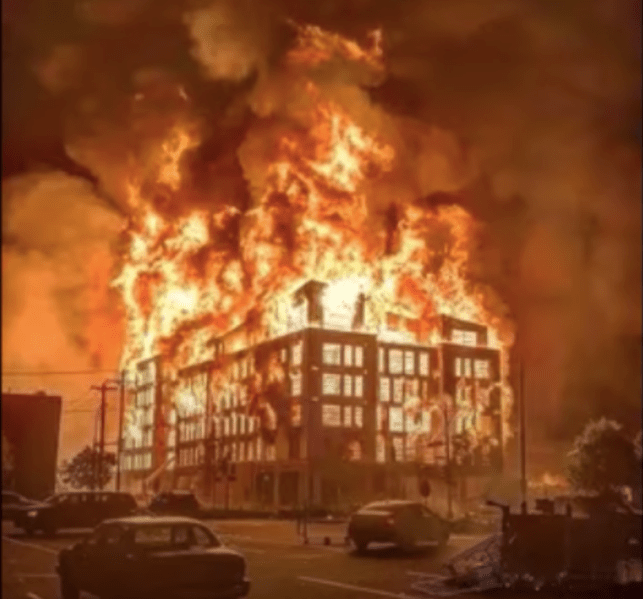
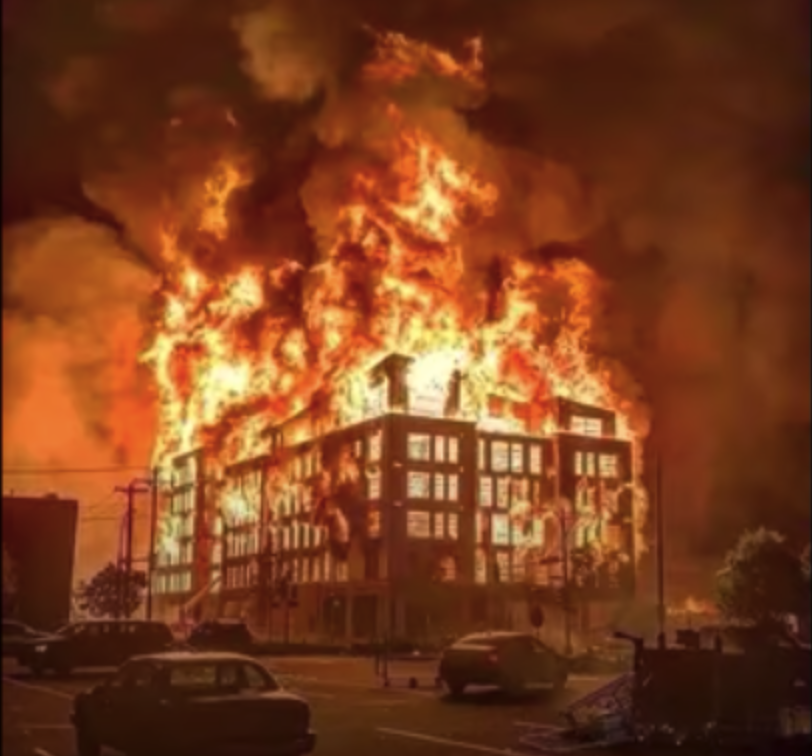
A black man gets shot right in front of you, and you don’t react but the sight of a burning building causes you to get angry? You have the same mindset as a slave owner at that point, you do realize that do you not? Property over human life, is where your emotions are. How did you get to be that type of person? Don’t you care?


The answer to this question is the same answer to the same question so many years ago, when slavers were raiding Africa and kidnapping people. The deaths of black men do not affect the average white people no more than a family being broken apart and sold to new owners affected white people in 1851. We white people are indifferent to the suffering of black men, the beating and imprisonment of black men, and the murder of black men, until we see a building being burned on videos on YouTube.


Why don’t these people give peace a chance?


You now, I hope, understand why that question might not go over well, especially with the family members of murdered black men.


What you see is what you get. White people have been silent and apathetic. They’ve secretly wondered if these black men were thieves, rapists, murderers, and the police were just doing their jobs, ma’am. We’re a divided and segregated society in our hearts and in our minds. Our souls are segregated.


What you’re seeing is civilization being stripped away. People who have longed for justice have reached the point they no longer believing it’s possible to achieve through social media and bumper stickers. What you are seeing is rage, and there is more where that came from, Brothers and Sisters.


Violence is the answer. It’s the only way to find a signal strong enough to reach people who still aren’t reacting to the incredible racial divide in America. Violence is the answer. Rioting, burning, looting, killing, and widespread destruction is the answer. It will continue to be the answer to the question: Why aren’t white people doing something about this?


When we white people get off our sofas, log off the laptop, stop binge watching Friends on our widescreens, get into our SUVs, drive down to the local protest, and get out into the streets with our fists and our voices raised, black people aren’t going to trust that violence isn’t the only thing that won’t wake us up. They aren’t going to trust that we believe in America. They aren’t going to trust we believe in liberty and justice, for all.


We can do this without violence. We can do this without hate, without death, and without destruction. No violence is not the answer, because Martin Luther King taught us it wasn’t, because Gandhi taught us is isn’t, and violence begets violence, we’re sure of that. We know better than to believe violence is going to make the world a better place because it never has, and it never, ever, will.


But as long as white people allow violence against black men, and as long as white people sit in silence when there is injustice, and as long as we care more about our convenience than we do the lives of other human beings, violence will continue.


If we white people do not speak against violence in our homes, in our churches, in the schools, and in the voting booths, until we take to the streets in peace and with our voices raised, violence is going to be the answer to our silence.


Violence is the answer to the question, “Why is it the white people do not care?”


Search your hearts, white people, for the answer to that question. And if you believe, truly believe, that you do care, get out there, get out there right now, be surrounded by black people in a protest and tell them you believe, and trust me, you’ll be welcomed. They need you, they want you there, and nothing will make the protestors happier than to see what Martin Luther King could only dream about: people together making a difference. Without violence.


I’m asking you to care. That’s the answer to violence. It’s what will shut it down.


Mike Firesmith

Sleep? Where!?!?!???

clock

Sleep has abandoned me, as it is wont to do, and even as I write this I wonder how many times I’ve sat down next to the bed to write instead of sleeping. It was a burden, to write late at night, when I worked for a living, but retirement brings a sort of timelessness to the day which allows writing without the feeling of regret late in the work day. To write or to work? To write or to sleep? To write or do mow the yard, or go out and socialize. There doesn’t seem to be an unclear choice, for as much work as writing might be, it’s less work than the world outside the human mind, no?

The blender is on tonight. There’s no clear image or scene in my head, nothing coherent, and the imagine of a story, new or old, is blank. This doesn’t mean I can’t write or there isn’t anything at all there, but there’s no sign of a plot, or a storyline. There’s a question in my mind in regard to a character, if I should make her evil, or even more evil, or create her in the image of someone who is as evil as she has to be in order to survive.

Feel like helping? Reba married Seth Johnson, the youngest Johnson son, and yes, there was this idea she married for money and security. She was older than he; she was twenty-three, and he only twenty, but times were desperate. Monsters stalked the human race, nearly to extinction, and the survivors in small county in South Georgia banded together, and formed a camp. They fought off the monsters, survived a coup attempt by the Johnson family, mainly because Reba’s husband had been killed, and she left the family for the second in command of the camp, and warned him of the Johnson’s plans. The Johnson’s are executed, and the camp survives. The fields produce crops, the monsters are vanquished, and life, while hard, is pretty good.

The issue that pops us is everyone knows the Johnson family had their own place for a while. And everyone knows the Johnson’s used slave labor. A few people at the new camp came in with the Johnson’s, but they were locals who simply quit and walked away. There were rumors, persistent rumors, the Johnson’s kidnapped people who came in from out of town, people stranded by the monsters, who were worked until they killed by monsters or starved to death. The locals weren’t treated well at all, but they did survive the experience, and they never saw any of the atrocities that may have, or may have not, went on earlier.

A few months after the execution of the Johnson family, a group of survivors are rescued from a camp in Tallahassee some fifty miles away. They’re nearly starved, dirty, and they were held in their camp as prisoners and slaves. Five of them, four women and one man, are escapees from the Johnson place, from the previous year. They all tell the same story: Reba was one of the people holding them at gunpoint.

What does management do, if anything?


If someone showed up and had evidence that a camp member was a murderer, would there be consequences?

You’d have to read the entire story to get a real feel for who is who and how people feel about a lot of things, but at the same time, it’s an interesting subject once existing government, and therefore existing laws, disappear. In a camp with just one hundred people, theft would be nonexistent because everyone would know what belonged to who. And after all, what would be a prized possession in a world where there would be so much just lying around?


Take away property crimes, and what’s left is people who would be punished for not working, or getting drunk while on the job. Maybe a fight here and there over a woman’s attention, and that’s where the pressure would really lie. A married couple in the camp has a wife who wants to leave her husband for another man, and the husband doesn’t want her to go. Who grants divorce? On what terms?


I invented a character named Daisy Cutter, who before everything ended, was a prostitute. In a camp where there are fewer women than men, does management allow Daisy to stay in business? Can they stop her? And what if she’s carrying some nasty little virus that’s permanent and spreadable?


And in the early days of the camp, when food is scarce, work is very hard, and life is exceedingly dangerous, what’s to be done with those too old, or too infirm to work? For the people who are running the camp, those who vote on how much food is allotted to which task and what punishment is handed down for infractions, once a decision is made on a subject, let’s say what to do with someone who is physically unable to work, then precedence takes hold. What to do with someone who is severely injured on the job? What to do with someone who is caught faking an injury?


But let’s get down to a personal level here. If Reba in the current time, was in a relationship with a man, and he discovered she helped keep people as slaves, how would he react to this news, if she admitted she did? Would this forever mark her as some sort of criminal, even if management of the camp didn’t punish her? How would her partner feel if he discovered this after Reba became pregnant?


We have it easy in our world, mostly. I think that might change sooner than later, but at the same time, it’s not like we live in Syria, or in a place where food is scarce or there’s impending doom, or a virus infecting everyone. Again, that may change, and if it does, I’m not likely to be any more prepared than anyone else. But who knows? Maybe if interdimensional creatures appear and begin wiping out the human race, I’ll be ready.


Take Care,

Mikeclock

Four-Thirty AM

It’s just after four in the morning and for reasons unknown, sleep has abandoned me. Tis an odd thing, night is, for I can hear the sound of a car, or a truck, out there in the dark, tires whining on the road, and it’s not a noise that is always heard. The acoustics here differ from season to season, temperature to temperature, raining to dry, so it’s not just the very real and very human ability to ignore or to tune out. The pitch of the sound gets higher as the car, or truck, gets closer, then it fades away, someone heading towards Quitman, or perhaps they’ll be home before then. Good to be home at this time of day, or at least somewhere you want to be.

She’s still bothers me, that young woman. She’s still stuck in my mind, still hanging around, and as of yet I haven’t had a chance to put her to fiction. She’s still too real, too immediate, and still unknown. It was 2009, and I was working nights on the Interstate. The shifts were ten hours, at a minimum, and sometimes a lot longer. A four month project had morphed into an eight month project, and the summer nights were getting longer. I was tired, more tired than I realized I could be, but I was driving home, at last, and now, sitting here, I wonder if that night someone heard my truck, and wondered where I was going. I lived twenty-five miles from the office where my truck had to be parked, and that morning, close to the time it is right now, just three and a half miles from home, there was a car in the middle of the road.

Deer wander out into the road, and they get hit by cars, and it’s usually catastrophic for both animal and vehicle. The deer are usually killed, if they’re lucky, and this one was very dead. Its body lay open in the night, steaming in the cooler air, eyes wide open in horror, and the front end of the car looked as bad. But the driver was a young woman. In a different light, she might have been pretty, or cute, or attractive in some way. There was no reason for her not to be, except her eyes. There was something about the way she looked at me, looked at the deer, or maybe she carried something inside that gave her that looked; wide eyed, intense, yet at the same time, there was something else there, rage, wrath, an anger, something I still cannot define, meth maybe, or maybe something else that I’ve never run into.

“You have to get me to Tallahassee,” she said. Those were the first words she spoke, and in my younger days, I might have done it, just to see what would happen. But after a ten hour shift on the interstate, I wasn’t looking for crazy. I told her I would call 911 for her.

“You fucking asshole,” she screams at me, the sound incredibly loud in the night. And pulls her hair back with both hands, stalks back to the car, and then back to me again.

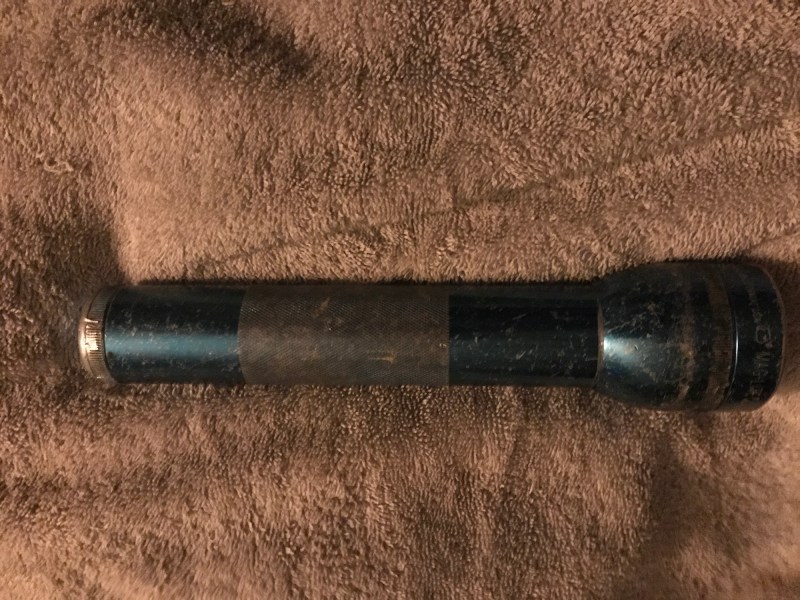
See the flashlight in the photo? It’s like a relic from a different age now, long, large, steel casing, and heavy. Four D cell batteries, like no one uses anymore, add even more mass, and there’s a reason cops once carried these, other than illumination; they make great clubs. Whatever she was on, what she might have been, or whatever she intended, I was pretty sure hitting her in the face with that flashlight would keep her off of me. Think about it. Here’s man who only wants to go home and get some rest, if not sleep. He stops to help a young woman. She’s all strung out or possessed. Suddenly, a man who has never hit a woman in his entire life, is thinking this might be the one chick that does something so weird he’s entering the realm of physical violence with her.

“That close enough,” I tell her, and she stops, and looks at me, as if she just noticed I was there.

“You can tow my car to Tallahassee,” the woman says. Her accent isn’t right. She isn’t Southern, but I can’t nail it down.

“Not about to, ma’am, but I’ll give you a ride into Quitman, or I’ll call 911,” I tell her, but there is no way in hell she’s getting into my truck.

“I’ll pay you when we get there,” and this is a demand, not a request. She’s restless, pacing, tossing her hair out of her eyes, her fingers moving like the fuses of lit firecrackers, and I plant my right foot. This is going to end poorly.

“You need to get me to Tallahassee, motherfucker,” and her voice rises again.

“Look,” I tell her, “two options, I leave you here, or I call 911, and leave you here,” I tell her, “but you see that security light about half a mile on the right? That’s the Andersons. They have three black labs. They’ll kill you if you go up there. Okay?” And I take a couple of steps back.

“Fuck you,” she snarls, but she gets back into her car.

Know when it’s time to go, and then go a minute before that time. I walk back to the truck and pull around her.

I call 911 when I get home, and they tell me they’ve just got a call from her.


Chances are, the sound from the tires is someone going home, or maybe going to work. I spent most of my adult life doing that, going to work early, coming back home late, and I hope like hell I’m done with that now. But somewhere out there, are very strange people, and maybe one of them is that young woman, eleven years older now. If she survived herself, and whatever else she was doing, she might be pushing thirty now. Maybe even older. I find myself wondering what she was doing, what drug, what substance, to change her like that, or maybe that was her authentic true self, but I strongly doubt it.

What if she’s looking for me?

The sound of tires are gone now, and in their place is the sound of that night, the engine cooling and creaking, the drip of fluids out of the car’s dead engine, the sound of insects buzzing, and the sound of her footsteps as she paced back and forth. I have to get up and write now. For whatever unknown Demons might have stalked that woman, I know which ones have their claws in me. I have to write. This is where I have to be towed.

Take Care,

Mike


Writing

Screen Shot 2020-02-16 at 8.16.49 AM

It’s been brought to my attention I’ve neglected my blog. While I once posted at least once a week or so, sometimes more, in the last couple of months there’s been more time spent on writing fiction than posting online. There’s a few things I’ve been working on:

Pine View: The story of a group of survivors in Brooks County Georgia trying to rebuild a society after the human population has been all but wiped out by creatures from another dimension. A tale of hardship, farming, and how things are going to be, if civilization ends. It’s a novel sized story, and I’ve been working on it for a while now.

Laster’s Bridge: A Bluegrass band from Valdosta Georgia heads to Canada to crash a party for the very rich and exclusive, hoping to play one good song in front of a well to do audience. A sudden storm strands them on a bridge, and a bear shows up. Deep in the Canadian wilderness, who can survive in a lonely cabin with few supplies?

Switch: A frat boy with a lot of money and toys, and a penchant for drugging women in order to rape them, gets cursed by a witch. He now has her body and her life, and she had his. How does it feel to be a poor woman in a society ran by men? He’s going to find out, and he isn’t going to like it much.

Then there’s the long range, long term projects that I’ve had around for a while that I won’t get into right now.


Overall, I’ve been writing more these days. I’ve been spending less time online than I once did. However, this blog has been operating since 2006, and I guess I ought to keep it updated more than I do.


Also, I am experimenting with the old Bondi font. It’s from the 1700’s and you’ll notice the difference right away.


To me, writing has been a constant companion. When I was a child, I read many books, as many as I could, and as I grew older I recognized good writing and better writing, versus that which might have been placed to page without any real thought. It’s not easy to write, and it’s hard to write well. Writing is work. It’s an effort to translate thought, smoothly and coherently, into words other human beings might be able to understand in a manner  the writer was attempting to convey.


In the beginning, I suspect writing was instructive, or used in accounting. This is the way that is done, or this person had that much barley put into the royal granary. But writing then evolved into this sort of thing, with one person drawing from the human mind words and thoughts that others might understand for its own sake. Writing had become part of the human experience as well as reading. If someone were to sit me down and tell me I could only have one hundred book for the rest of my life, it might take a while to decide which ones, but I could come up with one hundred that would last a lifetime.

When the internet became what it was, early on, I really and truly thought it would be a haven for writers, and those who liked to read. I never foresaw it would become a shouting match for the ignorant and the downright stupid, and popularity depended not so much on skill and content, but volume and noise.

Writing was once a revered skill, practiced and protected, by those who loved it. The keyboard has released many whose handwriting might be less than perfect, my own is barely legible, yet it has also made poor writing easier. It’s made writing errors more acceptable and I cannot help but wonder why. The tools are available to ensure writing is cleanly written, yet there are those who blow right past style and usage in the name of brevity.

When a person sits down to write, they should engage the same sort of intent used in building a bookshelf or a birdhouse, at a minimum. The edges should match, it should be level, and the design should be given some thought. Any fool can nail boards together in a manner than suggests carpentry but can a book rest upon wood and settle there with grace? Can a bird nest and bring forth generations of their kind? Writing should inspire others to read, and to write, and therefore it is very much like a birdhouse, where the egg of the craft is nested.

These days, it’s more popular to write like a drunken five year old with a substance abuse problem. Writing is use to provoke rather than to lead to thought. Writers now try to tell people what they are thinking rather than to lead them to think. Worse, in modern fiction, the leaning is towards so much dialog, most fiction might as well be written as plays. Gone are the vast swaths of text that describe in detail the setting, the scene, the mood, or the journey within the minds of characters.

Yet the New World of the internet is new. There is still time, and still hope, that a tool used as a bludgeon, might yet be refined into a stylus, to begin the new craft in freshly formed clay. There is still the dream of young people escaping not into the world of electronic games, but their own minds, where they might bring forth a generation of writing from the perspectives of those who will inherit the earth.

Nothing ever is born or dies, but is changed in some way, perhaps unrecognizable, yet it still exists, if nowhere else but the human mind. Reading will always be with us, certainly, but it has to change and be changed, by the idea that thought can be critical and must be. Writing, forever altered by the screen, will evolve also, in what form I cannot guess, but perhaps there will be a Renaissance of sorts, where there are great books written, and read, for an audience suddenly hungry for intelligent thought.

Take Care,

Mike