At midnight, the first rumble of thunder sounded off to the east. Drifting in and out of sleep, another boom, this time to the south, echoed through the woods, and I felt the power of the storm deep inside my body as the windows rattled. Now, it was building, scudding towards us, and would soon arrive.
By the time I released the dogs at four, the main body of the storm was coming fast. They came in just as hard rain began to fall, and breakfast was served with the background noises of thunder and rain.
Aqaba went to the door, stood up on his hind legs, and told us the storm was arriving. This cat has a thing about weather. He meows at us all, telling us it’s raining or a thunderstorm is coming. This morning, Aqaba is vocal, very vocal, which means the weather is going to be bad. This is one cat who spent months out in the woods and rode out Idalia, a CAT One hurricane. People dismiss category one hurricanes because they’re inside houses and safe. Aqaba was in the woods and on the ground. There’s a very good reason this cat is interested in the weather.
I opened the front door to look out into the darkness, and Aqaba got close and peered out, too. Rain pounded mom’s wheelchair ramp, which was the same spot where Aqaba first approached the house, walking up the ramp as if he wanted in. After six months inside, it must be strange to look out, and see the world that once nearly killed him.
Aqaba retreats turns and then looks again from a safer distance. This is Aqaba’s home now, not the house, but inside the house, and the rain that once drenched him, is now held at bay.
Aqaba wants to be a meteorologist, but he wants to do it from the comfort of his own home.
A moment arrives in your life as a writer when you realize writing, editing, sitting and staring at the last sentence, wondering when the next will arrive, all of it, is beginning to thrive.
Ex nihilo nihil fit.
The bad news and writers stash bad news away for scenes in writing, is to write well is to practice, and to practice means to take the time required to write, and that means there’s time you’re writing when other things are not being done.
In 1994, I called in sick one day to write. It was cold outside, and I had an idea for writing. I spent the entire day banging away at the story. By the time the sun had set, I realized the writing wasn’t that good, and I had blown off work for a day. Then I realized writing was eating away at my spare time.
The answer to this question of whether it was a worthwhile endeavor was to try to write better. That’s been the answer ever since that day. I want to write better. It’s costing me time and opportunities, relationships with people, housekeeping, okay, never mind about the housekeeping, but if I am going to do this and spend as much time as I do, I want to be better.
Someone asked me where the ideas come from or where the story is born. I get that question from people who do not create but never from someone who does. If your heart and soul is in tune with the Universe at large to be creative, inspiration never leaves you, and it never stops.
Those who claim Writer’s Block may be tired or may not be able to discern the signal, but they are not blocked. It arrives with each beat of the heart, loud and strong, and the creative person has only to listen.
There are ten million, five hundred seventeen thousand, six hundred and forty-two reasons not to create, given to you by the outside world every moment of your day. There is only one reason to do it; it feeds your soul. It defines your humanity. It is who you are.
You either can or you won’t. That’s the story, isn’t it? When you’re doom scrolling on social media, could you be writing? Writing is waiting while you watch some video of a half-naked twenty-year-old who is doing Yoga poses you won’t see me in unless I get hit by a log truck while I’m in a Volkswagen Beetle.
Hopefully, you will not see that anytime soon.
But you could be writing. A video game entertains you idly, and by idly, I mean it’s not your creativity behind the storyline, scenery, or characters. It’s not the same as getting down to the soul of someone only you can bring forth into existence.
You have a scene in mind. It’s nagging at you to do something with it. Why wait? Why wait to see if it functions? Mary is walking down the dirty sidewalk, stepping over used condoms and plastic whiskey bottles. A puddle of puke spreads out from a man passed out, face down, and she keeps walking.
Mary is going somewhere, doing something, but what? Who is she? What does she look like? What timeline is this? London in 1888?
See how easy that was? In the space of a paragraph, we have an idea of a woman with a destination and scenery.
Mary looks up at the numbers on the building and hesitates. This is a hovel house where men with money rent women who need it. The building looks reputable in front, with a barber shop, shave and a haircut for a few pennies, and a shoeblack works out front. But the main draw for the men are the women who work inside the building, who enter by the back entrance. Mary has been given the address by a woman who sets up these meetings. Mary must keep the appointment if she wants another, but this is the first. She’s never sold her body before.
And here we go. Now we know it’s London, back in the late 1800s, and we know Mary is young. We have to go back and change the way the story began to wooden walkways and get rid of the plastic bottle, but the feel of the scenery will be the same, won’t it?
2.0 let’s go! Mary is walking down the dirty wooden walk, stepping over apple cores and chicken bones tossed from the upper floors of a tavern. Puke spreads out from a man passed out, face down in the muddy street, and she keeps walking.
Unless Mary is heading into unknown territory here, we know she’s a denizen of the poorer sections of town. Then we add the next part, but what does Mary look like at this point? How do we find out in a time when Mary doesn’t take a selfie?
Walking into the back door of the Hovel House, the woman who hired her waits, “It’s you then? I gots to make sure the new ones show. He likes fair hair and fair skin from what he tells, and your eyes are pretty enough blue. If’n he messes you up some it’s paid extra unless you need a nurse. Ain’t you eati’n regular, missy? You need some meat on your bone other than what the men put on ya. Up the stairs, second floor, stay off the lift, go to room seven on the right, get undressed and in bed and wait for him’n to show. Don’t say nothing less you asked and act like you like it, right?” the woman hands Mary a key and walks away.
Dialogue is an interesting tool, no? In the space of a short paragraph, the unnamed, unformed, and temporary character describes much about what is going on. Twainesque, the dialogue also demotes Mary to uneducated, poverty-ridden, second-class citizens not allowed to use the elevator. A little dialect goes a long way unless you write superbly, and I’m not there yet.
As a side note, in the wildly popular television series, “The Walking Dead,” characters would be introduced speaking in dialect, yet after the first two sentences, switch over to more standard speech. The story’s writers dialect slows the story down.
Now Mary is walking down a long hallway, the key clenched in her fist. She’s never sold herself and wonders if it will hurt or if the man will be cruel. Will he demand she do things she does not know how to do? Fear slowly builds into terror, her thoughts cycling through faster and faster.
She gets undressed, gets into the bed, admires the clean sheets, soft pillow, and warm room. She hopes the man doesn’t keep the appointment, and she can nap here. But he arrives on time, says hello absently, and takes his clothes off. Mary lies still, terrified, yet unable to resist as he climbs on top of her. Seconds later, it seems, he gets up, dresses, and leaves without a word. Mary is lying in the bed, wondering if that’s it, and gets up, cleans herself off, picks up the coins he’s left on the table near the door and leaves.
And here we go. The scene of the man leaving, without speaking, without so much as looking at Mary, leaving a few coins on the table, can be pivotal. Mary has gone from a frightened young woman to one who has survived her first encounter with the oldest profession in the world. How does she feel? How has Mary changed from undressing to when she puts her clothes back on? The money is more than she would make in three days in the sweatshops, and here it is, a few moments later. Yet Mary has sold herself to a stranger. How does she feel now?
You sit idly and say you cannot write, but look at this. We’ve wandered through how writing comes together from thought, introduced three characters, maybe four if you count the puking man, and set up a lot of future conflicts.
You can, but you won’t. Is that what you are still saying?
Stephen King wrote a book, “On Writing,” that describes his journey from a creative kid to a struggling artist, to a force to be reckoned with, to an addict, to who he is today. In the book, he dismisses Writer’s Block as a copout, which I agree with. In the film“The Devil’s Advocate,” Al Pacino’s character asks a young lawyer of his skills, “I know you’re good, but can you summon it at will?”
Oddly, this writing was about something, and it turned into something else. I started two days ago, and at a little past five in the morning, on Hump Day, it’s finally getting here.
Initially, I reflected briefly on “The Man in the Iron Well,” which has been a work in progress for a while, but I feel the end is near. I’ve completed it once, going into a rewrite, and it feels good.
The story begins with a man catching his wife in bed with her lover; a gun fires, and the lover dies. It’s an accident, but no one will believe how it happened, so they must hide the body, and in doing so, a murder is born. Tension between the two simmers, but they have to rely on one another. Inserted into all of this is a brilliant and most evil creature, so they also have her to deal with. And, of course, this being in the present day, issues arise, the fallout from being suspected of a crime in the digital age.
But all the two have to do is dodge a murder charge.
I was working on this during the blackout caused by the hurricane. I rewrote two sections, was happy with the work, and thought to myself, “You’re doing good if you can work under these conditions.
Then yesterday, I went to the library to write during lunch, and a woman came in. The library is a beautiful, sprawling education center full of open spaces. Yet this woman had on so much perfume I was choking fifty feet away. Two young women at a table began coughing. I had to bail out.
Hubris, the thought I could write under any conditions at any time, catches up with me. No writer is as good as they hope. No writer is as bad as they fear. We simply are what we are, with whatever we are doing, and if it comes to something, then it is good, and if it only teaches us to write better, that is also enough.
Summer isn’t a season in the Deep South, but rather it is a condition, a state of being, or a prison sentence. Unlike any other time of year, Summer becomes omnipresent at all times of the day. She has minions, this one does, this Dragon Queen of Heat. It’s not just the mercury being forced higher into the thermometer, oh no, were it only that simple. Summer is an assault on many fronts of the human senses and psyche.
Any rain that accidentally falls, does so in sheets, in volumes, and it does so quickly, as if the clouds have only a specific time allotted to them by the Queen. Quickly, the heat turns rain back into clouds of humidity that are dense and suffocating.
One of my pet theories regarding Summer and the South is the citizenry scores so low in nearly every educational category is for four months of the year, they are in a state of half drowning in humidity. If this causes any permanent brain damage has never been tested, but it would explain a few things.
But humidity is a condition, not an entity. The Dragon Queen brings the scorching heat and billions of gnats, mosquitoes, biting flies, and all manner of creeping, crawling, and flying insects. No step is taken outside without an entourage of misery. Human eyes, ears, and noses are fair game for these peddlers of pain. Gnats, whose function is unknown to science, fly directly into the eye, and it’s painful to remove them. Mosquitoes alight on exposed skin, demand a blood donation and leave welts as payment. The biting flies are kamikazes, diving down to rend flesh and leave swelling wounds. Only poisons, like diethyltoluamide, create a barrier between the minions of the Dragon Queen and anemia. But this, too, is part of her world. Insect repellent is the cologne we wear to appease the Queen.
Yet the Dragon cannot concern herself with individuals. She must bring excess to her domain. Ponds explode with algae and water plants even as they dry up. Land vegetation grows overnight to require mowing or pruning. Gardens quickly produce, but fruit rots if not promptly harvested. Summer demands the world slows down but quickens the growth of all things green. Trees soak up sunlight like solar addicts. The woods thicken to the point of blocking the sun, creating a dark green globe of vegetation and shadows, each plant at war with all others for every photon.
Humans hide from the Dragon Queen of Summer. Safely secured in cars or their homes, air conditioning prevents any experience with the real world. Binge-watching, video games, and social media become electronic refugee camps for those who can or will not face the Queen.
I am part reptile, part lunatic, and fully cognizant of whose realm I trespass. Walking in the day’s heat brings her wrath upon me, and working in the compost pile irritates the Queen with my presence, but who are you? Would you cower behind your ceiling fans, their blades protecting you, as the world turns outside your drawn shades, blocking the sun’s assault? I breathe the Dragon’s Breath and feel her power, absorb the heat, and I become one with it. The path around the fenceline is cleared with a bush hook and with sweat and done in full view of the sun. Wide brim hat, long sleeves, work boots, and the desire to experience Summer, in all her glory, compel me to tempt the Dragon to kill me.
The Queen loves no human. She will leave me dead in the woods without a thought towards life. If I choose to dance with her, then it is up to me to survive the music played. Yet for decades, I have done this, walked into the heat, flexed muscle, bled sweat and swam in the river Styx. It is only hell if you choose to be unhappy. Misery is a state of mind. If you want to, if you set the conditions of your life to do so, you can walk inside the breath of the Dragon Queen, embrace the world she has created, and live to write about it.
I’m Rabbit Holing this morning and cannot stop. A story set in Savannah Georgia has to have landmarks and street names, and even real places, so I do a search for Savannah and then start mapping. But then I need Civil War dates, and I need historical figures, and battle names and it is on.
I grew up one hundred years after the Civil War was fought, and the south not only lost the war, but was left in a state of economic ruin, which is what you get when five percent of a region holds ninety-five percent of the wealth. There’s a lot to unpack in that last sentence, but that’s another discussion for another day. That’s a very large, and very deep, Rabbit Hole.
There’s no real reason for this story to be historically accurate. The part that occurs in Savannah is a chapter or two. There is no reason for this sort of detail, except I want it. I want to put the scene in a bar where a band is playing to feel like it is in Savannah, no not way back when, but today, yet with the past hanging over the older people there, like it does me sometimes.
I was a kid when George Wallace was shot, and some people thought it was a sign of the Apocalypse. Yeah, but they thought that about bar codes, too, small group of people, so there is that.
But now I’m wondering if I ought to take a trip, or three, to Savannah, and find a local bar somewhere, meet some strange people, and set the story right there. I know people in that town, and perhaps that the way to do this, truly, but at the same time, something suggests that going solo would be better.
There is danger, real danger, is having even a chapter set in a place that is a floating island of history. If you get there, you might have to stay there, write more about it, and then suddenly the scene is the story, and all is lost, or all is found, it all depends on how it’s written.
Better, now that I think of it, to write a little, leave something dangling for one of the characters to return to, years later, or perhaps the daughter of one of the characters, returning to find the path her mother made into music.
See? See how easily one hole opens and none of the others close?
There’s a feeling I get sometimes, all of this is necessary, essential even, a story has to have more that wasn’t written than was. A reader who is really into the tale will feel it, will see the Rabbit Hole open, want to follow it, seek out my desires to go elsewhere, but return to the path, sensing the depths of the story untold.
One of the reoccurring Dreamscapes is a building built on a slight rise, so the sidewalk in front of it would be great for skateboarding if concrete wasn’t broken up and cracked so badly. An awning once stood over the length of the sidewalk, but it’s missing in places. The flagpole stands naked. Why the building was abandoned, I have no idea, but the grounds have been kept somewhat, yet it’s deserted, mournful and empty.
More than once in my life, and often in my dreams, I’ve looked at a house or a structure and wondered what the designer had in mind, or if they were just making it up as they went along. Of course, all the Dreamscapes come from my mind, and I wonder what it says about me that this building exists in the form it’s taken.
Early in my career in transportation construction, there was a program that would give each congressional district X number of feet of roads to be resurfaced. These were not highway projects, but meant to be doled out to poor counties and small towns, and usually it amounted to resurfacing a street four of five hundred feet long, in a town with a few hundred citizens. Over the years, I paved roads in dozens of little towns and out in the middle of nowhere county roads, and I swear that building exists somewhere out there.
Damascus, Lawrence.
Life is stranger than fiction. Damascus Georgia, a small town, even for small towns, is the place I began writing, even though I was only there for a few hours. The building in the Dreamscape is possibly larger than the town of Damascus, yet somehow, the two locations, one in south Georgia and the other existing, possibly, only in my mind. I keep thinking I will go back to Damascus, to see if what I remember is still there, but it’s been over thirty years now, and it is possible reality doesn’t exist the way I remember it, for it rarely does.
Kestler.
That would make sense. The original name of Damascus was Kestler. I’m Rabbit Holing now, predawn, coffee setting in, mind bouncing around like a kid out in the rain, following each scrap of information like a Holy Grail. I’ve looked at Google Map shots, tried to find the street, think I might have, but it has been thirty years.
Having no basis in reality, how accurate is a Dreamscape each time it’s visited? Created wholly by the mind, is the mind readily accepting each new version as an exact replica of the last, and the first? Unless a dreamer was to draw a map of the building, each detailed defined, is each dream a newer representation of the same feeling of the building? Is the flagpole a new detail, yet my mind convinced it was there the last time?
There’s no way to tell when the mind is telling you’re the truth, because you are the mind.
Nothing we sense as the truth is totally real, or totally not real. We’re seventy percent water by volume, and if we could get that proportion of reality out of our daily lives, or our dreams, we would be, I think, never aware of it.
Remember when you were a little kid, maybe five years old, and you were watching something on the television? For whatever reason you liked it, you really liked it, but you didn’t have the same concept of time you do right now. A half hour in front of a television when you were a kid seemed to last longer, because you hadn’t developed a sense of time the way you would later in life.
At five, you’re not thinking about everything you have to do, a job, school, death, bills, alcohol, or any number of things that will invade your thoughts later in life.
Later in life, your thoughts will be crowded by much different issues, depending on what’s going on.
Even at the age of ten, you are still a kid, but now there are team sports, you’re beginning to notice other people as a gender, as a function as attraction, your ability to read has evolved, you’ve done things, illicit acts, your parents would worry if they found out, you realize life is more complicated than it seemed five years ago, and five years ago seems to be a long, long, time.
But then at twenty, ten years seems to be a long time, and at forty, if you’ve been married for five years at that point, it may, or it may not, seem to have lasted forever.
But then at fifty, see how I jumped there, because the older you get the shorter ten years can be, but now a half hour show is short, and how television is used, movies, binging, DVDs, series, makes the experience so much different.
Your memories, what actually happened, never really did. Yes, of course your dog died when you were five, and it hurt. But each year that memory is changed by who you’ve become, and who you once were is gone, and so is a vital ingredient of that memory. The person you are has no idea who you were because you have no mechanism to feel that change. All you have is memory, and because you cannot remember a password you reset an hour ago, you know memory is flawed.
And this all gets much worse.
You were sad your dog died and you still are sad when you remember the event. That tells you all you need to know. It’s the emotion of the event, not the event itself. You might not even recognize the dog if he walked up to you, but surely you would, because of photos and videos, but would you really know? It’s how you feel that creates memories, not the physical world. Do you remember the day of the week, what you were wearing, the hour of the day, the color of the shirt of the vet, a million details lost forever, added, deleted, forgotten, changed, but pain lingers, doesn’t it?
Were you five? Your sister remembers you being six. Your mother remembers it happened much earlier. If you have photos or a video, you have a touchstone, something that defines the moment in a certain way, but that doesn’t mean you remember it. It simply means you have a way to identify the time.
You can’t remember an overwhelming percentage of your life, you fight hard to remember names, you have to write down passwords, and someone from your past, you know you know that person, you went to school with them, but who in the hell are they?
You don’t remember. You rarely do, actually. Yet you let what memories you do have to have you, to control how you feel, and to judge you.
Let go of the past. You really do not remember it.
Jessica Elizabeth heads into mom’s room after breakfast but Budlore Amadeus wants to go out. An odd species of weather sits over Hickory Head, directly above the stars blaze, but water droplets like rain fall from the branches of the trees, and when I turn the flashlight on the beam of light is home for thousands, maybe even millions, of tiny specks of floating water. Bud has disappeared into the wet darkness, and where he had gone, and why is wants to go there, will never be known.
The Big Dipper high in the sky, is clearly visible, but the fog hides the woods, the world quiet except for the sound of water dripping from the trees, and for thousands of years, maybe even millions of years, before humans, this sound was one of the loudest any animal might hear, other than thunderstorms.
This water, these water molecules, hydrogen and oxygen, do these individual molecules last millions of years? Could they have seen the dawning of dinosaurs, the extinction of those dominant beasts, and now watch as humans destroy themselves? Is water eternal? Are the tiny droplets I inhale in the darkness those same particles who have passed through the lungs of a T-Tex? Did a Stegosaurus, whose species died off into extinction long before the T-Rex arrived, breathe this same fog?
Budlore makes no sounds in the woods that can be heard, but he’s been out there for half an hour now, and light begins to seep into the edges of the woods, and the sky is becoming more defined. My clothes feel cooler, heavier, as they absorb the moisture in the air, that which is dry becomes wetter, that which is wet becomes drier, that which is darkness becomes lighter, that which is light becomes darker, somewhere, someone watches the sunset right now.
I hear Budlore now, running at speed, he realizes I’m on the deck, and he leaps onto the wooden boards and heads for the door. Whatever it was is no longer holds his interest, and Bud returns home again. He rubs noses with me, a greeting as older than language, touching faces, exchanging breath and moistures, and then he heads for a morning nap.
My compulsion is just as you see, to write, to put into symbols this dawn, that dogs, the water, the trees, and light of the stars, from which we are all made.
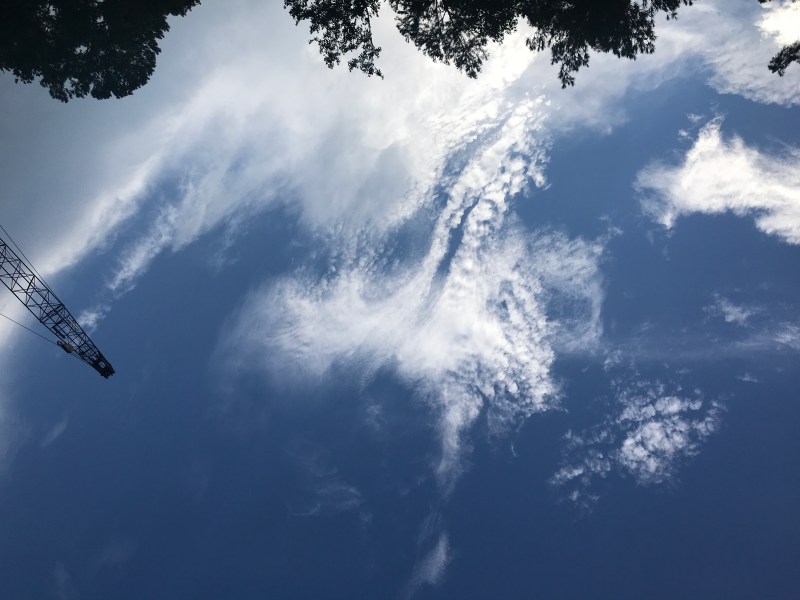
High above the cold morning are cirrocumulus or altocumulus clouds, scattered yet together, and the light coming through isn’t direct, nor is it shaded. It’s the same density of light we get in the summer, when the air is so thick with moisture even on a cloudless day the light is diffused and weakened. Not the heat, mind you, from May to September the heat is never weakened, not even by the deadest part of the night.
But today it is cold. The light has been diminished, not enough to really tell, unless you like photography, and you notice the light. Photography, no matter the level or purpose, is a study of light. If one wishes to do well with a lens, there must be an understanding of light, shadows, density, strength, and direction.
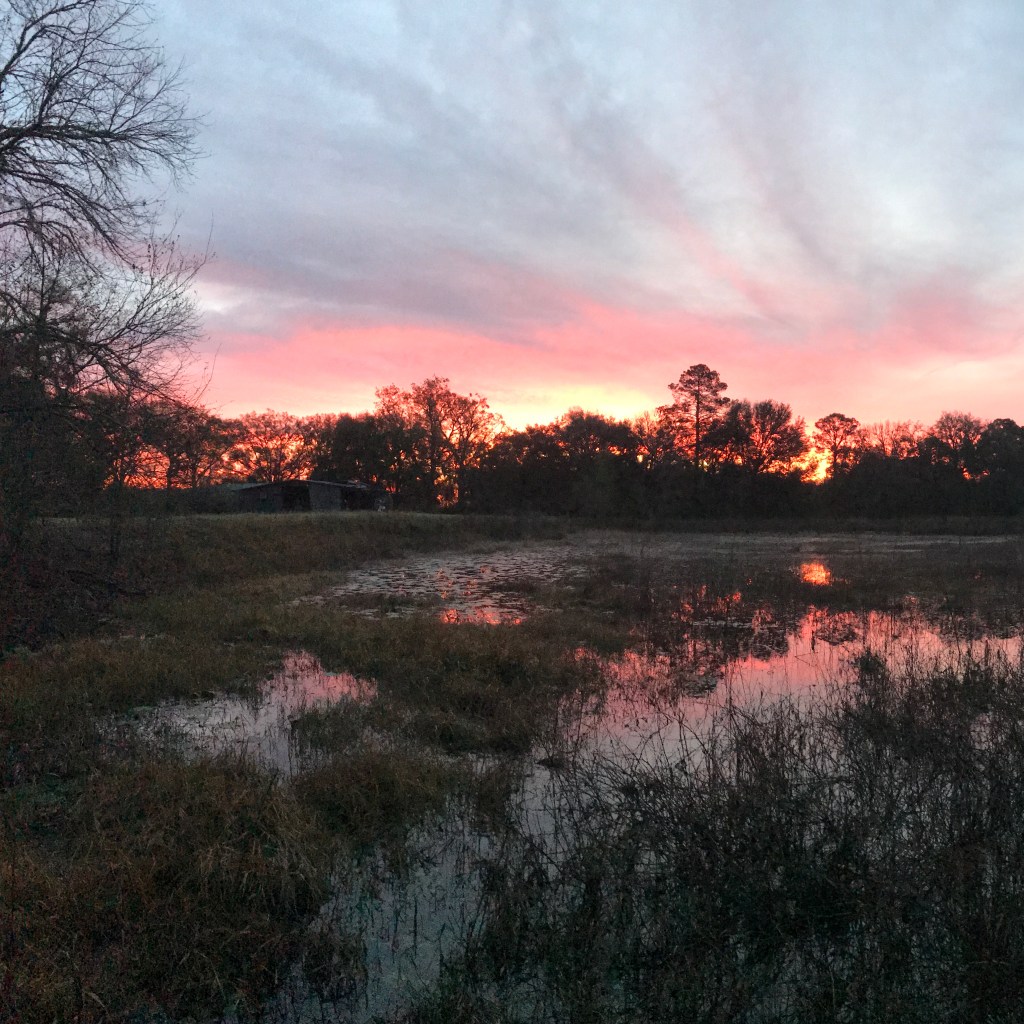
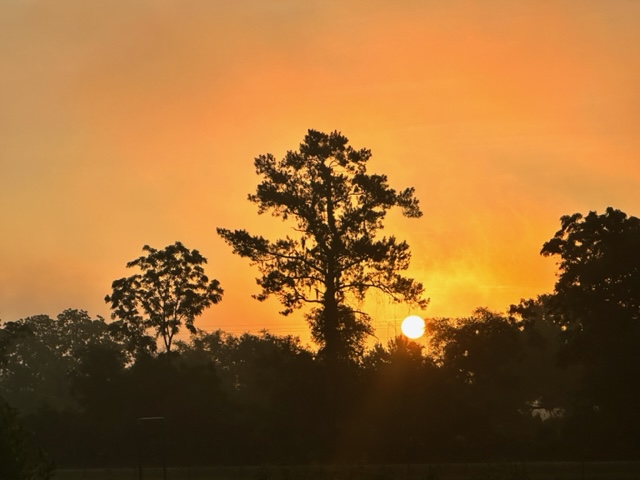
I step out of the truck, for the second time today, to take a photo of the sky. Dawn doesn’t demand any sort of greeting, but it’s rude not to stop and say hello, and thanks for the display.
Close to midmorning, there’s more of a mixing of the paint, a stirring of sorts, planning for some mono-colored work, perhaps, something undefined and indefinable, abstract if you will.
When you begin looking for light, looking at the light, in a different light, not for sight, but illumination in a manner of speaking, you can understand why the writers reads. It’s a study of the pattern of letters, for what purpose and method has nothing to do with words, or sentences, but again, of illumination.






 The Hickory Head Hermit