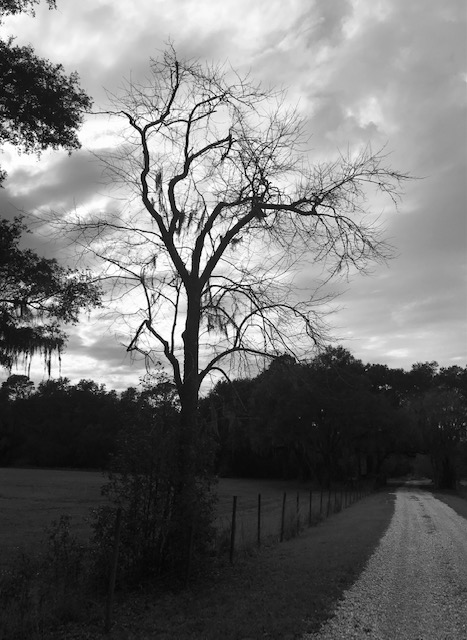

High above the cold morning are cirrocumulus or altocumulus clouds, scattered yet together, and the light coming through isn’t direct, nor is it shaded. It’s the same density of light we get in the summer, when the air is so thick with moisture even on a cloudless day the light is diffused and weakened. Not the heat, mind you, from May to September the heat is never weakened, not even by the deadest part of the night.
But today it is cold. The light has been diminished, not enough to really tell, unless you like photography, and you notice the light. Photography, no matter the level or purpose, is a study of light. If one wishes to do well with a lens, there must be an understanding of light, shadows, density, strength, and direction.
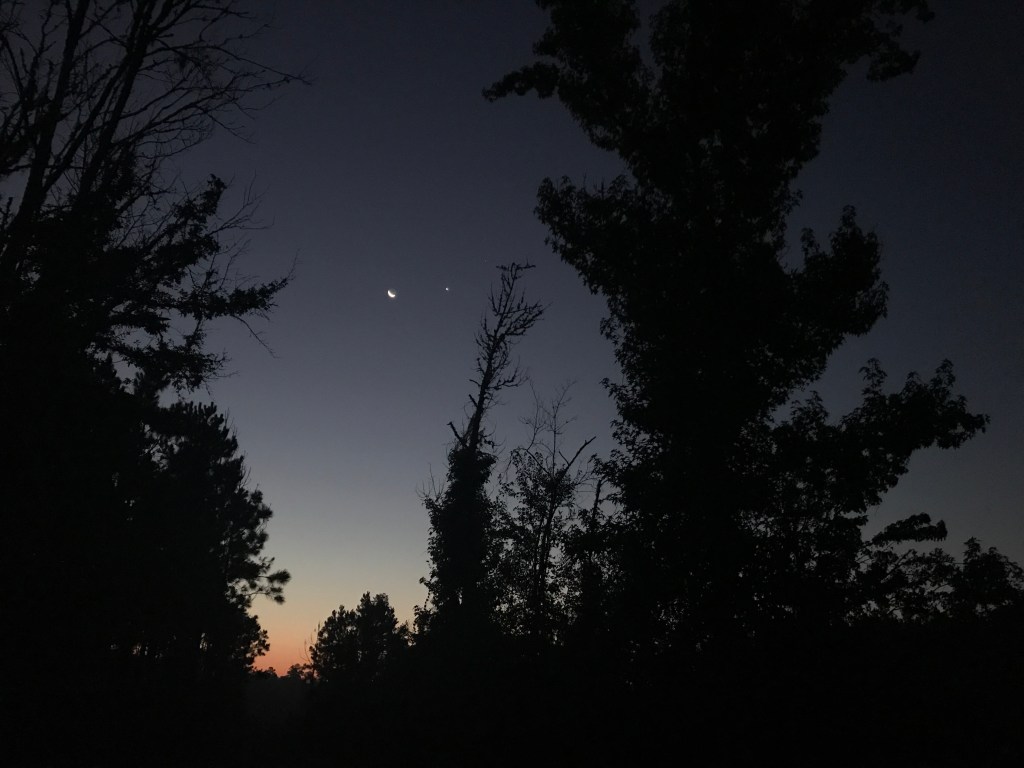
I step out of the truck, for the second time today, to take a photo of the sky. Dawn doesn’t demand any sort of greeting, but it’s rude not to stop and say hello, and thanks for the display.

Close to midmorning, there’s more of a mixing of the paint, a stirring of sorts, planning for some mono-colored work, perhaps, something undefined and indefinable, abstract if you will.
When you begin looking for light, looking at the light, in a different light, not for sight, but illumination in a manner of speaking, you can understand why the writers reads. It’s a study of the pattern of letters, for what purpose and method has nothing to do with words, or sentences, but again, of illumination.
Take Care,
Mike

Centuries ago, your spaceship lifted off from a dying planet to find a new home. One million people inhabit this ship, which recycles the water, uses fusion energy, and has enough food stores to last for the length of the trip. The ship is one vast metal city, with all the amenities of a ultra modern ecosystem where greed, want, poverty, crime, addiction, tribalism, and war is known only in history classes.
As Captain, your chief advisor, who is the ship’s computer has some disturbing news one morning. In one hundred years, you will reach the planet which has been the destination of the ship for the last thousand years, but probes sent have recently shown an asteroid has destroyed all life on the planet, and it will not be suitable for at least another five to six thousand years, at best.
The ship you are traveling in does not have an infinite lifespan. Built to withstand a lengthy voyage, it was also designed to shed its outer shell, which at some point would be weakened by radiation and impact with objects in space. If not shed, the shell will certainly collapse and its natural demise would be catastrophic.
The computer has a plan to dismantle the outer shell, which will revitalize the ship, and extend its life until the secondary planet can be reached.
The only issue is of the one million people onboard, one quarter of the population will have to be reduced, at least. One third would be optimum.
What is your criteria for this?
/
The airship hovered above the coffee shop, arriving silently, and everyone went to the windows to look. It was a zeppelin, long, gray, and beautiful. An elevator extended downward, a square shaft that reached to the ground, and two men stepped out in a few minutes.
I knew the woman, she was sitting behind me, we were close, friends, had been for a while. She had short gray hair, and was writing something on her laptop.
The elevator had a ladder for climbing, and inside the elevator shaft, multicolored sheets of fabric were loosely hung, so if someone slipped and fell they could reach out and grab one of the sheets, which were hung by their corners, creating pockets.
The two men took the woman a rose into the air, and I was to follow by climbing, five hundred feet at least.
I woke up too soon, before I reached the first rung.
She night and morning
Caught the goblins’ cry:
“Come buy our orchard fruits,
Come buy, come buy;”—
Beside the brook, along the glen,
She heard the tramp of goblin men,
The yoke and stir
Poor Laura could not hear;
Long’d to buy fruit to comfort her,
But fear’d to pay too dear.
She thought of Jeanie in her grave,
Who should have been a bride;
But who for joys brides hope to have
Fell sick and died
In her gay prime,
In earliest winter time
With the first glazing rime,
With the first snow-fall of crisp winter time.
Till Laura dwindling
Seem’d knocking at Death’s door:
Then Lizzie weigh’d no more
Better and worse;
But put a silver penny in her purse,
Kiss’d Laura, cross’d the heath with clumps of furze
At twilight, halted by the brook:
And for the first time in her life
Began to listen and look.
Laugh’d every goblin
When they spied her peeping:
Came towards her hobbling,
Flying, running, leaping,
Puffing and blowing,
Chuckling, clapping, crowing,
Clucking and gobbling,
Mopping and mowing,
Full of airs and graces,
Pulling wry faces,
Demure grimaces,
Cat-like and rat-like,
Ratel- and wombat-like,
Snail-paced in a hurry,
Parrot-voiced and whistler,
Helter skelter, hurry skurry,
Chattering like magpies,
Fluttering like pigeons,
Gliding like fishes,—
Hugg’d her and kiss’d her:
Squeez’d and caress’d her:
Stretch’d up their dishes,
Panniers, and plates:
“Look at our apples
Russet and dun,
Bob at our cherries,
Bite at our peaches,
Citrons and dates,
Grapes for the asking,
Pears red with basking
Out in the sun,
Plums on their twigs;
Pluck them and suck them,
Pomegranates, figs.”—
“Good folk,” said Lizzie,
Mindful of Jeanie:
“Give me much and many: —
Held out her apron,
Toss’d them her penny.
“Nay, take a seat with us,
Honour and eat with us,”
They answer’d grinning:
“Our feast is but beginning.
Night yet is early,
Warm and dew-pearly,
Wakeful and starry:
Such fruits as these
No man can carry:
Half their bloom would fly,
Half their dew would dry,
Half their flavour would pass by.
Sit down and feast with us,
Be welcome guest with us,
Cheer you and rest with us.”—
“Thank you,” said Lizzie: “But one waits
At home alone for me:
So without further parleying,
If you will not sell me any
Of your fruits though much and many,
Give me back my silver penny
I toss’d you for a fee.”—
They began to scratch their pates,
No longer wagging, purring,
But visibly demurring,
Grunting and snarling.
One call’d her proud,
Cross-grain’d, uncivil;
Their tones wax’d loud,
Their looks were evil.
Lashing their tails
They trod and hustled her,
Elbow’d and jostled her,
Claw’d with their nails,
Barking, mewing, hissing, mocking,
Tore her gown and soil’d her stocking,
Twitch’d her hair out by the roots,
Stamp’d upon her tender feet,
Held her hands and squeez’d their fruits
Against her mouth to make her eat.
White and golden Lizzie stood,
Like a lily in a flood,—
Like a rock of blue-vein’d stone
Lash’d by tides obstreperously,—
Like a beacon left alone
In a hoary roaring sea,
Sending up a golden fire,—
Like a fruit-crown’d orange-tree
White with blossoms honey-sweet
Sore beset by wasp and bee,—
Like a royal virgin town
Topp’d with gilded dome and spire
Close beleaguer’d by a fleet
Mad to tug her standard down.
One may lead a horse to water,
Twenty cannot make him drink.
Though the goblins cuff’d and caught her,
Coax’d and fought her,
Bullied and besought her,
Scratch’d her, pinch’d her black as ink,
Kick’d and knock’d her,
Maul’d and mock’d her,
Lizzie utter’d not a word;
Would not open lip from lip
Lest they should cram a mouthful in:
But laugh’d in heart to feel the drip
Of juice that syrupp’d all her face,
And lodg’d in dimples of her chin,
And streak’d her neck which quaked like curd.
At last the evil people,
Worn out by her resistance,
Flung back her penny, kick’d their fruit
Along whichever road they took,
Not leaving root or stone or shoot;
Some writh’d into the ground,
Some div’d into the brook
With ring and ripple,
Some scudded on the gale without a sound,
Some vanish’d in the distance.
In a smart, ache, tingle,
Lizzie went her way;
Knew not was it night or day;
Sprang up the bank, tore thro’ the furze,
Threaded copse and dingle,
And heard her penny jingle
Bouncing in her purse,—
Its bounce was music to her ear.
She ran and ran
As if she fear’d some goblin man
Dogg’d her with gibe or curse
Or something worse:
But not one goblin scurried after,
Nor was she prick’d by fear;
The kind heart made her windy-paced
That urged her home quite out of breath with haste
And inward laughter.
She cried, “Laura,” up the garden,
“Did you miss me?
Come and kiss me.
Never mind my bruises,
Hug me, kiss me, suck my juices
Squeez’d from goblin fruits for you,
Goblin pulp and goblin dew.
Eat me, drink me, love me;
Laura, make much of me;
For your sake I have braved the glen
And had to do with goblin merchant men.”
Laura started from her chair,
Flung her arms up in the air,
Clutch’d her hair:
“Lizzie, Lizzie, have you tasted
For my sake the fruit forbidden?
Must your light like mine be hidden,
Your young life like mine be wasted,
Undone in mine undoing,
And ruin’d in my ruin,
Thirsty, canker’d, goblin-ridden?”—
She clung about her sister,
Kiss’d and kiss’d and kiss’d her:
Tears once again
Refresh’d her shrunken eyes,
Dropping like rain
After long sultry drouth;
Shaking with aguish fear, and pain,
She kiss’d and kiss’d her with a hungry mouth.
Her lips began to scorch,
That juice was wormwood to her tongue,
She loath’d the feast:
Writhing as one possess’d she leap’d and sung,
Rent all her robe, and wrung
Her hands in lamentable haste,
And beat her breast.
Her locks stream’d like the torch
Borne by a racer at full speed,
Or like the mane of horses in their flight,
Or like an eagle when she stems the light
Straight toward the sun,
Or like a caged thing freed,
Or like a flying flag when armies run.
Swift fire spread through her veins, knock’d at her heart,
Met the fire smouldering there
And overbore its lesser flame;
She gorged on bitterness without a name:
Ah! fool, to choose such part
Of soul-consuming care!
Sense fail’d in the mortal strife:
Like the watch-tower of a town
Which an earthquake shatters down,
Like a lightning-stricken mast,
Like a wind-uprooted tree
Spun about,
Like a foam-topp’d waterspout
Cast down headlong in the sea,
She fell at last;
Pleasure past and anguish past,
Is it death or is it life?
Life out of death.
That night long Lizzie watch’d by her,
Counted her pulse’s flagging stir,
Felt for her breath,
Held water to her lips, and cool’d her face
With tears and fanning leaves:
But when the first birds chirp’d about their eaves,
And early reapers plodded to the place
Of golden sheaves,
And dew-wet grass
Bow’d in the morning winds so brisk to pass,
And new buds with new day
Open’d of cup-like lilies on the stream,
Laura awoke as from a dream,
Laugh’d in the innocent old way,
Hugg’d Lizzie but not twice or thrice;
Her gleaming locks show’d not one thread of grey,
Her breath was sweet as May
And light danced in her eyes.
Days, weeks, months, years
Afterwards, when both were wives
With children of their own;
Their mother-hearts beset with fears,
Their lives bound up in tender lives;
Laura would call the little ones
And tell them of her early prime,
Those pleasant days long gone
Of not-returning time:
Would talk about the haunted glen,
The wicked, quaint fruit-merchant men,
Their fruits like honey to the throat
But poison in the blood;
(Men sell not such in any town):
Would tell them how her sister stood
In deadly peril to do her good,
And win the fiery antidote:
Then joining hands to little hands
Would bid them cling together,
“For there is no friend like a sister
In calm or stormy weather;
To cheer one on the tedious way,
To fetch one if one goes astray,
To lift one if one totters down,
To strengthen whilst one stands.”

The woman lay in my arms, crying softly, wiping the tears with the sheet of her bed, and I knew better than to speak. Her son was ten and had boarded a bus for summer camp earlier in the day and his mother was inconsolable. She got up, walked to the window, her body framed by moonlight and darkness, and I remember vividly her silhouette.
“This is the first time in his life I have no idea where he is. I don’t know the town he’s in, I have no idea if he’s hungry or cold or sleeping, or if he’s snuck out of the cabin with some kid he just met and walking around in the woods. I have no idea where he is,” she said in a whisper.
I got up and put my arms around her and said nothing.
“It’s started like this, you know, one day I let some guy I met be intimate with me, we fell in love, and I got pregnant. I had a son, and now, ten years later, that kid is out there, somewhere, maybe not even missing me, and it’s like the first kiss, it’s going to lead to other things. In five years he’ll be driving, in eight he’ll go off to college or join the military, but right now, at this very moment, it’s beginning. It’s ending for me, to have him around,” the sound was nearly inaudible.
“I so needed some time, to feel loved, to be loved beyond my function was a mom, I so wanted to experience life without a kid around, you know, for a few days, but one day it’s going to be like this for months at a time, maybe even years, and right now I can feel the distance, I can taste it my mouth, I can smell it,” her voice was low but emphatic.
“If you got me pregnant tonight I would be happy, I would rejoice that I could stay in motherhood longer, but eventually, it has to end, I have to define myself in other ways, just like my son is doing right now. He’s left the orbit, he’s out there doing kid things with kids, and right now he’s tasting what it’s like to be away from home. He’s going to want more. He’s going to crave adventure, and I know, don’t fucking say it, I know I have to allow it, but it’s been such a short ten years, so little time, just a blink of an eye, and now I can see that in another ten I might be a grandmother, and he’ll be a father maybe, but there’s nothing that seems longer than having kids until you wake up one day and realize they’re going to leave,” she turned and grabbed me, hugging me tighter than I could stand almost.
 The Hickory Head Hermit